Fortescue battery trains in Western Australia: haulage design and energy notes for engineers
Reviewed by Joe Ashwell
First reported on MINING.com
30 Second Briefing
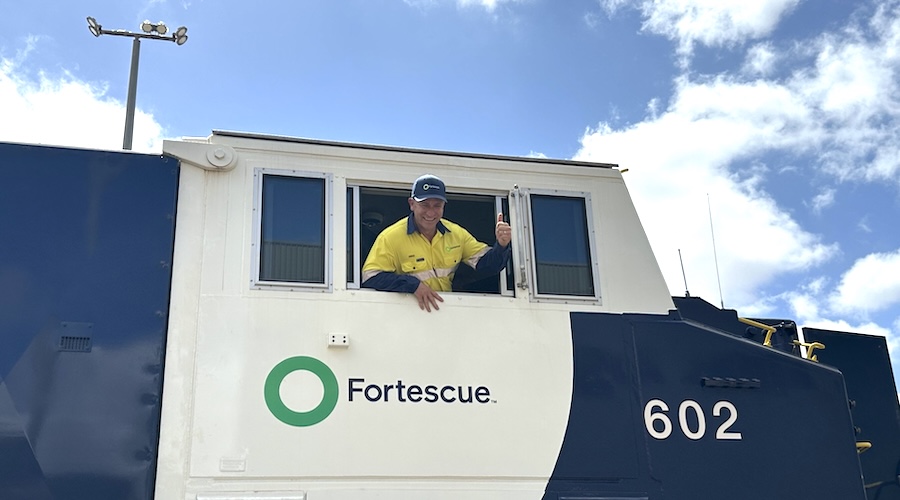
Fortescue has commissioned two Progress Rail battery electric locomotives in the Pilbara, each with a 14.5MWh onboard battery and 40–60% regenerative braking, to haul 40,000-tonne iron ore trains over 300–400km and cut about one million litres of diesel use per year. The units will run on renewable power from the Pilbara Energy Connect network, which already includes a 100MW solar farm with a 250MWh BESS at North Star Junction and a 760km electrified rail corridor linking five mines to Port Hedland. Fortescue is concurrently advancing 190–644MW-scale solar projects, its first Pilbara wind farm at Nullagine, and a green iron plant at Christmas Creek targeting first metal by June 2026.
Technical Brief
- Fortescue’s two Progress Rail battery locomotives are the first of their type deployed globally.
- The units operate on a 760km heavy-haul network linking five Pilbara iron ore mines to Port Hedland.
- Rail duty involves hauling 40,000t consists up 400m elevation gain over 300–400km, multiple cycles per day.
- Fortescue’s Pilbara decarbonisation forms part of a A$6.2 billion capital programme to 2030.
- North Star Junction’s 100MW solar farm is coupled to a 250MWh BESS delivering 50MW for five hours.
- Cloudbreak’s 190MW solar project is about two-thirds complete; Turner River’s 644MW solar has primary approvals.
- A 440MW Solomon solar project is awaiting a near-term investment decision, adding further generation close to mine loads.
- Fortescue is installing ~3,600 solar panels per day and using automation to accelerate deployment rates.
Our Take
The battery train rollout in the Pilbara sits alongside Fortescue’s commissioning of Progress Rail battery locomotives and XCMG ultra-class battery equipment in our recent coverage, signalling that rail, haulage and ancillary fleets are being electrified in parallel rather than sequentially across its iron ore system.
With a 760 km Pilbara rail network moving 195–205 Mtpa of iron ore by 2026, even partial substitution of diesel traction with 14.5 MWh battery units materially de-risks Fortescue’s exposure to diesel price volatility and future carbon pricing compared with many other iron ore operators in our database that still rely on conventional locomotives.
The scale of the Pilbara Energy Connect solar and storage build-out (e.g. 644 MW proposed at Turner River and 440 MW at Solomon) means Fortescue is effectively creating a dedicated renewables backbone sized for heavy-rail and mining loads, a level of integration not yet evident in most other iron ore or copper projects in our mining corpus.
Prepared by collating external sources, AI-assisted tools, and Geomechanics.io’s proprietary mining database, then reviewed for technical accuracy & edited by our geotechnical team.
Related Articles


Related Industries & Products
Mining
Geotechnical software solutions for mining operations including CMRR analysis, hydrogeological testing, and data management.
CMRR-io
Streamline coal mine roof stability assessments with our cloud-based CMRR software featuring automated calculations, multi-scenario analysis, and collaborative workflows.
HYDROGEO-io
Comprehensive hydrogeological testing platform for managing, analysing, and reporting on packer tests, lugeon values, and hydraulic conductivity assessments.
GEODB-io
Centralised geotechnical data management solution for storing, accessing, and analysing all your site investigation and material testing data.