Elevate’s Marenica uranium growth in Namibia: resource and processing notes for mine planners
Reviewed by Tom Sullivan
First reported on MINING.com
30 Second Briefing
Marenica’s uranium resource in Namibia has been increased by 35% to 134.5 million tonnes at 180 ppm U3O8 for 52.8 million lb., giving Elevate Uranium a total Namibian inventory of 129 million lb. across Marenica and the 76.2-million-lb. Koppies project. The calcrete-hosted portion now accounts for 98.6 million tonnes and 38.6 million lb., defined from 3,874 mainly shallow RC holes totalling 89,850 m, with mineralisation thickening eastwards in a palaeochannel system. Elevate is running bulk samples through its Namibian pilot plant to validate its U-pgrade process, which bench tests suggest can pre-reject most waste and roughly halve processing costs.
Technical Brief
- Resource classification split: 16.8 Mt indicated at 205 ppm (7.5 Mlb) and 117.7 Mt inferred at 175 ppm (45.3 Mlb).
- Ownership structure gives Elevate 75% of Marenica, equating to 39.6 Mlb attributable U3O8.
- Portfolio scale: 116 Mlb attributable U3O8 in Namibia and 173 Mlb globally across Namibia and Australia.
- Host lithologies divided into 98.6 Mt calcrete (73% of tonnes) and 35.8 Mt weathered basement, both averaging 180 ppm.
- Geological model shows mineralisation shallower in the west, thickening eastwards within a higher-grade palaeochannel system.
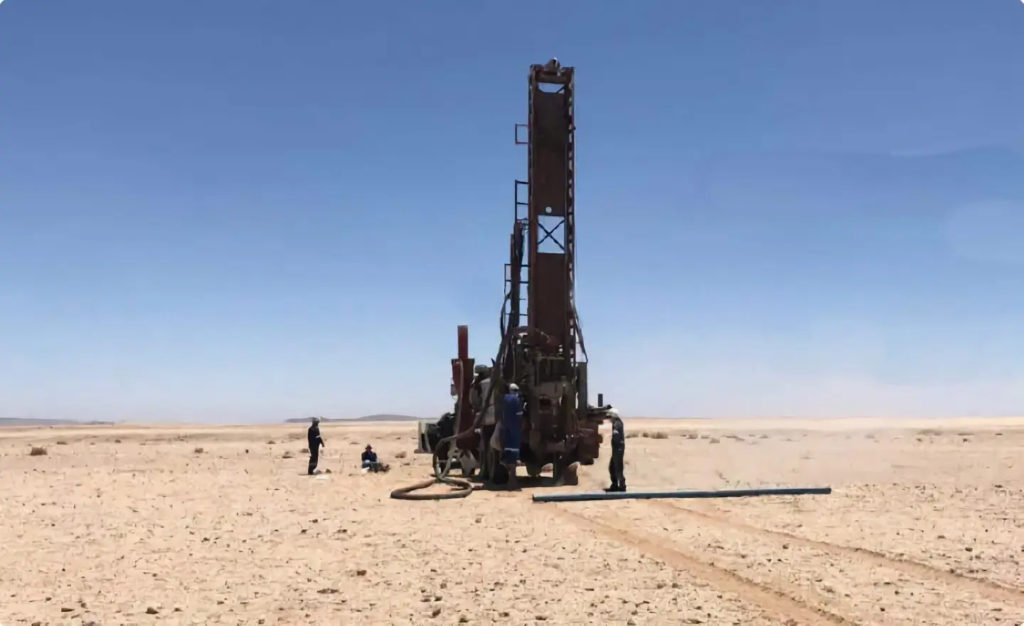
- Resource estimate constrained by 3,874 mainly shallow vertical RC holes totalling 89,850 m of drilling.
- Four drill rigs currently focused on upgrading inferred to indicated category to support feasibility-level studies.
- U-pgrade bench tests reportedly deliver ~50× grade upgrade, reject most waste pre-leach and remove acid consumers, targeting ~50% capex/opex reduction versus conventional circuits.
Our Take
With 129 million lb of uranium resources in Namibia and a 173 million lb global base, Elevate Uranium now sits in the mid-tier of uranium developers in our database, but still well behind established Erongo producers such as Paladin Energy at Langer Heinrich and China General Nuclear at Husab in terms of de-risked capacity.
The combination of relatively low grades at Marenica (around 180 ppm U3O8) and the claimed 50-fold U-pgrade beneficiation factor plus ~50% capex/opex cuts suggests Elevate’s business case hinges more on process IP than ore quality, which could influence how potential partners or acquirers in Erongo value the project versus more conventional calcrete deposits.
Erongo uranium region items in our coverage often flag permitting and infrastructure advantages compared with greenfield African uranium districts, so Marenica’s 250 km distance from Windhoek and proximity to existing operations like Rössing and Husab likely reduce development risk relative to similarly sized but more remote African uranium projects.
Prepared by collating external sources, AI-assisted tools, and Geomechanics.io’s proprietary mining database, then reviewed for technical accuracy & edited by our geotechnical team.
Related Articles
Related Industries & Products
Mining
Geotechnical software solutions for mining operations including CMRR analysis, hydrogeological testing, and data management.
Construction
Quality control software for construction companies with material testing, batch tracking, and compliance management.
CMRR-io
Streamline coal mine roof stability assessments with our cloud-based CMRR software featuring automated calculations, multi-scenario analysis, and collaborative workflows.
HYDROGEO-io
Comprehensive hydrogeological testing platform for managing, analysing, and reporting on packer tests, lugeon values, and hydraulic conductivity assessments.
GEODB-io
Centralised geotechnical data management solution for storing, accessing, and analysing all your site investigation and material testing data.