Creating mining districts: DPVI insights and M&A signals for mine planners
Reviewed by Tom Sullivan
First reported on MINING.com
30 Second Briefing
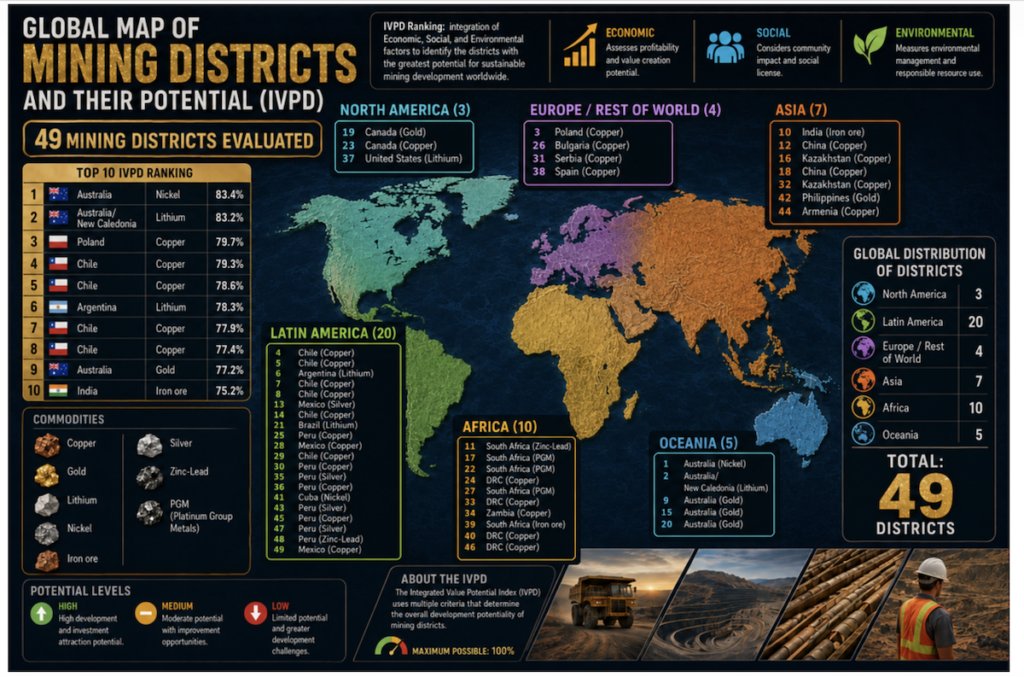
Creating integrated mining districts rather than standalone operations could unlock billions in additional value, with GEM Mining Consulting’s new District Potential Value Index (DPVI) ranking 49 districts from an initial 1,641 mines and projects on economic scale, shared infrastructure and long-term coordination. Top performers include the Altura-Pilgangoora lithium district in Australia, Chile’s Collahuasi-Quebrada Blanca and Andina-Los Bronces copper belts, Poland’s Lubin-Polkowice-Sieroszowice-Rudna copper district and Argentina’s Salar de Olaroz-Cauchari Olaroz lithium system. The work signals that water constraints, permitting risk and social conflict can outweigh geology, guiding where to prioritise acquisitions and regional infrastructure.
Technical Brief
- GEM’s DPVI filters an initial 1,641 mines/projects down to 49 ranked multi-asset districts.
- Index scoring weights economic scale, shared infrastructure potential and operational compatibility over simple geographic distance.
- Districts are classified into “mature”, “emerging” and “fragmented clusters” to guide sequencing of regional integration.
- Oceania’s high ranking is linked to large resource endowments plus comparatively strong social and environmental performance.
- Northern Chilean copper belts (e.g. Collahuasi–Quebrada Blanca, Andina–Los Bronces) exemplify value from existing power, transport and processing networks.
- District value is explicitly downgraded where water scarcity, permitting uncertainty, social conflict or weak governance constrain coordination.
- Output is intended to support portfolio-level decisions on acquisitions, shared corridors and long-term territorial planning rather than single-asset optimisation.
Our Take
GEM Mining Consulting’s work on battery substitution between 2026 and 2031 in lithium and other chemistries suggests that district-scale planning for assets like Altura-Pilgangoora and Salar de Olaroz–Cauchari Olaroz will need to factor in potential demand plateaus rather than unconstrained growth scenarios.
Anglo American’s deployment of real-time ore characterisation (AHS) in our recent coverage indicates that copper districts such as Collahuasi–Quebrada Blanca and Andina–Los Bronces are well placed to capture district-level synergies only if operators invest in shared high-resolution orebody knowledge and data infrastructure, not just shared haul roads and power.
With 49 districts evaluated across copper, graphite, lithium, nickel and other critical minerals, this study aligns with a broader pattern in our database where critical-mineral strategies in regions like Latin America and the USA are shifting from single-mine approvals to portfolio and corridor thinking, which tends to favour larger incumbents such as Anglo American and South32 in M&A-heavy environments.
Prepared by collating external sources, AI-assisted tools, and Geomechanics.io’s proprietary mining database, then reviewed for technical accuracy & edited by our geotechnical team.
Related Articles


Related Industries & Products
Mining
Geotechnical software solutions for mining operations including CMRR analysis, hydrogeological testing, and data management.
Construction
Quality control software for construction companies with material testing, batch tracking, and compliance management.
CMRR-io
Streamline coal mine roof stability assessments with our cloud-based CMRR software featuring automated calculations, multi-scenario analysis, and collaborative workflows.
HYDROGEO-io
Comprehensive hydrogeological testing platform for managing, analysing, and reporting on packer tests, lugeon values, and hydraulic conductivity assessments.
GEODB-io
Centralised geotechnical data management solution for storing, accessing, and analysing all your site investigation and material testing data.