Geomechanics.io

  • Free Tools
Sign UpLog In

Geomechanics.io

Geomechanics, Streamlined.

© 2026 Geomechanics.io. All rights reserved.

Geomechanics.io

CMRR-ioGEODB-ioHYDROGEO-ioQCDB-ioFree Tools & CalculatorsBlogLatest Industry News

Industries

MiningConstructionTunnelling

Company

Terms of UsePrivacy PolicyLinkedIn
    AllGeotechnicalMiningInfrastructureMaterialsHazardsEnvironmentalSoftwarePolicy
    Projects
    Standard/Guideline
    Sustainability

    Chile’s critical minerals strategy: project and permitting signals for engineers

    January 29, 2026|

    Reviewed by Joe Ashwell

    Chile’s critical minerals strategy: project and permitting signals for engineers

    First reported on MINING.com

    30 Second Briefing

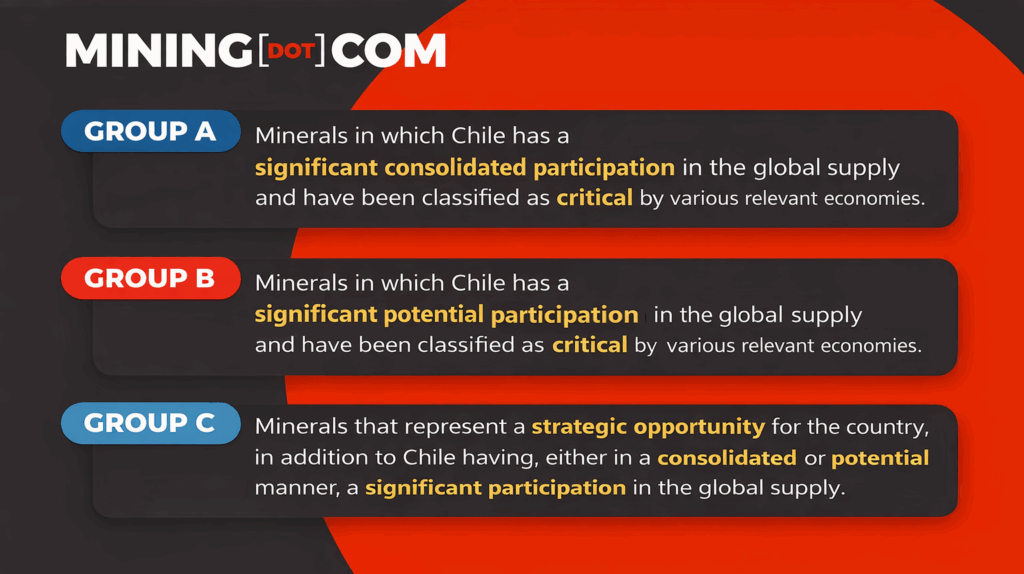
    Chile has released a National Critical Minerals Strategy that classifies 14 minerals into three groups, with copper, lithium, molybdenum and rhenium in “category A”, where Chile already supplies 23%, 20.4%, 14.6% and 46.8% of global output respectively. Consultants note category A growth will mainly come from brownfield expansions, while new streams such as cobalt, rare earths, selenium and tellurium will require greenfield social and environmental approvals and stronger state capacity. Lawyers and analysts stress the strategy is not law, lacks concrete near-term production commitments for minerals like cobalt and rare earths, and its impact will hinge on a forthcoming action plan, permitting performance and institutional execution.

    Technical Brief

    • Fourteen minerals are explicitly listed, including antimony, selenium, tellurium, boron, iodine and rare earth elements.
    • Category B minerals (e.g. cobalt, rare earths, antimony) currently have little or no Chilean production base.
    • GEM’s Juan Ignacio Guzmán expects category A growth mainly via brownfield expansions within existing social–environmental frameworks.
    • Category B developments are expected to require “breaking new ground” in social and environmental permitting, increasing project lead times.

    Our Take

    Chile’s identification of 14 critical minerals, including copper, lithium, molybdenum and rhenium, positions it as the most diversified single-country critical minerals node in Latin America in our database, contrasting with more single-commodity exposure in Bolivia (lithium) and Peru (copper) highlighted in the 27 January 2026 regional security piece.

    With Chile already supplying 23% of global copper and over 20% of global lithium, any policy tightening or new standards emerging from this 30‑day consultation window will likely have immediate pricing and supply-chain implications for the ‘critical minerals’ basket tracked in our recent Top 50 miners valuation coverage.

    The inclusion of lesser-discussed elements such as selenium, rhenium, tellurium and iodine in Chile’s framework broadens the policy lens beyond the copper–lithium duo that dominates most of the 31 keyword-matched pieces, signalling that future ESG and permitting rules may start to bite on by-product recovery circuits at existing Chilean operations.

    Geotechnical Software for Modern Teams

    Centralise site data, logs, and lab results with GEODB-io, CMRR-io, and HYDROGEO-io.

    No credit card required.

    • Save and export unlimited calculations
    • Advanced data visualisation
    • Generate professional PDF reports
    • Cloud storage for all your projects

    Prepared by collating external sources, AI-assisted tools, and Geomechanics.io’s proprietary mining database, then reviewed for technical accuracy & edited by our geotechnical team.

    Related Articles

    Construction Leadership Council board expansion: policy and skills lens for engineers
    Policy
    about 16 hours ago

    Construction Leadership Council board expansion: policy and skills lens for engineers

    The Construction Leadership Council board is being expanded from nine to 15 members as government scraps its separate construction advisory panel, adding civil service figures including NISTA chief executive Becky Wood and Cabinet Office markets director Clare Gibbs alongside industry sponsor for people & skills Mark Farmer. New seats are allocated to each of the four strategic workstreams and four sector groups, bringing in ICE director general Janet Young for infrastructure, HBF chief executive Neil Jefferson for house-building, NHIC chief executive Anna Scothern for domestic RMI, and Scape chief executive Mark Robinson for places, assets and commissioning. A new health, safety & wellbeing group led by Berkeley Group’s Karl Whiteman and the planned 2026 CLC Strategy and Construction Industry Workforce Plan signal tighter central government influence over construction policy and skills planning.

    WA ‘Kelly’s Law’ hit-and-run reforms: policy signals for road engineers
    Policy
    1 day ago

    WA ‘Kelly’s Law’ hit-and-run reforms: policy signals for road engineers

    Western Australia will amend the Road Traffic Act 1974 under “Kelly’s Law” to impose tougher, longer licence disqualifications on hit-and-run drivers who flee serious or fatal crashes. The reforms will target offenders who fail to stop and render assistance, preventing them from regaining a licence for extended periods and, in some cases, permanently. For road and traffic engineers, the move signals continued policy emphasis on driver behaviour and enforcement rather than geometric or asset changes to improve network safety outcomes.

    Antidumping duties and China’s playbook: pricing implications for critical minerals
    Policy
    1 day ago

    Antidumping duties and China’s playbook: pricing implications for critical minerals

    Antidumping duties under the US Tariff Act of 1930 are proposed as a floating “price-gap” mechanism to counter China’s below-cost exports of rare earths and other USGS-designated critical minerals, with duties rising automatically as Chinese export prices fall. Erik Groves, corporate strategy and in-house counsel at Morgan Companies, argues this would extend the logic of the US Department of Defence’s floor-price agreement with MP Materials at Mountain Pass without Washington acting as buyer of last resort. Coordinated antidumping actions by the US, EU, Canada, Australia, Japan and South Korea could establish de facto price floors across multiple Western markets.

    Related Industries & Products

    Mining

    Geotechnical software solutions for mining operations including CMRR analysis, hydrogeological testing, and data management.

    Construction

    Quality control software for construction companies with material testing, batch tracking, and compliance management.

    CMRR-io

    Streamline coal mine roof stability assessments with our cloud-based CMRR software featuring automated calculations, multi-scenario analysis, and collaborative workflows.

    HYDROGEO-io

    Comprehensive hydrogeological testing platform for managing, analysing, and reporting on packer tests, lugeon values, and hydraulic conductivity assessments.

    GEODB-io

    Centralised geotechnical data management solution for storing, accessing, and analysing all your site investigation and material testing data.