Beijing’s decoy effect in critical minerals: capital signals for project teams
Reviewed by Tom Sullivan
First reported on MINING.com
30 Second Briefing
Beijing’s periodic threats of export controls on rare earths and other critical minerals are framed by economic geologist Dr Nicholas Vafeas as a “decoy effect” masking its real tactic of state-backed oversupply in lithium, cobalt, nickel and midstream refining. By expanding processing capacity in China and overseas, from Indonesian nickel projects to domestic rare earth separation hubs, Beijing can push prices below Western operating costs, deterring private finance for multi‑billion‑dollar refineries. Vafeas argues Western responses must shift from upstream grants to long-term offtake guarantees, price floors and aggressive retention of refined metals already within allied economies.
Technical Brief
- MOFCOM’s periodic updates to its export licensing catalogue act as the visible “decoy” policy lever.
- Recent export-licence targeting of MP Materials and USA Rare Earth keeps Western focus on upstream access risk.
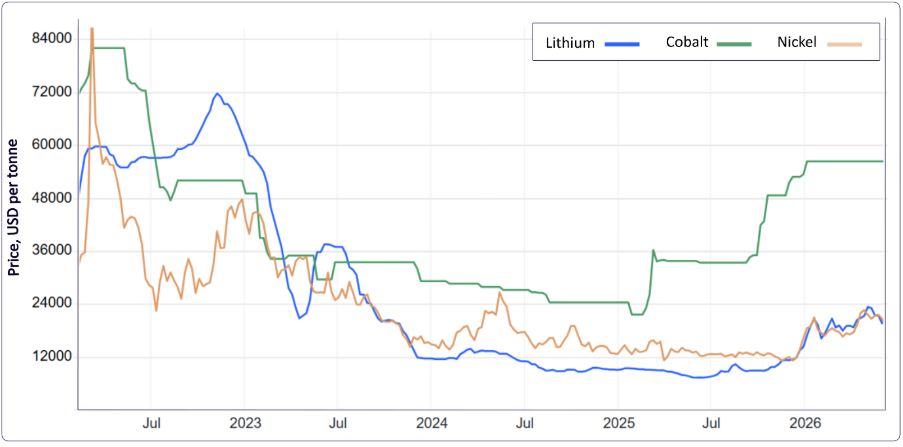
- Lithium, cobalt and nickel prices have trended down sharply from mid‑2022 to mid‑2026 per Tradingeconomics.com.
- Treatment and refining charges for copper and nickel are being compressed as Chinese-backed processing capacity outpaces raw ore supply.
- Chinese state support extends from domestic rare earth separation hubs to Indonesian nickel projects, embedding control across midstream nodes.
- Vafeas argues multi‑billion‑dollar Western refineries become unbankable when benchmark prices are set below OPEX by subsidised competitors.
- G7 Critical Minerals Alliance meetings in Evian acknowledged Western projects cannot compete on geology alone against a price‑setting monopoly.
- Permitting, financing and construction timelines of 5–10 years leave new Western mines exposed to price floors reset before first production.
- Stranded upstream assets created by this timing mismatch are frequently acquired cheaply by Chinese interests, reinforcing value‑chain dominance.
- Proposed countermeasures include binding long‑term offtake contracts and price floors for allied materials, effectively a regulatory firewall against predatory pricing.
Our Take
In our Policy coverage, critical minerals pieces that mention China’s Ministry of Commerce or MOFCOM typically focus on export controls and quota management, signalling that any pricing ‘decoy’ effect discussed here will likely be reinforced by formal trade levers rather than market psychology alone.
MP Materials and USA Rare Earth appear only sporadically in our 223 keyword-matched critical minerals items, underscoring how thin the listed Western rare earths pipeline remains compared with copper names like Antofagasta, which feature far more often and thus face a different balance of Chinese influence versus diversified global supply.
Prepared by collating external sources, AI-assisted tools, and Geomechanics.io’s proprietary mining database, then reviewed for technical accuracy & edited by our geotechnical team.
Related Articles


Related Industries & Products
Mining
Geotechnical software solutions for mining operations including CMRR analysis, hydrogeological testing, and data management.
Construction
Quality control software for construction companies with material testing, batch tracking, and compliance management.
QCDB-io
Comprehensive quality control database for manufacturing, tunnelling, and civil construction with UCS testing, PSD analysis, and grout mix design management.