Albert Bridge motor closure: fracture mechanics and safety notes for engineers
Reviewed by Tom Sullivan
First reported on New Civil Engineer
30 Second Briefing
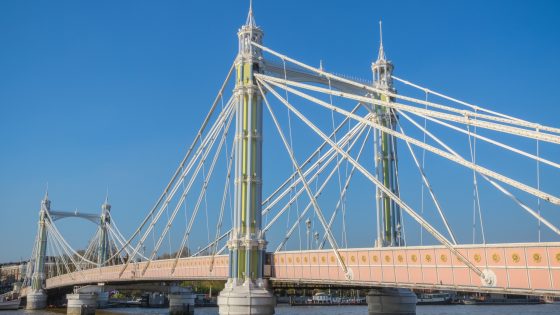
Albert Bridge in west London has been closed to motor traffic after a routine inspection found a cracked cast iron component at one of the bridge abutments, Kensington and Chelsea council confirmed. The 1873 Grade II* listed structure, a hybrid cable‑stayed and suspension bridge over the Thames, remains open to pedestrians and cyclists while engineers assess the defect. Structural investigations will focus on load paths through the affected abutment detail and the implications for fatigue and brittle fracture behaviour in the historic cast iron.
Technical Brief
- Routine inspection regime on Albert Bridge follows scheduled visual checks of critical cast iron details.
- Crack at the abutment component triggers assessment of local stress concentrations and historic casting defects.
- Engineers will likely deploy dye penetrant or magnetic particle testing to map crack extent in situ.
- Fracture mechanics checks will compare detected flaw size with critical crack length under current traffic loading.
- Monitoring options include crack gauges and periodic high‑resolution photography to track any propagation.
- Temporary traffic restrictions reduce live load ranges, limiting further fatigue demand on the cracked element.
Our Take
Among the 696 Infrastructure stories in our database, very few UK pieces tagged both ‘Failure’ and ‘Safety’ involve Victorian-era cast iron elements like those on Albert Bridge, underscoring how ageing heritage structures in west London present a distinct inspection and retrofit challenge compared with newer concrete or steel bridges.
For the Royal Borough of Kensington and Chelsea, a high-profile closure of Albert Bridge is likely to strengthen the case for more intrusive non-destructive testing and load-path modelling on similar decorative or listed structures, which often sit outside standard highway bridge management regimes.
With 1971 tag-matched pieces touching on ‘Failure’, ‘Safety’ and ‘Projects’, this incident will probably be used as a reference case in future UK project planning to justify early allowance for emergency works, traffic management and stakeholder communication around critical but fragile river crossings in Chelsea and wider west London.
Prepared by collating external sources, AI-assisted tools, and Geomechanics.io’s proprietary mining database, then reviewed for technical accuracy & edited by our geotechnical team.
Related Articles


Related Industries & Products
Construction
Quality control software for construction companies with material testing, batch tracking, and compliance management.
Mining
Geotechnical software solutions for mining operations including CMRR analysis, hydrogeological testing, and data management.
CMRR-io
Streamline coal mine roof stability assessments with our cloud-based CMRR software featuring automated calculations, multi-scenario analysis, and collaborative workflows.
HYDROGEO-io
Comprehensive hydrogeological testing platform for managing, analysing, and reporting on packer tests, lugeon values, and hydraulic conductivity assessments.
GEODB-io
Centralised geotechnical data management solution for storing, accessing, and analysing all your site investigation and material testing data.