£500M Derby four-line tram scheme: design and delivery notes for engineers
Reviewed by Joe Ashwell
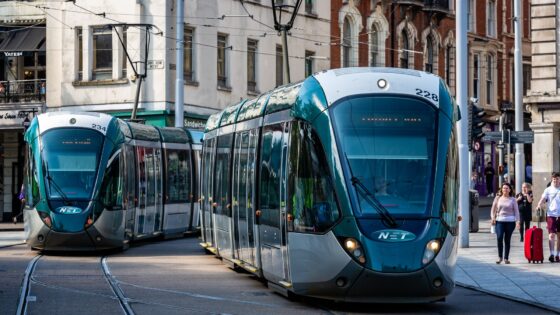
First reported on New Civil Engineer
30 Second Briefing
A £500M four-line tram network has been proposed for Derby, aiming to divert tens of thousands of daily car trips onto fixed-track public transport and cut congestion on key radial routes. The campaign group’s concept focuses on linking suburban corridors directly to the city centre, using segregated alignments where possible to improve journey time reliability over existing bus services. For civil and geotechnical teams, the scheme would trigger major street-running trackworks, utility diversions and new stop structures in a constrained urban environment.
Technical Brief
- Capital cost is stated as £500M for the four-line fixed-track system.
- Scheme is at campaign/concept stage, with no client, procurement route or programme yet defined.
- No preferred technology specified (on-street tram, tram-train, catenary-free, etc.), leaving power and OLE design open.
- Alignment, stop spacing and depot location remain undefined, so land-take and property acquisition needs are unknown.
- Absence of route detail means extent of utility diversions, track slab depth and foundation works cannot yet be scoped.
- Funding structure is unspecified, with no indication of central government, local authority or private finance split.
- Interfaces with existing rail corridors, highways schemes and flood defences around Derby are not described at this stage.
Our Take
Within the 382 Infrastructure stories in our database, very few urban schemes outside the largest UK cities approach the £500M scale, so a four-line tram proposal in Derby would likely compete for national-level funding rather than relying solely on local budgets.
Tagging under both Projects and Sustainability signals that any Derby scheme will be judged against other low-carbon urban transport investments in our coverage, where demonstrable modal shift from cars has been a key factor in business case approvals.
For mid-sized cities like Derby, multi-line tram networks at this cost level often trigger phased delivery in other projects we track, suggesting that breaking the four-line build into stages could be critical for managing disruption and aligning with funding windows.
Prepared by collating external sources, AI-assisted tools, and Geomechanics.io’s proprietary mining database, then reviewed for technical accuracy & edited by our geotechnical team.
Related Articles


Related Industries & Products
Construction
Quality control software for construction companies with material testing, batch tracking, and compliance management.
CMRR-io
Streamline coal mine roof stability assessments with our cloud-based CMRR software featuring automated calculations, multi-scenario analysis, and collaborative workflows.
HYDROGEO-io
Comprehensive hydrogeological testing platform for managing, analysing, and reporting on packer tests, lugeon values, and hydraulic conductivity assessments.
GEODB-io
Centralised geotechnical data management solution for storing, accessing, and analysing all your site investigation and material testing data.