Geomechanics, Streamlined.
© 2026 Geomechanics.io. All rights reserved.
GBM Konect is now the core field data and asset management platform for Banyule City Council in Melbourne’s north-east, supporting service delivery across more than 20 suburbs and a population above 130,000. The cloud-based, location-aware system lets crews capture condition data, photos and GPS coordinates in real time for roads, paths, drainage and open space assets, replacing paper workflows. Engineers gain a single geospatial view of assets and maintenance history, improving defect prioritisation, scheduling and compliance reporting without bespoke in-house GIS development.
The 20th International Conference of the Australian Flexible Pavement Association in Adelaide brought together more than 400 delegates, 50 speakers and 40 exhibitors to tackle emerging technical and delivery challenges in flexible pavements. Sessions focused on future-ready road design, including performance-based asphalt specifications, recycled materials in dense-graded and stone mastic mixes, and data-driven asset management for high-volume freight corridors. For practitioners, the event signalled accelerating adoption of advanced binders, additives and mechanistic-empirical design tools in Australian pavement practice.
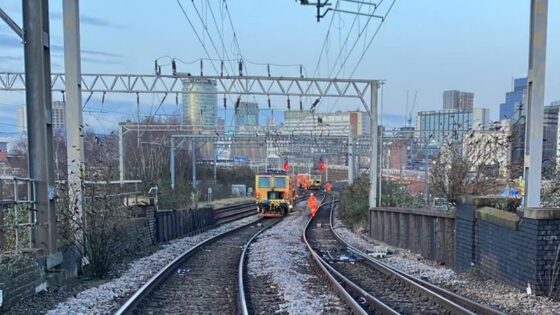
Network Rail is delivering £160M of works over Christmas and New Year across England, Wales and Scotland, combining large-scale renewals of ageing track, structures and overhead line equipment with installation of modern digital signalling. Possessions will concentrate on key main line bottlenecks and junctions, with multi-day blockades used to replace life-expired assets and reconfigure layouts for higher line speeds and more reliable timetabling. Contractors will need to manage intensive access windows, complex isolations and winter working risks while handing back routes for the post-holiday peak.
NCE’s Top 10 most read in-depth pieces of 2025 span major UK infrastructure themes, from long-span bridge renewals and high-capacity rail corridors to complex urban tunnelling and flood defence upgrades. Interviews with project directors and design leads examine issues such as whole-life carbon in reinforced concrete, geotechnical risk allocation on large D&B contracts, and digital twins for asset monitoring. For practitioners, the list signals where peers are focusing attention: programme delivery under tight funding, resilience to extreme rainfall, and constructability on constrained brownfield sites.
Early-career civil engineers recognised as Graduates and Apprentices of the Year are calling for project delivery models that combine productivity gains with whole-life carbon reduction and climate resilience. They point to digital design tools and offsite manufacture to cut programme times while enabling low-carbon materials, and stress the need for earlier integration of environmental assessment into concept design. Their comments signal growing pressure on contractors and consultants to embed decarbonisation targets alongside traditional KPIs such as cost, time and asset performance.
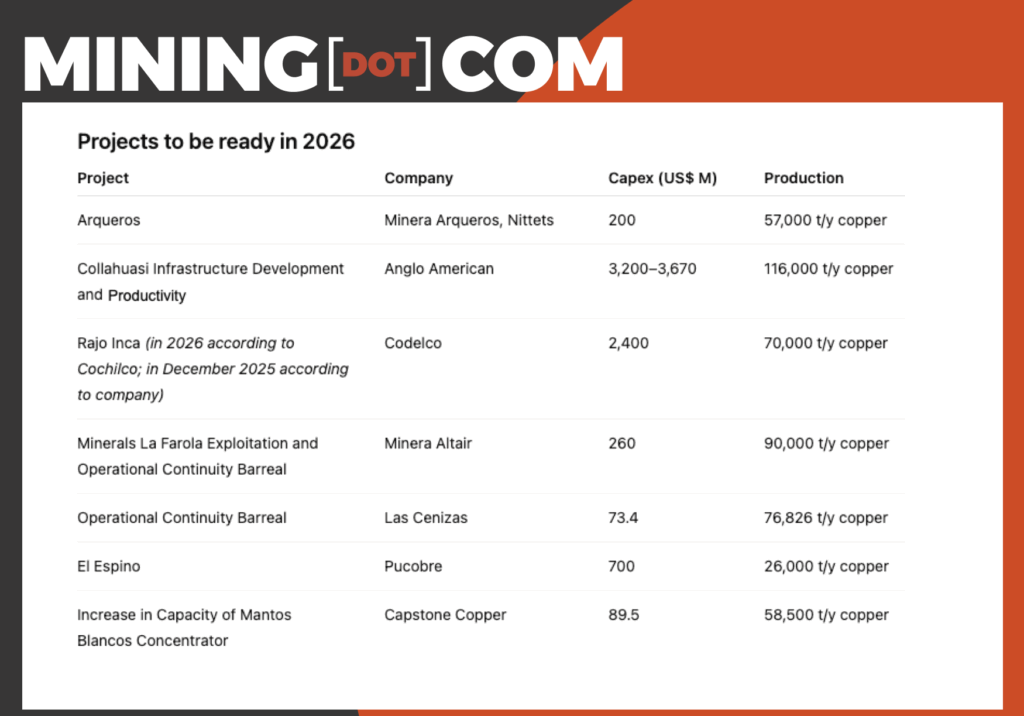
Thirteen Chilean copper projects worth $14.8 billion are targeting key 2026 milestones, with seven operations including Collahuasi’s C20+ life-extension, Codelco’s Rajo Inca and Capstone’s Mantos Blancos expected to add almost 500,000 tonnes/year of new capacity. A further six projects, such as BHP’s Spence and Capstone’s Santo Domingo, plan to start construction within a $7.7 billion pipeline that Cochilco says could lift national output to about 5.6 Mt, against a forecast 2026 deficit of 150,000–330,000 tonnes. José Antonio Kast’s incoming government is expected to streamline permitting and environmental approvals, but unresolved community opposition and potential legal challenges remain the main execution risk.
Sandvik will build a new purpose-built mechanical cutting, parts and services facility in Saskatoon, Saskatchewan, on a 155-acre (63 ha) industrial development east of Highway 11 and north of Marquis Drive to support mines across Central and Western Canada. The site is intended as a regional hub for equipment overhaul, component rebuilds and rapid parts distribution for continuous miners and other mechanical cutting fleets operating in potash and hard-rock operations. For mine operators, local OEM support should cut overhaul lead times and reduce downtime risk on critical cutting systems.
Epiroc’s 66 t Minetruck MT66 S eDrive has begun a six‑month performance trial at Gold Fields’ Granny Smith mine, hauling ore at the Wallaby underground operation in Western Australia’s Laverton District. The diesel-electric truck is being benchmarked in Granny Smith’s existing truck fleet under real production conditions, with Epiroc specialists stationed on site for the full trial period. Outcomes will focus on fuel burn, cycle times and maintenance behaviour in deep-level, long‑haul stoping, informing future fleet replacement and electrification strategies.
Grecian Magnesite is adding a fully electric, battery-powered Aramine L440B loader to its Koutzi underground magnesite mine in Evia, Greece, to help ramp towards the site’s ~50,000 t/y design capacity of pre-concentrated ore. The new L440B will work alongside an existing Aramine L140B, expanding the battery LHD fleet for production and development headings without increasing diesel equipment underground. For mine planners and ventilation engineers, the move signals continued adoption of battery loaders to cut heat and diesel particulates while sustaining output in confined workings.
Metso has secured an order from Leone Rock Metal Group to supply minerals processing equipment for the Phase III 30 Mt/y magnetite concentrator at the Tonkolili iron ore project in Sierra Leone. The package covers engineering, manufacturing, supply, installation and commissioning support for the new concentrator line, booked in Metso’s Minerals segment 2025 Q4 orders. The scale of the 30 Mt/y phase signals substantial additional crushing, grinding and magnetic separation capacity, with implications for tailings handling, water balance and power demand on an already large West African iron ore operation.
Champion Iron has agreed to acquire all issued and outstanding shares of Norwegian high‑grade iron ore producer Rana Gruber ASA in a transaction valued at about NOK 2.93 billion (US$289 million). The deal will be funded through a mix of new equity, additional debt and existing cash, signalling an expansion of Champion’s pellet feed and concentrate portfolio beyond its Quebec operations. For mine planners and process engineers, the move points to potential integration of Scandinavian high‑grade ore supply into existing blast furnace and DR‑grade feed strategies.
Las Zirh, a Turkish family-owned mining tyre chain specialist founded in 1978 by Hüseyin Şedele and now led by President and CEO Fatih Sedele, is expanding rapidly from its core European base into major mining markets. The company focuses on heavy-duty protection chains for large OTR tyres on loaders and haul trucks, targeting abrasive and high-impact conditions in open-pit operations. For mine operators, longer chain life and reduced tyre damage directly affect haulage costs, maintenance planning and fleet availability.
BUMA Australia has secured a multi-year contract extension worth about A$740 million with Blackwater Operations Pty Ltd, a Whitehaven Coal Mining subsidiary, to continue overburden removal and coal mining services at the Blackwater Mine in Queensland’s Bowen Basin. The deal runs to 2031 and covers pre-strip, dragline and truck–shovel operations, drill and blast, and coal processing support across multiple pits. For contractors and OEMs, the extension signals sustained demand for large-scale fleet deployment, maintenance, and high-availability support in one of Australia’s largest open-cut coal complexes.
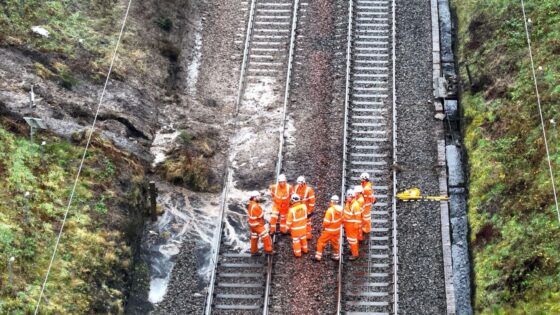
Lineside monitoring systems on parts of Britain’s rail network may fail to detect embankment or cutting slope movements during extreme rainfall, the Rail Accident Investigation Branch has warned following the 3 November passenger train derailment near Shap, Cumbria. The warning concerns remote condition monitoring equipment installed to trigger alerts for ground instability, which did not prevent the derailment. Geotechnical and asset engineers are being urged to review sensor siting, trigger thresholds and system performance in severe weather, particularly on high-risk slopes.
Heathrow Airport will launch £1.3bn of terminal upgrades and a new baggage system in 2026, targeting more reliable operations and better accessibility across its busiest passenger hubs. Works are expected to include major reconfiguration of existing terminal layouts and replacement of legacy baggage handling equipment with higher-capacity, fully screened systems integrated into current structures. Civil and structural teams will need to manage complex phasing in a live airport environment, with tight possession windows, stringent security constraints and limited landside–airside access for heavy plant and materials.
Outline proposals for the Northern Powerhouse Rail (NPR) network are now expected from the UK government in early 2026, resetting the timetable for defining new high-speed and upgraded rail corridors across key northern city pairs such as Liverpool–Manchester–Leeds. The plan is likely to clarify preferred route alignments, junction interfaces with existing main lines, and station options, which will drive subsequent GRIP/Project SPEED design stages and geotechnical investigation programmes. Contractors and consultants will be watching for commitments on phased delivery, electrification standards and target line speeds to shape bidding and resource planning.
Iron ore, gold and copper projects are driving a stronger Australian resources and energy pipeline, with new and expanded operations in the Pilbara, WA goldfields and key copper provinces signalling renewed capital expenditure. Higher benchmark iron ore prices and robust gold margins are supporting feasibility work on large-scale open pits and underground expansions, while copper’s role in electrification is sustaining interest in long-life sulphide deposits. For geotechs and mine planners, this points to continued demand for large waste dumps, tailings storage expansions and long-horizon pit slope designs.
Capricorn Metals will acquire the Yalgoo gold project in Western Australia from Tempest Minerals, expanding its footprint beyond the 2.1Moz Karlawinda operation near Newman. The Yalgoo package lies in the Murchison region, close to existing processing and haulage infrastructure used by multiple mid-tier gold producers. For geotechnical and mine planners, the deal signals further open-pit and potentially underground resource drilling in an established Archean greenstone belt, with scope for satellite ore trucking strategies similar to Karlawinda.
Fortescue has signed a technology development agreement with Taiyuan Iron and Steel (TISCO), a subsidiary of China Baowu, to jointly explore green iron production routes using Fortescue’s ore and TISCO’s low‑carbon steelmaking capability. The partnership centres on piloting and scaling technologies such as hydrogen‑based direct reduction and renewable‑powered electric furnaces within Baowu’s existing integrated steel complexes. For miners and steel producers, the move signals growing demand for ore specifications, beneficiation strategies and process control tailored to low‑carbon ironmaking flowsheets in China.
Larvotto Resources has begun underground development at its Hillgrove antimony–gold project in New South Wales, re‑opening historical workings to access high‑grade antimony and refractory gold mineralisation. The restart involves rehabilitating existing declines and levels, upgrading ground support, and re‑establishing services to support modern mechanised mining fleets. For geotechnical and mining teams, early focus will be on re‑assessing legacy excavation stability, water inflows and ventilation capacity to safely transition Hillgrove back into sustained underground production.
Liontown Resources has completed three years of open pit mining at its Kathleen Valley lithium project in Western Australia and is now transitioning fully to underground operations. The mine is shifting to long-term underground production targeting high-grade spodumene beneath the existing pits, supported by the Dragonfly accommodation village constructed to house the expanded workforce. The move concentrates activity on deeper ore zones, with implications for ground control, ventilation design and paste backfill planning in a hard-rock lithium setting.
Allied Gold has started Phase 1 expansion at the Sadiola mine in Mali, bringing a new fresh ore comminution circuit online to lift annual output to 200,000–230,000 oz, up 17–30% on 2023. The upgrade increases higher-grade fresh ore in mill feed from about 20% to as much as 60% at an expected throughput of 5.7 Mt/y, with the first full quarter of higher fresh-ore volumes due in Q1 2026. Engineering is advancing for a 2026 pre-leach thickener and plant-wide control system upgrade, underpinning a Phase 2 build-out through 2029 and supporting group guidance above 375,000 oz in 2025.
Smart money is rotating back into gold and Canadian mining assets as Sean Boyd, former CEO and now Chair of Agnico Eagle, points to gold breaking out across multiple currencies and shifting from a short-term trading instrument to a core portfolio holding. Boyd argues that in critical minerals the main constraint is processing capacity rather than geology, making concentrators, refineries and downstream plants the real choke points. He says Canada’s competitive edge will depend on faster permitting, better federal–provincial coordination and decisive backing for large-scale processing infrastructure.
First Nordic Metals has rebranded as Goldsky Resources Corp., with its shares to begin trading on 24 December on the TSX Venture Exchange under the new ticker GSKR following the acquisition of Mawson Finland. Agnico Eagle Mines retains a 13% stake after investing C$8.2 million last year to advance the Oijärvi gold project in Finland, which Agnico previously owned. The enlarged company’s portfolio is anchored by the Barsele Project joint venture, described as one of the Nordic region’s largest undeveloped gold projects, and now carries a market capitalisation of about C$155 million.