Geomechanics, Streamlined.
© 2026 Geomechanics.io. All rights reserved.
Repairs to York’s Lendal Bridge, originally planned for spring 2026, have been pushed back to 2027 after unanticipated issues on the adjacent Station Gateway transport scheme disrupted the programme. The Victorian road bridge is a key River Ouse crossing on the inner ring road, so the delay prolongs loading and fatigue concerns on an ageing structure already carrying high daily traffic volumes. Designers and asset managers will need to re-sequence inspections, temporary works and traffic management, and may face higher costs if further deterioration occurs before intervention.
Southern England local authorities have started early market engagement for a new £90M coastal and flood works framework covering shoreline protection, fluvial defences and related civil engineering packages. The framework is expected to bundle multi-year programmes of sea walls, rock armour, beach nourishment and flood alleviation schemes across several councils, giving contractors a pipeline of medium-scale projects rather than single-site tenders. Geotechnical and marine specialists should expect demand for ground investigation, scour protection design and resilient foundation solutions for assets exposed to wave loading and coastal erosion.
Scotland is missing out on roughly 5,000 high‑quality nuclear jobs because the Scottish Government continues to block new civil nuclear reactors, according to the Nuclear Industry Association. The NIA links the lost roles to supply‑chain, construction and long‑term operations work comparable to projects such as Hinkley Point C and the UK’s emerging small modular reactor (SMR) programme. For civil and geotechnical engineers, the policy effectively removes opportunities for major nuclear-grade concrete, deep excavation and marine intake/outfall works north of the border.
Anglian Water has launched a new £1.5bn Major Projects Framework for AMP8 to bring in “additional firepower” from tier one contractors to deliver a sharply increased programme of strategic water and wastewater schemes. The framework is intended to sit alongside its existing Integrated Main Works Capital Alliance, targeting complex, high-value assets such as large treatment works upgrades, new trunk mains and resilience schemes across its water-stressed East of England region. For civil and geotechnical contractors, this signals substantial upcoming demand for major earthworks, deep shaft and pipeline construction, and brownfield treatment plant expansion under tighter regulatory and carbon constraints.
Piling works for the electrification of the Borders Railway are due to start this week on sections of the 49km route between Edinburgh and Tweedbank, preparing foundations for overhead line equipment masts. The programme will focus on installing steel piles adjacent to the existing single‑ and double‑track formation, with works sequenced to maintain rail operations under possession constraints. Geotechnical teams will need to manage vibration, settlement risk and limited access along embankments and cuttings typical of this former Waverley Route corridor.
Publication of the UK government’s 2026 Green Book update marks the biggest overhaul of public investment appraisal in more than a decade, reshaping how major transport, flood defence and regeneration schemes outside London are valued. The reforms are expected to give greater weight to regional productivity, social value and resilience benefits, rather than relying heavily on agglomeration effects in already prosperous areas. For civil and geotechnical teams, this could shift business cases towards schemes addressing ageing regional assets, climate adaptation and brownfield infrastructure upgrades.
Westgold Resources has sold its Mt Henry–Selene gold project in Western Australia for $110 million and is progressing a spin-out of its Reedy mining centre into a new vehicle, Valiant Resources. The cash sale strengthens Westgold’s balance sheet for its core Murchison underground operations, including the Big Bell and Bluebird mines, where it is targeting higher-grade, lower-cost production. The Reedy spin-out carves out a discrete mining hub with existing underground workings and plant, creating optionality for separate capital allocation, mine planning and development timelines.
Bellevue Gold has approved construction of a paste backfill plant to service the Deacon and Deacon North underground mining areas at its namesake project in Western Australia, aiming to increase ore recovery from pillars and narrow stopes. The plant will use tailings-based paste to fill voids, improving ground support and allowing tighter stope spacing and higher extraction ratios compared with cemented rockfill. For geotechnical and mine planners, the move signals a shift towards engineered backfill to control dilution, manage seismicity and extend mine life in deep, high-grade zones.
Major tram maintenance works are closing the Spencer–Bourke Street intersection in Melbourne’s CBD from 15–26 February as crews replace worn tram tracks, reconstruct road pavement and install new poles and 600–750V overhead wiring. The full road closure will affect multiple Yarra Trams routes and general traffic, with diversions pushing vehicles onto adjacent CBD arterials and increasing loading on nearby intersections. For civil and track engineers, the works concentrate disruptive grinding, welding and slab replacement into an 11‑day occupation, limiting longer-term settlement and fatigue issues at this high-axle-load junction.
Real Time Density and Smart Compact Pro compaction control from Wirtgen’s Hamm rollers are giving asphalt crews pass-by-pass feedback on stiffness and density, sharply reducing the need to mill out and replace under-compacted mats. Sensors on the drum continuously measure compaction in real time and display colour-coded maps in the cab, allowing operators to adjust vibration amplitude, frequency and rolling pattern on the fly. Craig Yeats, Product Support Manager – Hamm, says the calibrated system is cutting rework and improving consistency across full-width lanes and longitudinal joints.
Kennards Hire is scaling its temporary works and plant offering for large renewable energy builds, supplying cranage, access equipment and high-capacity generators to grid-scale solar and wind projects alongside traditional road and civil jobs. The company is bundling traffic management, lighting towers and site power into integrated packages to support remote construction compounds and high-voltage substation works. For contractors, the shift means greater reliance on a single hire partner for critical-path equipment planning, mobilisation and maintenance across multi-year infrastructure programmes.
Consultation has opened on upgrading the High Street Road–Mowbray Drive signalised intersection in Wantirna South, a project within the Victorian and Federal governments’ $1.2 billion Suburban Road Blitz. The works are expected to target congestion and turning movements at this local arterial junction, which currently handles mixed residential and commercial traffic and feeds directly to the EastLink corridor. Designers should anticipate community input on lane configuration, pedestrian crossing phases and potential safety treatments for right‑turn and school‑peak traffic.
Tender has opened for New South Wales’ South West Active Transport Link (SWATL), a continuous “MetroWay” cycling and walking corridor running the full length of the Sydney Metro Southwest extension. The package will integrate paths with multiple new and existing stations, requiring complex interfaces with rail viaducts, drainage, and road crossings along the corridor. Civil and geotechnical scopes are expected to focus on retaining structures, pavement design for shared paths, lighting foundations, and managing utilities in a constrained brownfield rail environment.
BHP’s Australian copper division has delivered record results, driven by strong output from Copper South Australia and the Olympic Dam underground mine–smelter complex. Higher copper production from these assets, which integrate large-scale sublevel open stoping with onsite concentration and smelting, is lifting group earnings at a time of tight global copper supply. For mine planners and process engineers, the performance signals continued capital focus on deep underground copper orebodies and associated concentrator–smelter debottlenecking in South Australia.
Liebherr’s R 9800 G6 backhoe excavator at Yancoal’s Mount Thorley Warkworth mine in New South Wales has set new performance benchmarks for ultra-class loading, working the main overburden fleet alongside 340-tonne haul trucks. The machine, in the 800-tonne class, is designed for high-volume overburden removal with a nominal bucket capacity around 40 m³ and electric-drive assistance for faster cycle times. For mine planners and maintenance teams, the deployment signals growing confidence in ultra-large excavators for sustained production in hard overburden conditions.
Surging global demand for lithium-ion batteries for electric vehicles and grid storage is pushing Australia to move beyond spodumene concentrate exports into domestic refining and cathode‑grade chemical production. Industry proposals centre on converting hard‑rock feed into battery‑grade lithium hydroxide and carbonate in Western Australia, leveraging existing Tier‑1 deposits and port infrastructure but facing high energy costs, skills shortages and permitting timelines. For miners and process engineers, the shift implies greater focus on impurity control, reagent optimisation and integration of hydrometallurgical circuits with upstream mine planning.
New Hope Group has lifted coal output across its Australian assets and is advancing growth plans at the Bengalla thermal coal mine in the Hunter Valley, where it holds an 80 per cent interest alongside Mitsui, Taipower and J-Power. The open-cut operation, which typically produces export-quality thermal coal for Asian power utilities via the Port of Newcastle, is the company’s key near-term expansion focus. For mine planners and geotechs, any Bengalla growth path will centre on additional strip mining, dragline and truck–shovel sequencing, and associated waste dump and haul road reconfiguration.
Australian miners are hitting a data wall as high‑bandwidth sensors, autonomous fleets and video streams overwhelm traditional cloud links, pushing operations towards private LTE networks and on‑site edge computing. Vendors such as Vocus are pairing Starlink Business Rural satellite backhaul with 4G/5G private LTE to keep haul trucks, crushers and fixed plant connected in real time, even on remote pits and waste dumps. For engineers, this shift means designing networks and control systems around low‑latency, on‑site processing for fleet dispatch, collision avoidance and condition monitoring rather than centralised data centres.
Niger’s junta has moved an estimated 1,000 tonnes of uranium concentrate from Orano’s seized Somaïr open-pit mine to Air Base 101 beside Niamey’s main airport, where it remains unsold despite talks with potential buyers from Russia, China, the US and the UAE. The stockpile is subject to an ICSID order prohibiting sale or transfer without Orano’s consent, while the French state-owned company threatens “any and all actions” to block third-party acquisition. Security analysts warn the base location is highly exposed after Islamic State-linked militants approached the capital in a recent attack.
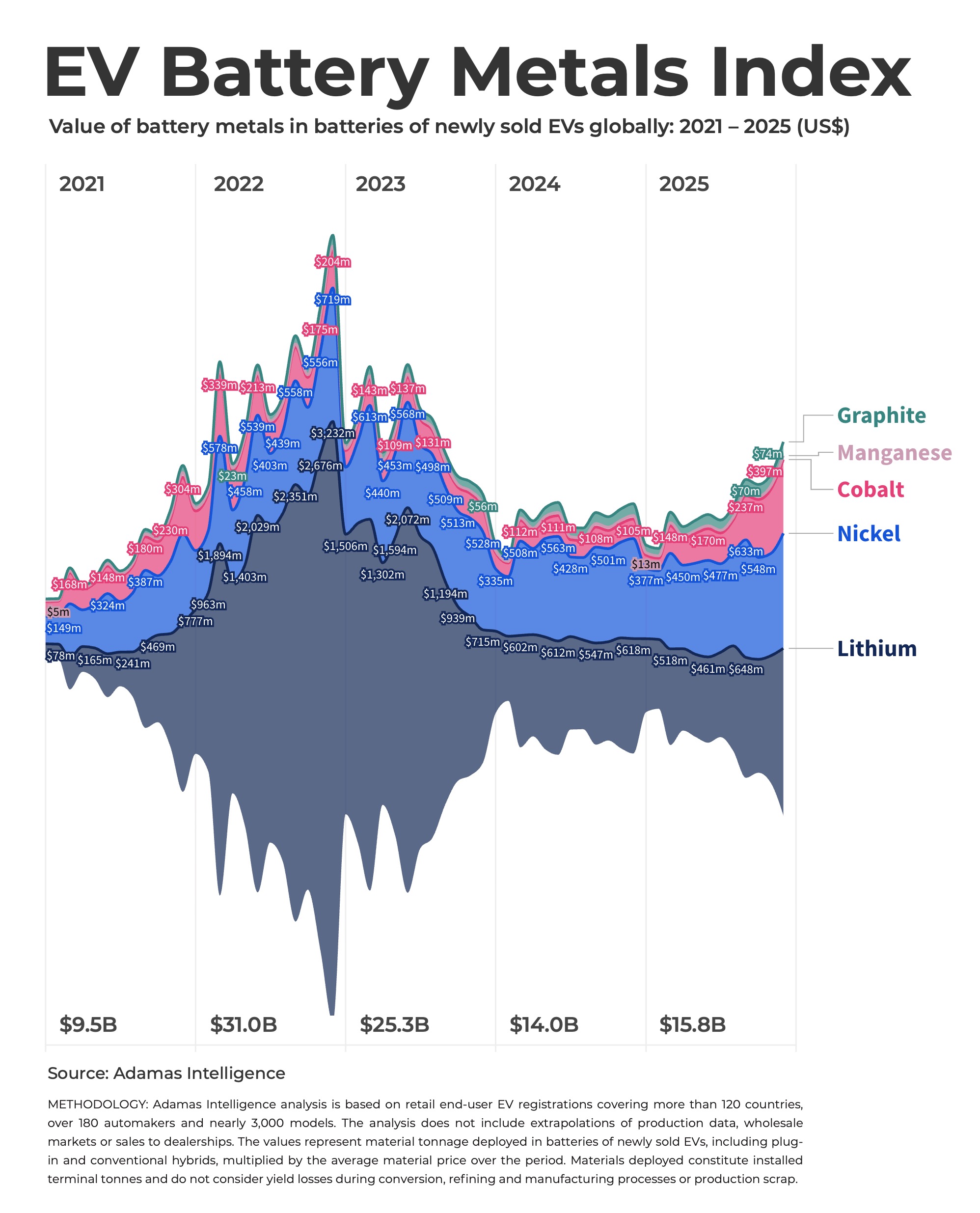
EV raw material spend for lithium, graphite, nickel, cobalt and manganese in newly sold passenger EVs reached $15.8 billion in 2025, up 13% year on year, with December’s monthly bill topping $2 billion for the first time since August 2023 as lithium hydroxide/carbonate and nickel sulphate prices climbed. Global EV battery capacity deployment is on track to exceed 1 TWh in 2025, nearly quadruple 2021’s 286 GWh, with LFP packs accounting for almost 50% of capacity and 83% of LFP roll-out concentrated in China. Cobalt’s share of the EV Metal Index rebounded to 14% ($2.4 billion) on >200% year-on-year sulphate price gains, while nickel and lithium each surpassed $6 billion in contained value, supported by high‑nickel NCM chemistries in the US and Europe despite growing LFP penetration.
Copper exchange inventories on Comex, the LME and Shanghai Futures Exchange have climbed to 1.012 million tonnes, breaching the 1 million tonne mark for the first time since 2004 as tariff-driven stockpiling in the US combines with weak Chinese demand. In thin holiday trade, March copper in New York slipped nearly 1% to $5.76/lb ($12,700/t), around 12% below late-January highs after a more than 40% price gain through 2025. Satellite data also show January global smelter activity at its lowest level in nearly a decade of monitoring, signalling tighter refined output despite swollen visible stocks.
Project Vault will create a US$12 billion US critical minerals stockpile, combining US$1.67 billion in private capital with a US$10 billion Export-Import Bank loan to buy and store materials for automakers, tech firms and other industrial users. Following a Section 232 probe covering the full USGS critical minerals list plus uranium, the administration found imports threaten national security but chose negotiated price floors and trade mechanisms over tariffs. Forthcoming US–Mexico and US–EU–Japan action plans, under the new FORGE framework, will define which minerals are prioritised, how any border-adjusted price floor is calculated, and how rules of origin or downstream products are treated.
Erewash Borough Council has approved Fassa Bortolo’s new UK headquarters and building materials factory at New Stanton Park, a 170,000 sq ft complex with manufacturing plant, training academy and warehousing. The facility will feature a 60-metre main tower, three metres higher than the former Stanton Ironworks chimney, on a 220-acre brownfield business estate masterplanned for up to 4,000 jobs. For materials suppliers and contractors, the site signals a significant East Midlands production hub for renders, mortars and plasters within a £350m global expansion programme.
Alumno has started construction of a £23m, six-storey purpose-built student accommodation block on St George’s Road in Glasgow’s Woodlands district, delivering 262 beds in four- and five-bed cluster flats plus studios. Clark Contracts is acting as design-and-build contractor, with Stallan Brand Architects, RankinFraser Landscape Architecture, Will Rudd Davidson, Ridge & Partners and Sound Advice Acoustics forming the professional team, and funding from Henderson Park. The scheme includes a ground-floor common room, sixth-floor dining, study and lounge spaces, and rear landscaped courtyards, with completion targeted for summer 2027.