Geomechanics, Streamlined.
© 2026 Geomechanics.io. All rights reserved.
Pantoro Gold will start developing a third underground mine at its Norseman gold project in Western Australia later this year, expanding beyond the existing OK and Scotia underground operations. The new decline will target additional high-grade lodes within the historic Norseman field, where past production has exceeded 5Moz, using conventional longhole stoping and existing processing capacity at the 1Mtpa Norseman plant. For geotechnical and mine planners, the move signals further sequencing of narrow-vein underground stopes and potential updates to ground support and dewatering strategies across the multi-mine complex.
Rising coal prices are driving a surge in Australia’s fly-in, fly-out (FIFO) activity, with US camp operator Civeo Corporation reporting sharply higher occupancy across its remote accommodation villages. The company, which runs modular camps and lodge-style facilities in key coal basins such as the Bowen and Hunter, is expanding room capacity and camp services to support longer rosters and larger contractor workforces. For mine operators and EPCM contractors, tighter camp availability is starting to influence project scheduling, labour sourcing and the timing of major shutdowns.
Rox Resources has secured a $350 million funding package from three financiers to take the Youanmi gold project in Western Australia through to production, covering mine development, processing plant construction and associated infrastructure. The brownfields operation, centred on the historic Youanmi underground and open-pit workings, is planned as a conventional gold operation using a new processing facility rather than refurbishing legacy plant. For geotechnical and civil contractors, the funding clears the way for portal rehabilitation, new decline development, tailings storage facility construction and upgrades to site power and haul roads.
Tutt Bryant has launched a new range of Yanmar Compact Track Loaders in Australia, extending a 46‑year distribution partnership focused on compact earthmoving equipment for civil and infrastructure works. The loaders are engineered for high output in confined sites, with compact dimensions suited to urban road reconstruction, drainage corridors and services trenching where conventional skid steers and excavators struggle to manoeuvre. For contractors, the key implications are tighter working radii, reduced ground disturbance on pavements and verges, and better utilisation of small crews on multi-phase projects.
Travis Perkins has relocated its Stratford branch to a nearly three‑acre site on Joseph Ray Road, Leytonstone, roughly 2.5 miles away, tripling operational footprint in east London. The new branch incorporates a Benchmarx kitchens and joinery showroom and an expanded tool and plant hire service, aimed at higher stockholding and faster availability for local contractors. Staffing has risen to 34, with all Stratford employees retained, signalling capacity for greater throughput of building materials and fit‑out products across the area.
Housebuilding costs rose 2% year-on-year in Q4 2025, according to the latest BCIS survey of UK house builders, with respondents expecting inflationary pressure to persist into 2026. Firms report particular sensitivity to materials and logistics costs linked to imported products, with any prolonged conflict in the Persian–Arabian Gulf likely to push up prices for fuel, petrochemical-based materials and long-haul shipping. Contractors and developers may need to reprice fixed-cost contracts, tighten risk allowances and revisit procurement timing for major residential schemes.
The first update to the UK National Infrastructure and Construction Pipeline projects a workforce requirement of 629,000–706,000 over the next five years, with the energy sector taking more than 50% of total investment. Schools and hospitals are identified as major drivers of labour demand, adding pressure on civil, M&E and building services capacity already stretched by grid upgrades, offshore wind and nuclear projects. Contractors and consultants face concurrent peaks in public-sector building and energy work, intensifying competition for skilled engineers and site supervisors.
Truflo Pumps, founded as a family agricultural pump service in regional New South Wales, has grown into a specialist supplier of high-capacity dewatering and slurry pumps for Australian mines. The company manufactures modular skid- and trailer-mounted units with wet-end stock tailored for abrasive mine water, and deploys diesel- and electric-driven pumpsets for pit dewatering, underground sumps and tailings transfer. For operators, the focus is on rapid mobilisation, standardised spares and robust materials selection to keep pits accessible and haul roads dry during high-rainfall events.
Leading manufacturers of insulating glass units are adopting laser distance sensors to monitor and precisely adjust glass panel positioning during automated assembly. Dimetix D‑Series laser distance sensors, supplied locally by AMS Instrumentation & Calibration, provide non-contact measurement over several metres with millimetre-level accuracy, enabling closed-loop control of panel spacing and alignment. For mining and industrial plant glazing, this level of positional control reduces rework, improves seal integrity in multi-pane safety glass, and supports consistent thermal and acoustic performance in harsh environments.
Westgold Resources has approved a final investment decision to expand its Higginsville processing plant from 1.6 million tonnes per annum to 2.6 million tonnes per annum, creating a larger regional hub for its Western Australian gold operations. The expansion is designed to process additional ore from the Beta Hunt underground mine and surrounding open pits, consolidating treatment that is currently split across multiple facilities. For mine planners and metallurgists, the higher nameplate capacity enables higher throughput scheduling, potential cut-off grade optimisation, and reduced haulage distances to alternative plants.
According to Surbiton Associates Pty Ltd, Australia’s gold sector generated about $71 billion in 2025 as bullion prices set new records, extending a multi‑year surge in output and revenue. Producers are pushing higher‑grade underground stopes and expanding open pits in Western Australia and New South Wales, while marginal orebodies that were uneconomic below previous price decks are being reconsidered. The revenue spike is expected to drive more brownfield drilling, accelerated resource conversion to reserves, and renewed investment in processing plant debottlenecking and tailings storage upgrades.
Construction is underway on Fortescue’s 440 MW solar farm at Solomon Airport in the Pilbara, set to be Western Australia’s largest single-site solar installation and a key power source for the Solomon iron ore hub. The project will integrate with existing battery energy storage systems such as the North Star Junction BESS to displace a substantial share of gas and diesel generation on the mine’s microgrid. For mine planners and electrical engineers, this scale of behind-the-fence PV will drive new approaches to load management, contingency planning and grid stability.
Phoenix Copper has sacked executive chairman Marcus Edwards-Jones and CFO Richard Wilkins after an internal probe found about $1.765 million was paid between 2016 and 2025 to Lloyd Edwards-Jones, a corporate finance firm owned by Edwards-Jones, without board knowledge or AIM-related party approvals. Investigators also identified a further £610,000 in unauthorised payments, including transfers to an intermediary linked to bond financing made despite explicit board instructions not to proceed. Interim chair Catherine Evans and a newly appointed interim CFO are tightening governance and controls, while Phoenix warns working capital only covers operations at the Empire Copper Reserve project until end-Q2 2026.
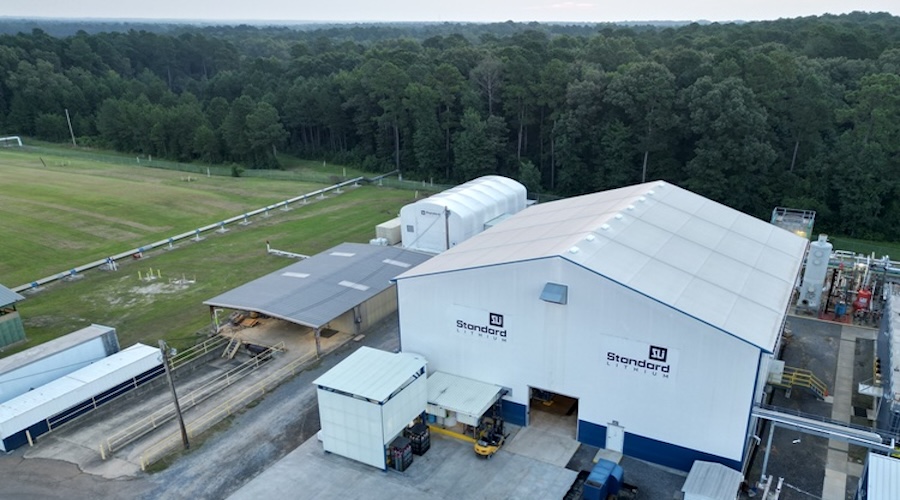
Trafigura has signed a 10‑year take‑or‑pay offtake with Smackover Lithium, securing 8,000 t/y of US‑produced battery‑grade lithium carbonate from the South West Arkansas (SWA) brine project, totalling 80,000 tonnes. The JV between Standard Lithium and Equinor is targeting 22,500 t/y in its first phase using direct lithium extraction from the Smackover Formation, with this contract covering over 40% of planned initial output and final investment decision expected in 2026 for 2028 start‑up. Wood Mackenzie forecasts demand could exceed 13 Mt by 2050, with potential supply deficits from 2028 without major new investment.
Pan African Resources will acquire Emmerson Resources in an all-share deal valuing the Australian junior at about A$311 million, with Emmerson investors to receive 0.1493 new Pan African shares as CHESS Depositary Interests for ASX trading. The transaction, to be implemented via an Australian court-approved scheme of arrangement requiring 75% shareholder support in a June 2026 vote, will give Pan African full ownership of the Tennant Creek mineral field, consolidating its existing 75:25 joint venture. Emmerson’s board has unanimously backed the deal, with holders of roughly 26% of shares already indicating support.
TMC the metals company has cleared a key US hurdle after the National Oceanic and Atmospheric Administration ruled its consolidated exploration and commercial recovery permit application for deep-sea polymetallic nodules “in substantial compliance” with revised Deep Seabed Hard Mineral Resources Act regulations. The submission, the first under President Trump’s streamlined regime, covers about 65,000 km² in the Clarion-Clipperton Zone and an estimated 619 million tonnes of wet nodules, with a further 200 million tonnes of upside. Greenpeace International argues the move breaches TMC’s International Seabed Authority contracts and urges the ISA to consider non-renewal.
DEScycle has formed a strategic partnership with Mitsubishi Corporation to deploy its ionometallurgy-based e-waste metals recovery platform in Japan, combining deep eutectic solvent chemistry with MC’s trading network and investment capacity. MC is funding a UK demo plant intended as a template for repeatable, distributed units, targeting capital-light deployments rather than billion‑dollar smelter-scale projects. The collaboration focuses on critical and precious metals from e-scrap, aiming to cut energy use and environmental load versus conventional smelting while strengthening domestic, sovereign metals supply chains.
La Mancha Resource Capital is lifting its stake in G Mining Ventures to 19.9% via a C$427 million purchase of 9.3 million shares at C$45.89, backing the ramp-up of the Tocantinzinho mine in Pará, Brazil, and development of the $973 million Oko West project in Guyana. G Mining guides 2026 output of 160,000–190,000 oz. at Tocantinzinho at AISC of $1,230–$1,444/oz, and targets first gold at Oko West in H2 2027 with 350,000 oz./year over 12.3 years at $1,123/oz AISC. A 2025 feasibility study pegs Oko West’s post-tax NPV at $2.2 billion and IRR at 27% at $2,500/oz gold, with 80.3 Mt indicated at 2.1 g/t (5.4 Moz) and a 2.9-year payback.
Gold fell as much as 3% to about $5,015/oz on Monday, with US futures still down 1%, as a stronger US dollar and expectations of prolonged higher US interest rates outweighed its safe-haven appeal, while silver gained over 2% to trade above $85/oz. Analysts from Oversea-Chinese Banking Corp. and Marex describe current selling as a cash-raising phase amid Middle East war-driven inflation fears, with many investors opting to “wait” rather than add exposure. Despite the pullback, gold remains up roughly 18% year-to-date, supported by central-bank buying, including 16 consecutive months of purchases by the People’s Bank of China.
A contractor has died from injuries sustained during maintenance activities at Endeavour Mining’s Mana gold mine in Burkina Faso, where a carbon-in-leach plant processes ore from the recently transitioned underground operation. Mining and processing continue while Endeavour conducts an internal investigation, with no reported impact on the mine’s more than 2.1 million oz historical production profile or current output. Endeavour’s shares fell up to 3% in Toronto to about C$83.90, with the 85%-owned Mana and nearby Houndé mines remaining key assets in its C$20 billion portfolio.
Two firms have been fined after a cherry picker struck an 11kV overhead powerline at the Willand Biogas anaerobic digestion site in Cullompton, Devon on 1 June 2020, killing 34-year-old Carl Parsons and leaving colleague Luke Madavan with life-changing injuries. Willand O&M Ltd, advised by both its contractor and Western Power Distribution to divert or bury the line, failed to act or install controls such as height restrictors or exclusion zones, and was fined £51,000 plus £28,467 costs. New Wave Marine Ltd, whose risk assessment and supervision were deemed inadequate, was fined £30,000 with £8,000 costs.
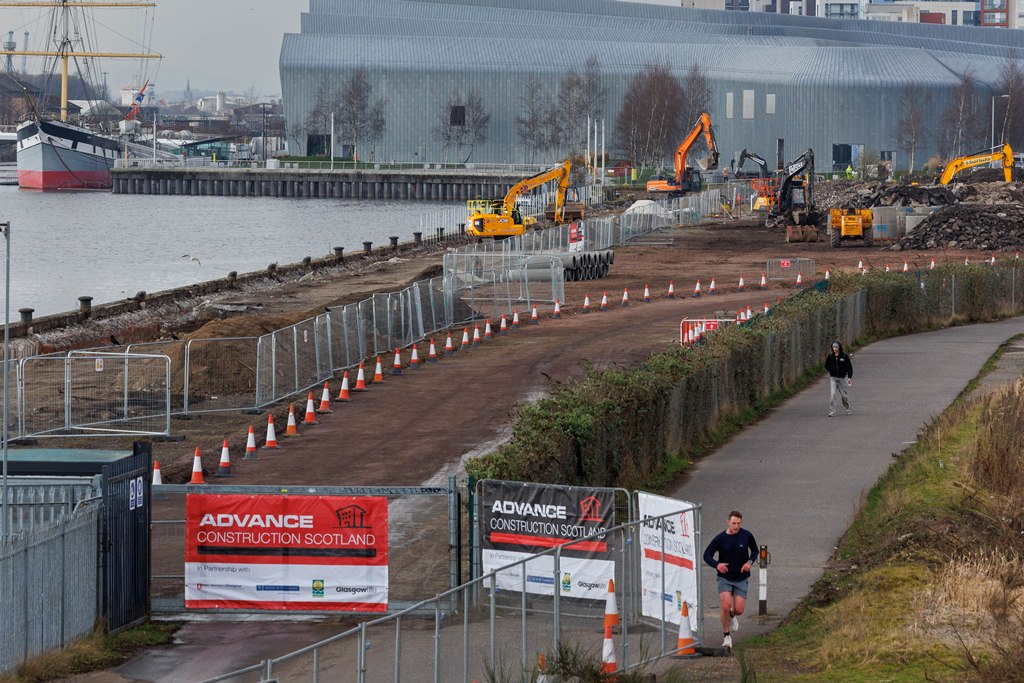
Infrastructure works have begun at Yorkhill Quay in the Glasgow Waters district, where Peel Waters plans 1,100 waterfront apartments on a 13‑acre brownfield site along the River Clyde. Advance Construction Scotland has a £3.75m contract running to December 2026 to deliver core enabling works, including a 400‑metre waterfront promenade and a combined footpath/cycle path. The new route will link The Clydeside Distillery and The Riverside Museum, improving active‑travel connectivity and setting out the primary public realm framework for subsequent phases.
Lighthouse Charity, Willmott Dixon and local artist Rob Fenton have installed a large mental health mural at Staffordshire University’s new Student Village construction site in Stoke-on-Trent, depicting a lighthouse beacon as a symbol of hope for male workers. The unveiling coincided with a site-wide safety stand-down on mental health, delivered by Lighthouse’s specialist team for the DBFO consortium of Willmott Dixon, Hochtief PPP Solutions, Plenary and Pinnacle Group. Contractors are positioning the artwork as a permanent prompt for on-site “check-in” conversations in a traditionally male-dominated environment.
The Department for Education has let four main works contracts worth more than £125m, including Bowmer & Kirkland’s £54.9m scheme at The Bromfords School in Wickford and £14.5m Lime Hills SEND School in North Somerset, plus Willmott Dixon’s £40.4m project at Outwood Academy Kirkby and Galliford Try’s £16.2m rebuild of St Helens Primary in Hartlepool. Pre-construction service agreements have also been issued to Willmott Dixon, Kier, Bam and John Graham for eight further schools, signalling a rapid mobilisation phase under the £15.4bn Construction Framework 25.