Devon power line fatality: safety and risk control lessons for project teams
Reviewed by Tom Sullivan
First reported on The Construction Index
30 Second Briefing
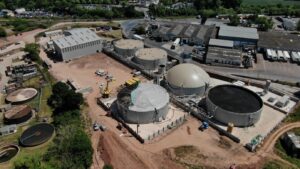
Two firms have been fined after a cherry picker struck an 11kV overhead powerline at the Willand Biogas anaerobic digestion site in Cullompton, Devon on 1 June 2020, killing 34-year-old Carl Parsons and leaving colleague Luke Madavan with life-changing injuries. Willand O&M Ltd, advised by both its contractor and Western Power Distribution to divert or bury the line, failed to act or install controls such as height restrictors or exclusion zones, and was fined £51,000 plus £28,467 costs. New Wave Marine Ltd, whose risk assessment and supervision were deemed inadequate, was fined £30,000 with £8,000 costs.
Technical Brief
- HSE investigation focused on line routing decisions, work-at-height planning and adequacy of site-specific risk controls.
- Willand O&M breached Electricity at Work Regulations 1989 Reg 3(1)(a) via Reg 14 by allowing work near live conductors without suitable precautions.
- New Wave Marine’s failings were prosecuted under Management of Health and Safety at Work Regulations 1999 Reg 3(1) and Work at Height Regulations 2005 Reg 4(1).
- Identified missing controls included plant height restrictors, physical exclusion zones and robust site induction for overhead line hazards.
- HSE noted arcing risk over several metres, meaning contact can occur without direct physical touch.
- Ongoing operations near overhead lines should incorporate formal monitoring of work envelopes, supervision competence and periodic review of line diversion options.
Our Take
With 36 Hazards stories in our database, this United Kingdom case at the Willand Biogas site stands out as one of the few involving an anaerobic digestion facility rather than conventional construction or mining, signalling that power-line interface risks are now a live issue for smaller distributed energy assets.
The nearly six‑year gap between the June 2020 incident at Willand Biogas and the 2026 Exeter sentencing mirrors other UK safety cases in our coverage where lengthy investigations and prosecutions have complicated lessons‑learned cycles for operators and contractors.
Willand O&M’s liquidation in 2024, ahead of the 2026 court outcome, underlines a recurring pattern in our Hazards coverage where smaller service companies exposed to fatality investigations may not survive to implement remedial safety systems, leaving asset owners and incoming contractors to pick up the risk management legacy.
Prepared by collating external sources, AI-assisted tools, and Geomechanics.io’s proprietary mining database, then reviewed for technical accuracy & edited by our geotechnical team.
Related Articles

Related Industries & Products
Mining
Geotechnical software solutions for mining operations including CMRR analysis, hydrogeological testing, and data management.
Construction
Quality control software for construction companies with material testing, batch tracking, and compliance management.
CMRR-io
Streamline coal mine roof stability assessments with our cloud-based CMRR software featuring automated calculations, multi-scenario analysis, and collaborative workflows.
HYDROGEO-io
Comprehensive hydrogeological testing platform for managing, analysing, and reporting on packer tests, lugeon values, and hydraulic conductivity assessments.
GEODB-io
Centralised geotechnical data management solution for storing, accessing, and analysing all your site investigation and material testing data.