Geomechanics, Streamlined.
© 2026 Geomechanics.io. All rights reserved.
US military stockpiles hold only about two months of rare earth supplies for systems such as missile guidance, fighter jet actuators and phased-array radar, exposing operations against Iran to potential disruption if Chinese exports tighten. China controls over half of global rare earth mine output and nearly all processing capacity, has already imposed export controls, and plans to strengthen industry development and export management under its 15th Five-Year Plan (2026–2030). A $12 billion US stockpiling and allied trade-bloc initiative is unlikely to bring non-Chinese projects online fast enough, concentrating pricing and supply-chain power in a few producers.
Gold advanced on Tuesday as US President Donald Trump signalled an imminent end to the Iran war, knocking oil off recent 30%-plus gains and easing inflation fears that had capped bullion. Spot gold rose up to 1.8% to about $5,240/oz and US gold futures gained 2.7%, while silver climbed 2% toward $90/oz, reversing part of last week’s 3% gold price drop and a 30-tonne ETF outflow, the largest in over two years. Analysts at TD Securities and BMO still flag elevated energy prices and unresolved Strait of Hormuz disruptions as key macro risks for miners and metals investors.
ICMM has released a Global Mining & Metals Greenhouse Gas Emissions Dataset and insights report showing that extraction of minerals critical for renewable energy technologies and sustainable development contributes a relatively small share of global GHG emissions. The dataset aggregates Scope 1 and 2 emissions from mining and metals operations worldwide and distinguishes them from downstream processing and end-use sectors such as power generation and transport. ICMM positions the tool to support more accurate value-chain accounting, scenario analysis and decarbonisation planning for commodities like copper, nickel, lithium and rare earths.
G&H has appointed former Mitie account manager and Amey operations manager Ian Moorby as its first head of operations to lead maintenance delivery, performance and growth. Moorby brings experience managing PFI contracts and compliance, planned and reactive maintenance, and project works across the northeast prison network for the Ministry of Justice. His role will cover recent and ongoing building maintenance and decarbonisation projects including Pudsey Sixth Form College, Windsor House, Evans Property Group’s head office, and Centrica-backed schemes at Heartlands and Hereford County Hospitals.
Clark Contracts has broken ground on a £20m, 191-bed purpose-built student accommodation scheme for Alumno and Henderson Park in Edinburgh’s Meadowbank and Jock’s Lodge area, with completion targeted for summer 2027. The development combines cluster flats with shared kitchens and self-contained studios, plus study and social spaces, landscaped courtyards, rooftop gardens and a ground-floor café/restaurant. For contractors and consultants, the long programme suggests phased delivery and extended coordination of fit-out, public realm and mixed-use ground-floor interfaces.
Grafton Group has agreed to acquire Macroom-based Cygnum Holdings, a timber frame manufacturer that generated more than €45.6m in revenue in 2024 from supplying offsite frames to house-builders across Ireland. Cygnum will be integrated into Grafton’s Chadwicks Group merchant network, with the existing management team retained and incentivised to grow profitability, subject to clearance from Ireland’s Competition & Consumer Protection Commission. The deal increases Grafton’s exposure to a housing market where notified timber frame use in scheme developments has risen from 37% in 2019 to 61% in 2025.
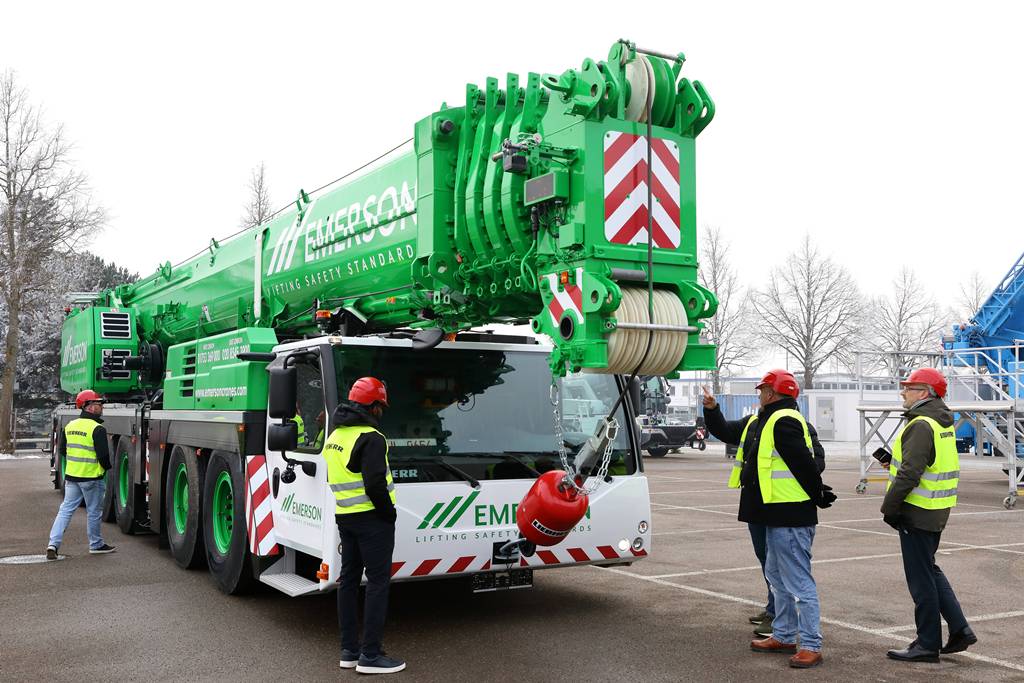
Emerson Crane Hire has taken delivery of the UK’s first Liebherr LTM 1400-6.1, a six-axle mobile crane with a 70-metre telescopic boom and 400-tonne safe working load on a chassis normally used for 300-tonne class machines. The unit is specified with an 80.5-metre luffing jib giving 120 metres maximum hoist height and 97 metres working radius, plus a 45.5-metre hydraulically adjustable jib with up to 40 degrees offset. Under UK STGO rules it travels at 16.5-tonne axle loads carrying its hook block, 10 tonnes of ballast and the Y-Guying system, which self-assembles via integrated hydraulic and electrical quick couplings.
Galliford Try has secured a £28m contract from Clarion Housing Group to build 126 canal-side social rent flats at the City Place site on Charterhall Drive in Chester, adjacent to the Shropshire Union Canal and the grade-II-listed Chester Shot Tower. The scheme comprises 23 one-bed and 103 two-bed units, with Latimer, Clarion’s development arm, overseeing delivery as part of the wider City Place masterplan. All homes are designed to be fossil-fuel-free, achieve at least EPC B, and provide 100% electric vehicle charging provision.
Costain’s 2025 results show revenue down 16% to £1,045.7m but pre-tax profit up 32% to £48.2m, as a 50% fall in road revenue and 25% fall in rail were offset by growth in energy and nuclear & defence work. Adjusted operating profit rose 9% to £47.1m, with adjusted free cash flow more than doubling to £63.1m and year-end net cash increasing to £189.3m despite a £10m share buyback and higher dividends. The forward work position reached a record £7.0bn, including £1.1bn already secured for 2026, giving strong visibility for civils and infrastructure delivery.
Fines exceeding £90,000 and a 26‑week suspended prison sentence have been imposed after 218 m² of asbestos-containing materials and debris were illegally disturbed and cleared at a demolition site on Greenheath Road, Cannock. Sohan Group Limited was fined £74,900 for failing to appoint a principal contractor under CDM 2015, while Maize Metals Limited was fined £13,400 for proceeding with demolition despite an asbestos management survey identifying ACMs. Unlicensed contractor Disa Properties’ representative, Ali Raza Baig, received a suspended custodial sentence, five-year director disqualification and curfew for arranging unlicensed asbestos removal.
Clarion Housing Group has awarded the Hill Group a £45m contract for phase two of the High Path estate regeneration in Merton, delivering 147 new homes – nine houses on Abbey Road and 138 apartments at High Path/Pincott Road – within a wider £1bn programme replacing 1,800 homes with 2,800. Demolition of Lovell House and Marsh Court finished in winter 2025, with house construction scheduled for spring 2026 and apartment blocks from early 2027, subject to Building Safety Regulator approval. All new homes will be gas-free, using air source heat pumps and rooftop photovoltaics, with upgraded shared spaces, cycle storage and a re-provided community centre.
Mott MacDonald has been appointed by Westmorland and Furness Council to develop a concept masterplan for a significantly upgraded Windermere railway station, forming the core of a wider “Gateway” vision for the Lake District. The commission focuses on remaking the arrival experience for visitors while improving local multimodal transport links, including rail–bus–active travel interchange. For civil and transport engineers, early design work is likely to centre on station circulation, public realm reconfiguration and integration with constrained town-centre highway and pedestrian networks.
Work has started on a strategic business case for a potential mass rapid transit (MRT) system for Greater Cambridge, led jointly by the Cambridge Growth Company and the Cambridgeshire and Peterborough Combined Authority. The study will define preferred MRT corridors, technology options such as segregated busways or light rail, and integration with existing assets including the Cambridgeshire Guided Busway and Cambridge railway station. Outcomes will shape future decisions on alignments, tunnelling versus surface routes, and funding strategy for high-capacity, segregated public transport infrastructure across the sub‑region.
The updated UK 10‑year Infrastructure Pipeline now totals more than £700bn of planned public and private capital projects and, for the first time, includes quantified estimates of workforce demand by project, region and phase. Granular data on skills requirements – covering roles from tunnelling and geotechnical specialists to steel fixers and plant operators – is intended to support contractors, consultants and training providers in sequencing recruitment and apprenticeships. For civil and ground engineering firms, the dataset offers an evidence base for capacity planning against overlapping major schemes in transport, energy and water.
Epiroc has signed its first ground support partnership in Oceania and Indonesia with DYWIDAG Australia, giving it wider distribution for products such as rock bolts, mesh and dynamic ground support systems in hard‑rock underground mines. The agreement targets high-stress, deep mining environments in Australia and Indonesia, where squeezing ground, seismicity and corrosion demand integrated support packages rather than standalone consumables. For operators, the deal signals broader local availability, shorter lead times and potentially more standardised support designs across multi-mine portfolios in the region.
Construction has commenced on Fortescue’s 440 MW Solomon Airport solar farm in the Pilbara, set to be Western Australia’s largest solar development and supplying about one-third of the solar capacity the company says it needs to reach its Real Zero emissions target. The project will feed Fortescue’s nearby iron ore operations, reducing reliance on gas and diesel generation across the Solomon power network. For mine planners and electrical engineers, this scale of behind-the-fence renewables will drive changes in load management, network stability design and contingency planning for remote operations.
Huawei’s Mining Business Unit president Andy Wu claims the company is at least six months ahead of rivals in deploying 4G, private LTE and 5G connectivity tailored for mine sites, integrating networks with edge computing and cloud platforms. Solutions discussed include autonomous haulage over dedicated 5G slices, high‑definition video for crusher corridors and stockpile monitoring, and unified OT/IT architectures linking SCADA, fleet management and environmental sensors. For engineers, the message is that robust, low‑latency wireless backbones are becoming a prerequisite for scaling automation and data‑driven optimisation underground and in large open pits.
Effect of joint orientation on inter-ramp stability is analysed using 2D limit equilibrium and 3D numerical modelling for slopes with persistent bedding, cross-joints and random joint sets. The work compares circular, non-circular and step-path failure modes, showing that adverse bedding dipping out of the slope can reduce inter-ramp factors of safety to below design targets even where bench-scale wedges appear stable. Guidance is given on selecting inter-ramp angles and slope heights when joint sets are variably oriented, stressing 3D assessment where joints are only semi-persistent.
OreNova Engineering in Perth is developing AI-based tools to compress the engineering schedule for new mineral processing plants, targeting faster concept-to-detailed-design workflows. By automating repetitive design tasks and drawing generation, and embedding process design rules for comminution and flotation circuits, the company aims to cut plant engineering time and reduce late-stage rework. For miners chasing shorter time-to-first-ore and quicker ramp-up to nameplate capacity, this could materially change how front-end engineering design and approvals documentation are produced.
Epiroc has agreed to acquire the business of Eventspec Proprietary Limited, a Johannesburg-based mining aftermarket specialist that manufactures parts for drill rigs, mine trucks and loaders and provides rebuilds, repairs and field services. Eventspec brings more than 20 years of regional experience supplying components and overhaul support for mobile fleets operating in South African hard-rock and open-pit mines. The deal strengthens Epiroc’s in-country capability for life-cycle support of its drilling and loading equipment, potentially shortening lead times and improving availability of critical wear and structural parts for existing fleets.
Hewlett Packard Enterprise and STRACON Tech are expanding their strategic alliance to deploy artificial intelligence across STRACON’s contract mining operations, targeting real-time decision-making and more robust predictive models. The partnership will combine HPE’s edge-to-cloud infrastructure and AI platforms with STRACON Tech’s mine planning and fleet management solutions to support use cases such as predictive maintenance, dispatch optimisation and production forecasting. For geotechnical and operations teams, this signals more data-driven control of haul fleets and fixed plant, with AI models pushed closer to shovels, crushers and pit networks.
Anglo American is establishing an AI Centre of Excellence to coordinate “safe and responsible” deployment of machine learning across its portfolio, as outlined in its 2025 annual report. The group is targeting use cases from orebody characterisation and geometallurgical modelling to predictive maintenance on haul fleets and processing plants, integrating AI with existing digital platforms such as VOXEL and P101. Governance will focus on model risk management, data security and human-in-the-loop decision support, signalling tighter controls on algorithm use in mine planning and operations.
SandLix™, Anglo American’s novel heap leach process for low-grade copper ores, has reached a key milestone with a 15,000 t prototype heap now under operation, scaling up from earlier 100–1,000 t test pads. The technology targets finely ground, sand-sized material rather than conventional crushed rock, using controlled agglomeration and irrigation to improve percolation and copper recovery from ores that are currently marginal or sent to waste. If commercialised, SandLix™ could materially change mine planning by converting large tonnages of sub-economic material into leachable reserves with relatively low additional footprint.
The Federal Government will provide $53 million to establish a new Cooperative Research Centre focused on boosting Australia’s critical minerals refining capability, targeting value-adding beyond raw lithium, rare earths and other battery and magnet metals. The CRC is expected to link universities, CSIRO and industry to develop refining flowsheets, pilot-scale processing and advanced materials, building domestic capability in hydrometallurgy, separation technologies and product qualification. For miners and processors, this signals stronger support for downstream projects, process innovation and local supply chains for cathode, permanent magnet and alloy precursors.