Geomechanics.io

  • Free Tools
Sign UpLog In

Geomechanics.io

Geomechanics, Streamlined.

© 2026 Geomechanics.io. All rights reserved.

Geomechanics.io

CMRR-ioGEODB-ioHYDROGEO-ioQCDB-ioFree Tools & CalculatorsBlogLatest Industry News

Industries

MiningConstructionTunnelling

Company

Terms of UsePrivacy PolicyLinkedIn
    AllGeotechnicalMiningInfrastructureMaterialsHazardsEnvironmentalSoftwarePolicy
    Projects

    Zimbabwe export ban: Fitch’s BMI lithium outlook and pricing notes for mine planners

    March 3, 2026|

    Reviewed by Joe Ashwell

    Zimbabwe export ban: Fitch’s BMI lithium outlook and pricing notes for mine planners

    First reported on MINING.com

    30 Second Briefing

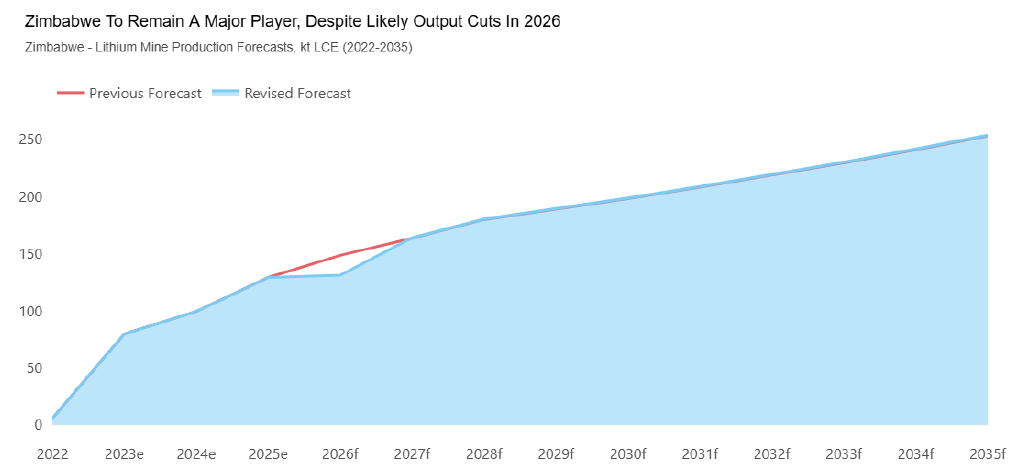
    Zimbabwe’s immediate ban on exports of raw minerals, including lithium concentrates, is expected by Fitch’s BMI to tighten the lithium market only temporarily, with Zimbabwe currently supplying about 10% of global output and mine production now forecast at 131,100 tonnes LCE in 2026. Huayou Cobalt’s Arcadia plant, due online shortly, will process only its own concentrates, leaving other operators such as Sinomine Resources’ Bikita mine and the state-owned Kamativi mine to curb production until their planned lithium sulphate plants ramp up from mid-to-late 2027. BMI has lifted its 2026 Chinese lithium carbonate and hydroxide price forecasts to $13,500/tonne and $13,000/tonne respectively, warning that prolonged disruptions could sustain higher prices.

    Technical Brief

    • Export of lithium concentrates was banned immediately in late February, nearly three years earlier than planned.
    • Earlier 2022 restrictions had already prohibited export of unprocessed lithium ore, pushing miners towards concentrate production.
    • Huayou Cobalt’s Arcadia processing plant will be dedicated to in‑house feed, excluding third‑party concentrates.
    • Additional lithium sulphate plants are planned at Sinomine’s Bikita mine and the state‑owned Kamativi operation from 2027.
    • Democratic Republic of Congo’s 2025 cobalt export curbs were later converted into a quota system after market disruption.
    • DRC controls about 75% of global cobalt output, so its export constraints directly escalated battery‑grade cobalt costs.
    • Zimbabwe’s policy is expected by BMI to be more effective at attracting local processing investment than DRC’s approach.

    Our Take

    With Zimbabwe accounting for about 10% of global lithium output in our database, any export disruption mainly affects spodumene and concentrate flows to Chinese converters such as Huayou Cobalt and Sinomine rather than total battery‑grade chemical availability, which is still dominated by Australia and South America.

    BMI’s recent industrial metals outlook (Feb 2026) also flagged lithium alongside nickel and tin as particularly sensitive to policy and supply shocks, so a Zimbabwe ban reinforces their thesis that price volatility will be driven more by episodic regional interventions than by long‑term resource scarcity.

    The combination of Zimbabwe’s lithium position and the DRC’s roughly 75% share of world cobalt production concentrates two key battery inputs in central and southern Africa, which in our coverage has been pushing OEMs and traders to diversify into Brazil and other jurisdictions despite higher operating and permitting hurdles there.

    Geotechnical Software for Modern Teams

    Centralise site data, logs, and lab results with GEODB-io, CMRR-io, and HYDROGEO-io.

    No credit card required.

    • Save and export unlimited calculations
    • Advanced data visualisation
    • Generate professional PDF reports
    • Cloud storage for all your projects

    Prepared by collating external sources, AI-assisted tools, and Geomechanics.io’s proprietary mining database, then reviewed for technical accuracy & edited by our geotechnical team.

    Related Articles

    MetalQuest’s Lac Otelnuk iron project: economics and infrastructure lens for engineers
    Mining
    1 day ago

    MetalQuest’s Lac Otelnuk iron project: economics and infrastructure lens for engineers

    MetalQuest Mining’s Lac Otelnuk project in northern Quebec hosts 4.9 billion tonnes of proven and probable reserves grading 28.7% Fe, with a 2015 feasibility study outlining an 11.6 km by 2.8 km open pit, post-tax NPV of US$5.24 billion (8% discount), IRR of 13% and capital costs of about US$14.2 billion. The study forecasts 68.5% Fe concentrate with 0.02% P and 2.95% SiO₂, positioning it for DRI-based low-emission steelmaking using Quebec hydro power. Infrastructure remains the critical constraint, with a previously proposed 755 km concentrate slurry pipeline to Sept-Îles now likely to be replaced by road and rail, and MetalQuest seeking a major partner ahead of a new feasibility targeted for 2030.

    Mining
    2 days ago

    XCMG–Codelco MoU: haul fleet competition and design notes for Andean copper mines

    XCMG has signed a memorandum of understanding with Chilean copper major Codelco in Santiago on 3 March, following Codelco Chairman Máximo Pacheco’s visit to XCMG’s Xuzhou manufacturing base in February. The agreement, signed by XCMG Vice President Liu Jiansen and Codelco Chief Procurement Officer Mauricio Acuña, centres on expanding supply of large-scale mining equipment and support services to Codelco’s open-pit and underground copper operations. For engineers, the deal signals intensifying competition with established OEMs on haul trucks, loaders and drilling fleets in high-altitude Andean conditions.

    Oklahoma critical minerals refining push: infrastructure and power notes for engineers
    Mining
    2 days ago

    Oklahoma critical minerals refining push: infrastructure and power notes for engineers

    Oklahoma is positioning itself as a critical minerals processing hub rather than a mining state, anchored by Emirates Global Aluminium’s proposed US$4 billion primary aluminium smelter at the Port of Inola on the McClellan–Kerr Arkansas River system and backed by surplus low‑cost power from wind and natural gas. USA Rare Earth is building a vertically integrated rare earth magnet plant in Stillwater with about US$1.6 billion in public and private funding, while Stardust Power (NASDAQ: SDST) is advancing a lithium refinery in Muskogee with Sumitomo offtake and key permits secured. The cluster targets defence and aerospace demand around Tinker Air Force Base and other installations, aiming to plug the “missing middle” between raw mineral supply and finished components.

    Related Industries & Products

    Mining

    Geotechnical software solutions for mining operations including CMRR analysis, hydrogeological testing, and data management.

    CMRR-io

    Streamline coal mine roof stability assessments with our cloud-based CMRR software featuring automated calculations, multi-scenario analysis, and collaborative workflows.

    HYDROGEO-io

    Comprehensive hydrogeological testing platform for managing, analysing, and reporting on packer tests, lugeon values, and hydraulic conductivity assessments.

    GEODB-io

    Centralised geotechnical data management solution for storing, accessing, and analysing all your site investigation and material testing data.