Geomechanics.io

  • Free Tools
Sign UpLog In

Geomechanics.io

Geomechanics, Streamlined.

© 2026 Geomechanics.io. All rights reserved.

Geomechanics.io

CMRR-ioGEODB-ioHYDROGEO-ioQCDB-ioFree Tools & CalculatorsBlogLatest Industry News

Industries

MiningConstructionTunnelling

Company

Terms of UsePrivacy PolicyLinkedIn
    AllGeotechnicalMiningInfrastructureMaterialsHazardsEnvironmentalSoftwarePolicy
    Projects
    Sustainability

    WoodMac lithium demand to 2050: supply, capex and risk takeaways for mine planners

    March 3, 2026|

    Reviewed by Joe Ashwell

    WoodMac lithium demand to 2050: supply, capex and risk takeaways for mine planners

    First reported on MINING.com

    30 Second Briefing

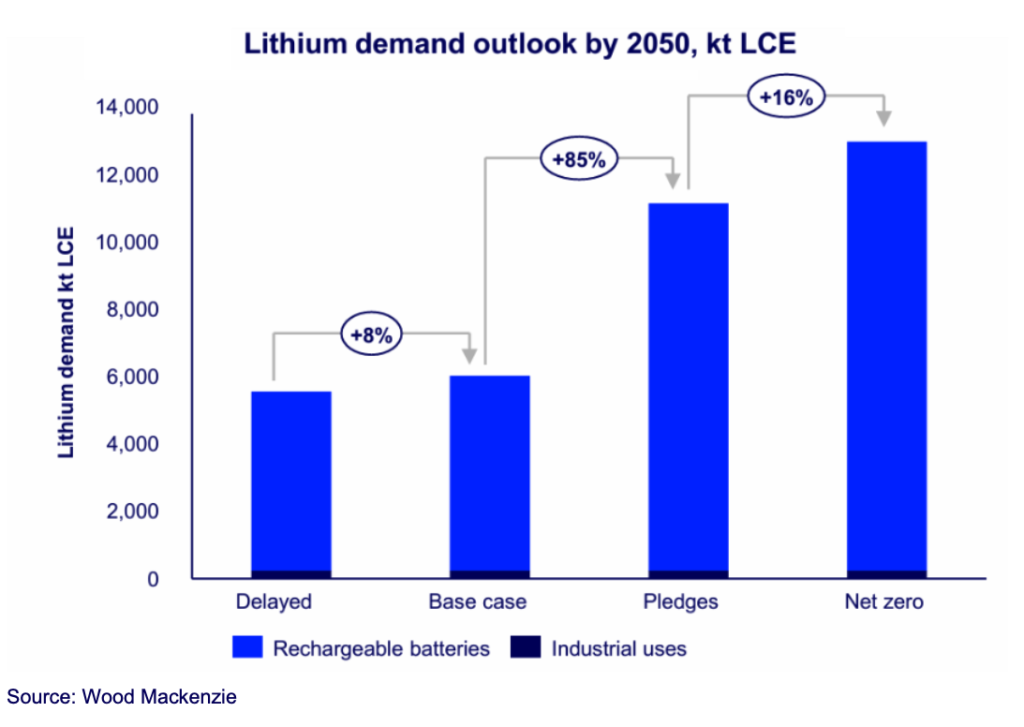
    Global lithium demand is projected by Wood Mackenzie to reach up to 13.2 million tonnes LCE by 2050 under a net-zero pathway, with market deficits starting as early as 2028 and total sector investment needs ranging from $104 billion (delayed transition) to $276 billion (net zero). Electric vehicles account for 72%–80% of demand across scenarios, with EV penetration reaching 75% by 2040 under current country pledges and 95% under net zero, while grid-scale energy storage grows 6%–7% annually. Recycling is forecast to supply 2.3–2.7 million tonnes LCE by 2050, leaving 6.7–8.5 million tonnes of new supply still required, implying sustained pressure on new mines, refineries and regionalised supply chains from the 2030s.

    Technical Brief

    • Wood Mackenzie’s Energy Transition Outlook for Lithium defines four demand scenarios out to 2050.
    • Scenario demand spans from 5.6 Mt LCE (delayed transition) to 13.2 Mt LCE (net zero) by 2050.
    • Under delayed transition, supply remains adequate until about 2037 before deficits appear.
    • Country pledges case requires an additional 6.7 Mt LCE of new supply by 2050.
    • Net-zero pathway needs 8.5 Mt LCE extra supply by 2050, with deficits from 2028 onwards.
    • Rechargeable batteries across all uses account for 96–98% of lithium consumption by mid‑century.

    Our Take

    With lithium and lithium carbonate appearing in over 100 keyword-matched pieces in our database, Wood Mackenzie’s 13–13.2 Mt LCE 2050 demand range effectively sets the high-end bookend that many recent project and pricing stories have lacked when framing long-term market size.

    The projected 2.3–2.7 Mt LCE contribution from recycling by 2050 implies that even aggressive circularity leaves most supply coming from new mines, which will matter for operators in Australia, Latin America and the USA already facing permitting and social-licence constraints in our recent coverage.

    The need for 6.7–8.5 Mt LCE of additional supply by 2050 suggests that diversified miners such as BHP, which feature frequently in our Mining category, are structurally better placed than single-commodity juniors to pivot capital from coal and gold into large-scale lithium projects as policy tightens towards net-zero pathways.

    Geotechnical Software for Modern Teams

    Centralise site data, logs, and lab results with GEODB-io, CMRR-io, and HYDROGEO-io.

    No credit card required.

    • Save and export unlimited calculations
    • Advanced data visualisation
    • Generate professional PDF reports
    • Cloud storage for all your projects

    Prepared by collating external sources, AI-assisted tools, and Geomechanics.io’s proprietary mining database, then reviewed for technical accuracy & edited by our geotechnical team.

    Related Articles

    Queensland mine rehabilitation scholarships 2026: closure design signals for engineers
    Mining
    about 4 hours ago

    Queensland mine rehabilitation scholarships 2026: closure design signals for engineers

    Applications have opened for Queensland’s 2026 mine rehabilitation scholarships, targeting emerging researchers working on post-mining land use, tailings management and progressive rehabilitation of open-cut and underground sites across the state. The programme is expected to support projects on issues such as acid mine drainage control, cover system design for waste rock and tailings, and long-term stability of backfilled pits under Queensland’s tightening rehabilitation and financial assurance regime. For consultants and operators, the scheme signals future regulatory and technical priorities for closure planning and geotechnical design.

    Sunrise scandium project: feasibility outcomes and supply notes for engineers
    Mining
    about 4 hours ago

    Sunrise scandium project: feasibility outcomes and supply notes for engineers

    Sunrise Energy Metals has completed the feasibility study for its Syerston scandium project in New South Wales, positioning the deposit as a potential large-scale, long-life source of scandium for global alloy and battery markets. The study confirms mine and process plant designs tailored to scandium recovery, including hydrometallurgical treatment of lateritic ore and downstream refining to high-purity scandium oxide. For engineers, the project signals future demand for scandium-bearing aluminium alloys and solid oxide fuel cell materials, with supply security moving from by-product to dedicated primary production.

    Sunrise Energy Syerston scandium study: capex, costs and mine plan for engineers
    Mining
    about 4 hours ago

    Sunrise Energy Syerston scandium study: capex, costs and mine plan for engineers

    Sunrise Energy Metals has completed the feasibility study for its Syerston scandium project in New South Wales, outlining Phase 1 production of 60 tonnes per year of scandium oxide (Sc2O3) over a 32‑year mine life at a capital cost of $120 million and C1 cash operating costs of $534/kg. The laterite deposit, about 450 km west of Sydney, contains nearly 46 million measured and indicated tonnes grading 414 ppm scandium, positioning it as one of the largest high‑grade scandium resources outside China. With China supplying 80–85% of global scandium and tightening exports, Syerston is being framed as a key non‑Chinese source for aerospace aluminium alloys, solid oxide fuel cells for AI data centres, and advanced electronics.

    Related Industries & Products

    Mining

    Geotechnical software solutions for mining operations including CMRR analysis, hydrogeological testing, and data management.

    CMRR-io

    Streamline coal mine roof stability assessments with our cloud-based CMRR software featuring automated calculations, multi-scenario analysis, and collaborative workflows.

    HYDROGEO-io

    Comprehensive hydrogeological testing platform for managing, analysing, and reporting on packer tests, lugeon values, and hydraulic conductivity assessments.

    GEODB-io

    Centralised geotechnical data management solution for storing, accessing, and analysing all your site investigation and material testing data.