Why the Arctic won’t save the energy transition: project risk lessons for miners
Reviewed by Joe Ashwell
First reported on MINING.com
30 Second Briefing
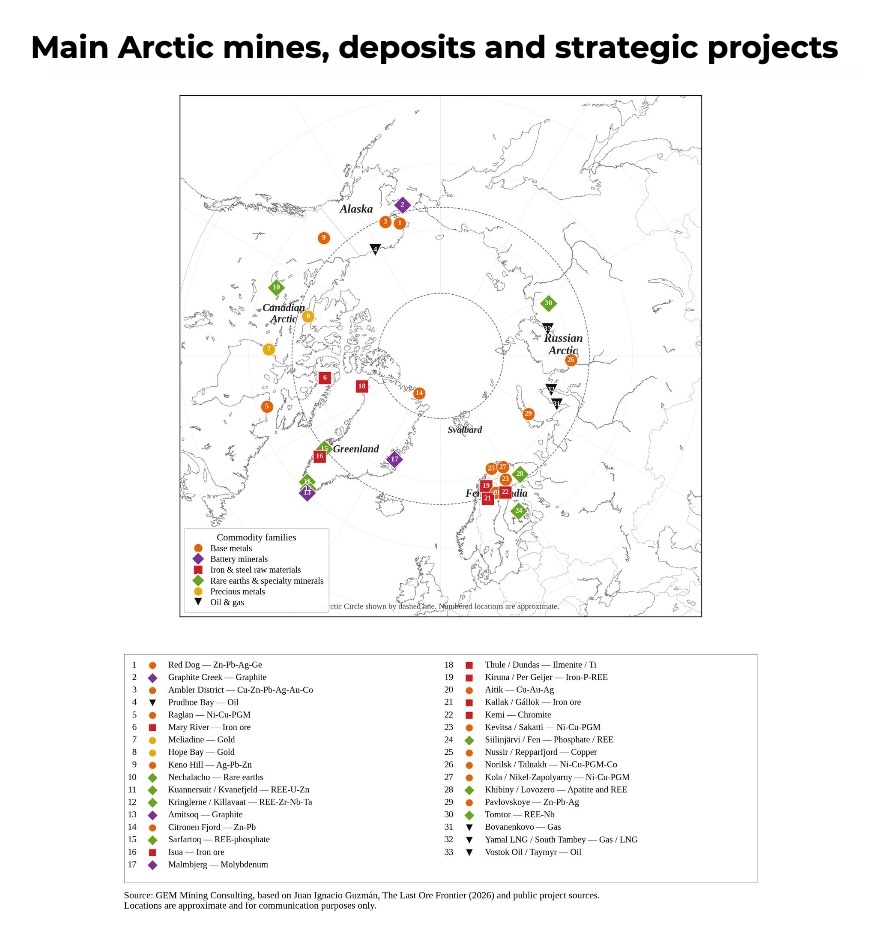
The Arctic’s vast copper, nickel, graphite and rare earth deposits will not by themselves secure the energy transition, as long, diesel-dependent supply chains, permafrost, short construction seasons and limited power grids can turn apparently robust orebodies into uneconomic projects. Juan Ignacio Guzmán of GEM Mining Consulting contrasts northern Scandinavia’s rail-linked, renewable-powered districts in Sweden, Finland and Norway with logistics‑constrained projects in northern Canada, Alaska and Greenland that still need ports, roads, processing plants and skilled workforces. He argues that Indigenous rights, rigorous baseline data on water, biodiversity and permafrost, and upfront closure planning now sit alongside grade and tonnage as decisive investment criteria.
Technical Brief
- Subsidies and “strategic” designations can lower financing costs but cannot offset structurally high unit operating costs.
- Indigenous governments are treated as rights holders, with benefit agreements negotiated before engineering is finalised.
- Baseline data on water quality, biodiversity, permafrost and wildlife is required pre‑development to de‑risk permitting and design.
- Closure planning, financial assurance and multi‑decade monitoring of waste and water systems must be embedded from concept stage.
Our Take
GEM Mining Consulting has recently framed Arctic and near-Arctic jurisdictions like Greenland as high execution-risk for critical minerals in its coverage of Energy Transition Minerals’ Kvanefjeld dispute, signalling that permitting and political stability may be a bigger bottleneck than geology for rare earths and uranium in the North.
In our database, GEM Mining Consulting’s District Potential Value Index work on copper, nickel and graphite districts suggests that integrated, infrastructure-rich belts in lower-latitude regions can often deliver battery metals faster and cheaper than isolated Arctic projects in Canada or northern Scandinavia.
The idling of Sherritt’s cobalt refinery in Canada, linked in another piece to US sanctions, underlines that even existing mid-latitude processing for cobalt and nickel is vulnerable to geopolitics, so relying on new Arctic upstream supply alone will not resolve security-of-supply issues for battery metals and critical minerals.
Prepared by collating external sources, AI-assisted tools, and Geomechanics.io’s proprietary mining database, then reviewed for technical accuracy & edited by our geotechnical team.
Related Articles


Related Industries & Products
Mining
Geotechnical software solutions for mining operations including CMRR analysis, hydrogeological testing, and data management.
Construction
Quality control software for construction companies with material testing, batch tracking, and compliance management.
CMRR-io
Streamline coal mine roof stability assessments with our cloud-based CMRR software featuring automated calculations, multi-scenario analysis, and collaborative workflows.
HYDROGEO-io
Comprehensive hydrogeological testing platform for managing, analysing, and reporting on packer tests, lugeon values, and hydraulic conductivity assessments.
GEODB-io
Centralised geotechnical data management solution for storing, accessing, and analysing all your site investigation and material testing data.