Geomechanics.io

  • Free Tools
Sign UpLog In
Built byBoxcut Studio

Geomechanics.io

Geomechanics, Streamlined.

© 2026 Geomechanics.io. All rights reserved.

Geomechanics.io

CMRR-ioGEODB-ioHYDROGEO-ioQCDB-ioFree Tools & CalculatorsBlogLatest Industry News

Industries

MiningConstructionTunnelling

Company

Terms of UsePrivacy PolicyLinkedIn
    Projects
    Product
    Sustainability
    Safety

    Weir’s sustainable mining flowsheets: HPGR design implications for engineers

    August 3, 2026|

    Reviewed by Joe Ashwell

    Weir’s sustainable mining flowsheets: HPGR design implications for engineers

    First reported on International Mining – News

    30 Second Briefing

    Weir is pushing “sustainability by design” in comminution and classification, using high‑pressure grinding rolls (HPGRs) and re‑engineered flowsheets to cut energy use and water demand while maintaining throughput. Regional Engineering Director EMEA Christian Stehle points to dry or low‑water circuits, advanced process control and digital twins to optimise mill and crusher performance in real time. For geotechnical and plant engineers, the shift towards HPGR‑centric, coarse‑particle and dry‑stack compatible circuits directly affects tailings design, water balances and plant layout.

    Technical Brief

    • Weir is aligning new equipment designs with miners’ ESG reporting frameworks, embedding energy and water KPIs.

    Our Take

    Weir’s sustainability messaging here aligns with recent coverage of its GEHO pumps for Lloyds Metals’ iron ore slurry pipeline in India, signalling a push to frame high-pressure transport and dewatering equipment as enablers of lower-footprint bulk materials handling rather than just reliability upgrades.

    Across our database, Weir appears more often in project-specific items like the Brightstar Resources Goldfields gold plant crushing circuit than in broad ESG features, suggesting this piece is part of a deliberate effort to reposition the company from a component supplier to a technology partner on ‘sustainable mining’ outcomes.

    Geotechnical Software for Modern Teams

    Centralise site data, logs, and lab results with GEODB-io, CMRR-io, and HYDROGEO-io.

    No credit card required.

    • Save and export unlimited calculations
    • Advanced data visualisation
    • Generate professional PDF reports
    • Cloud storage for all your projects

    Prepared by collating external sources, AI-assisted tools, and Geomechanics.io’s proprietary mining database, then reviewed for technical accuracy & edited by our geotechnical team.

    Related Articles

    McEwen’s $55M Ontario asset sale: production growth lens for mine planners
    Mining
    1 day ago

    McEwen’s $55M Ontario asset sale: production growth lens for mine planners

    McEwen has agreed to sell its Fuller and Paymaster gold properties in Ontario’s Timmins district to Discovery Mining for $55 million in cash and stock, freeing capital to push a production target of 250,000–300,000 gold-equivalent ounces per year by 2030. The deal covers 210 hectares at Fuller, a 60% stake in the 179-hectare Paymaster property, and associated surface rights, consolidating Paymaster under Discovery’s Dome Mine subsidiary. Proceeds will be reinvested into the Fox Complex (Froome, Stock, Grey Fox), Nevada’s Gold Bar Complex, and Mexico’s El Gallo build, with Stock Mine slated for first ore in Q4 2026 and commercial output in Q1 2027.

    Lithium Triangle extraction hurdles: hydrogeological insights for project teams
    Mining
    1 day ago

    Lithium Triangle extraction hurdles: hydrogeological insights for project teams

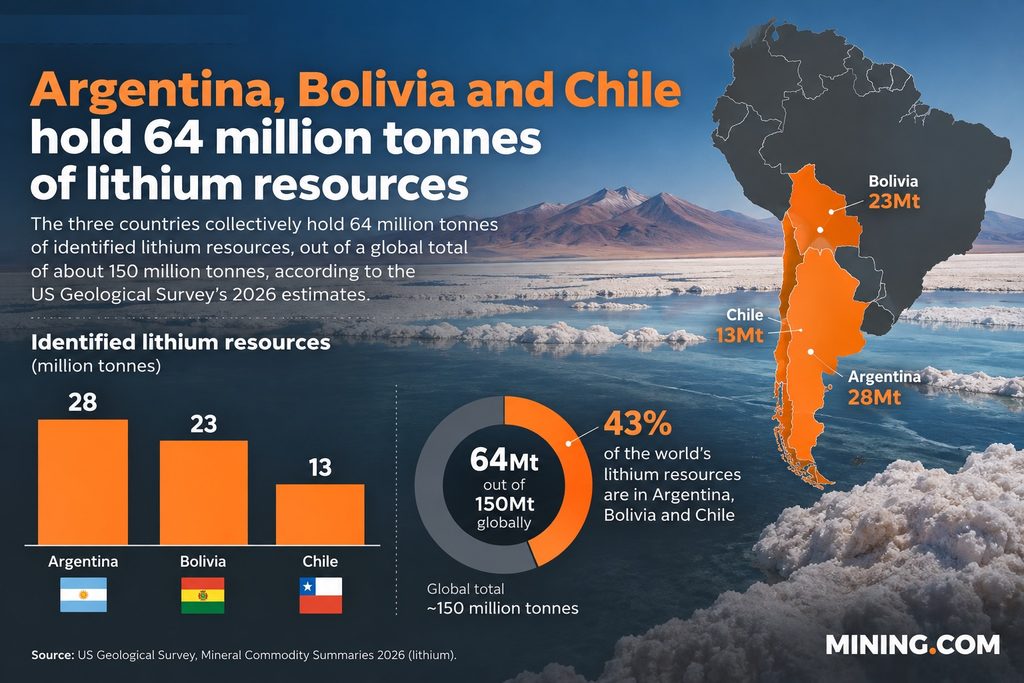
    South America’s Lithium Triangle holds about 64 million tonnes of identified lithium resources (43% of the global 150 million tonnes), yet geologist José Cabello’s review of 43 salt flats across Argentina, Bolivia and Chile shows that variable brine chemistry, impurities and groundwater behaviour make recovery and costs highly site-specific. Salar de Atacama benefits from ultra‑dry climate, relatively clean brines and strong logistics, while other basins such as Altoandinos, Pedernales, Hombre Muerto Oeste, Rincón, Sal de los Ángeles and Sal de Vida face tighter water and hydrogeological constraints. Direct lithium extraction (DLE) could unlock lower‑grade or impurity‑rich brines, but Cabello stresses that trade‑offs between brine withdrawal and freshwater consumption mean technology selection must be tailored to each basin’s hydrology and ecosystem.

    KGHM’s $2.4bn copper projects fast-tracked: CRMA implications for mine planners
    Mining
    1 day ago

    KGHM’s $2.4bn copper projects fast-tracked: CRMA implications for mine planners

    EU regulators have granted strategic status under the Critical Raw Materials Act to KGHM’s 9.5‑billion‑zloty ($2.44bn) Retków‑Grodziszcze mine and Legnica smelter conversion, unlocking faster permitting, streamlined administration and access to preferential financing. Retków‑Grodziszcze is planned to deliver over 100 million tonnes of ore by 2055, yielding about 1.5 million tonnes of copper and 5,000 tonnes of silver, while Legnica’s recycling line targets 135,000 tonnes of electrolytic copper and 250 tonnes of nickel per year. The move materially boosts EU copper and nickel recycling capacity, central to the CRMA’s 25% recycling target.

    Related Industries & Products

    Mining

    Geotechnical software solutions for mining operations including CMRR analysis, hydrogeological testing, and data management.

    CMRR-io

    Streamline coal mine roof stability assessments with our cloud-based CMRR software featuring automated calculations, multi-scenario analysis, and collaborative workflows.

    HYDROGEO-io

    Comprehensive hydrogeological testing platform for managing, analysing, and reporting on packer tests, lugeon values, and hydraulic conductivity assessments.

    GEODB-io

    Centralised geotechnical data management solution for storing, accessing, and analysing all your site investigation and material testing data.

    AllGeotechnicalInfrastructureHazardsEnvironmental