Lithium Triangle extraction hurdles: hydrogeological insights for project teams
Reviewed by Joe Ashwell
First reported on MINING.com
30 Second Briefing
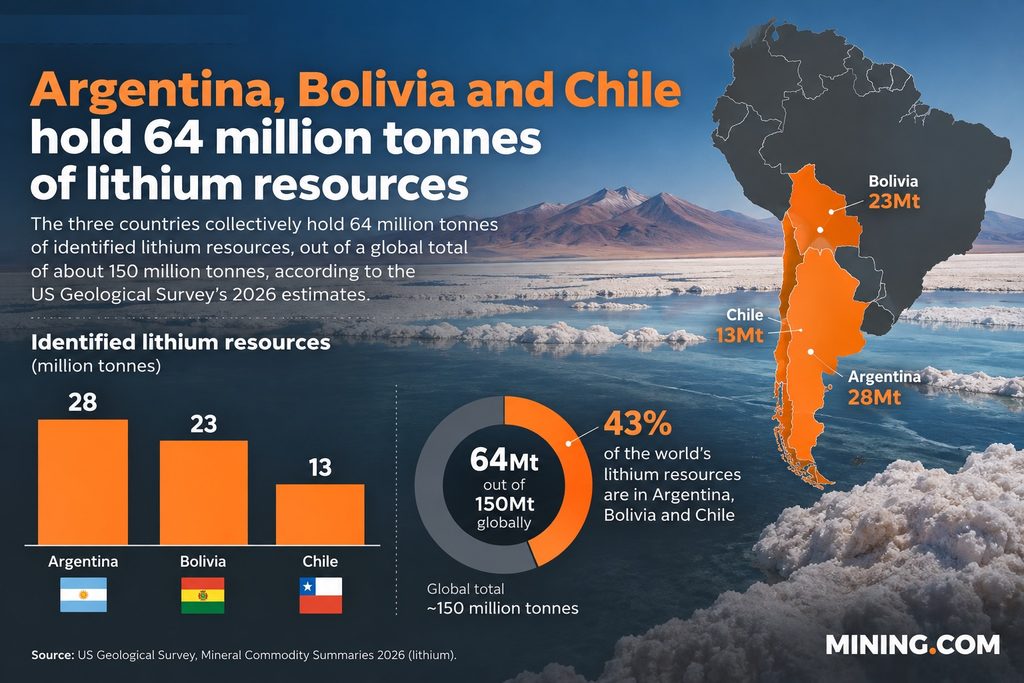
South America’s Lithium Triangle holds about 64 million tonnes of identified lithium resources (43% of the global 150 million tonnes), yet geologist José Cabello’s review of 43 salt flats across Argentina, Bolivia and Chile shows that variable brine chemistry, impurities and groundwater behaviour make recovery and costs highly site-specific. Salar de Atacama benefits from ultra‑dry climate, relatively clean brines and strong logistics, while other basins such as Altoandinos, Pedernales, Hombre Muerto Oeste, Rincón, Sal de los Ángeles and Sal de Vida face tighter water and hydrogeological constraints. Direct lithium extraction (DLE) could unlock lower‑grade or impurity‑rich brines, but Cabello stresses that trade‑offs between brine withdrawal and freshwater consumption mean technology selection must be tailored to each basin’s hydrology and ecosystem.
Technical Brief
- Cabello’s compilation reports >16 Mt contained lithium in Argentina and Chile, based on individual deposits.
- The review covers 43 evaluated salars within a wider population of ~130 Central Andean salt flats and lagoons.
- Contained lithium figures are distinguished from lithium carbonate equivalent, affecting direct comparison with project announcements and feasibility metrics.
- Resources are separated from reserves, stressing that only reserves reflect economically recoverable tonnages under defined operating conditions.
- Argentina and Chile jointly produced ~79,000 t lithium in 2025, ~27% of global mine output per USGS 2026.
- Brine systems are described as mobile groundwater bodies, complicating sampling strategies, resource estimation and prediction of drawdown impacts.
- Direct lithium extraction options are framed around trade-offs between brine withdrawal volumes and freshwater consumption, not just recovery efficiency.
- Research methods combine peer‑reviewed work, company disclosures and government datasets, while deliberately excluding inferred resources from the compiled totals.
- Suggested follow‑up work includes detailed assessment of individual salars and remote sensing to locate smaller closed basins with lithium potential.
Our Take
Our database shows multiple recent copper‑market pieces, including China’s push to expand strategic copper reserves and LME copper stocks hitting a six‑week low, which underscores that Central Andean brines containing both lithium and copper could become more attractive targets for integrated critical‑minerals strategies if extraction hurdles are solved.
Prepared by collating external sources, AI-assisted tools, and Geomechanics.io’s proprietary mining database, then reviewed for technical accuracy & edited by our geotechnical team.
Related Articles


Related Industries & Products
Mining
Geotechnical software solutions for mining operations including CMRR analysis, hydrogeological testing, and data management.
CMRR-io
Streamline coal mine roof stability assessments with our cloud-based CMRR software featuring automated calculations, multi-scenario analysis, and collaborative workflows.
HYDROGEO-io
Comprehensive hydrogeological testing platform for managing, analysing, and reporting on packer tests, lugeon values, and hydraulic conductivity assessments.
GEODB-io
Centralised geotechnical data management solution for storing, accessing, and analysing all your site investigation and material testing data.