Uranium market gathers momentum in 2026: Sprott’s supply and project lens for engineers
Reviewed by Tom Sullivan
First reported on MINING.com
30 Second Briefing
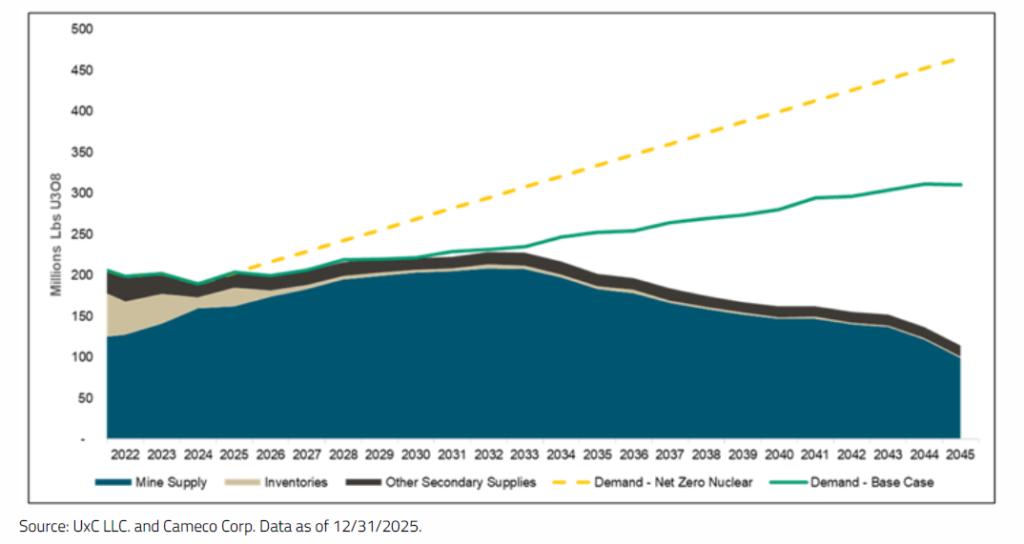
Uranium spot prices jumped about 25% in January to above US$100/lb, with Sprott’s Jacob White arguing that policy shifts such as the Trump administration’s Section 232 critical minerals framework and a US ambition to quadruple nuclear capacity by 2050 are pulling investor focus back to upstream supply. Sprott has added 4 million lb to its uranium fund in 2026, taking holdings to nearly 79 million lb, while Kazakhstan’s tighter exploration controls and Kazatomprom’s warning that current prices do not justify new production signal constrained future output. With utility fuel contracting undershooting replacement needs for a 13th consecutive year in 2025, Sprott sees 2026 procurement decisions as critical for early‑2030s mine development and pricing.
Technical Brief
- January’s ~25% spot price jump took uranium above US$100/lb for the first time since 2024.
- Sprott’s physical uranium fund bought 4 Mlb in early 2026, lifting holdings to nearly 79 Mlb.
- Price path in 2025 was highly volatile, dropping to low US$60s then rebounding to high US$80s.
- US Section 232 critical minerals framework explicitly designates uranium as strategic for energy and national security.
- Washington’s US$2.7 billion, 10‑year programme targets expansion of domestic uranium enrichment capacity, not just mining.
- Kazakhstan tightened uranium exploration controls in December 2025, adding regulatory friction to the world’s largest supply base.
- Kazatomprom states current pricing does not meet its hurdle rates for sanctioning new uranium production capacity.
- Sprott links future uranium demand growth partly to power requirements from AI data centre build‑out, not only reactors.
Our Take
The rapid lift in Sprott Physical Uranium Trust holdings from about 74.9 million lb in early January to roughly 79 million lb now, as seen across our recent uranium coverage, signals that financial buyers are absorbing a meaningful slice of spot supply just as utilities face tighter primary output from Kazakhstan and elsewhere.
US ambitions to quadruple nuclear capacity by 2050 and have 10 new large reactors under construction by 2030, alongside Meta’s multi‑GW nuclear power deals reported in January, suggest that US utilities and data‑centre operators could become structurally more exposed to uranium price spikes above US$100/lb unless long‑term contracting accelerates.
Black Pine’s large but low‑grade gold resource in the western US sits within a wider Sprott narrative that bundles gold with uranium and other critical minerals as ‘hard assets’, implying that project financing conditions for such bulk‑tonnage gold systems may benefit indirectly from the same macro flows currently driving uranium funds higher.
Prepared by collating external sources, AI-assisted tools, and Geomechanics.io’s proprietary mining database, then reviewed for technical accuracy & edited by our geotechnical team.
Related Articles


Related Industries & Products
Mining
Geotechnical software solutions for mining operations including CMRR analysis, hydrogeological testing, and data management.
Construction
Quality control software for construction companies with material testing, batch tracking, and compliance management.
CMRR-io
Streamline coal mine roof stability assessments with our cloud-based CMRR software featuring automated calculations, multi-scenario analysis, and collaborative workflows.
HYDROGEO-io
Comprehensive hydrogeological testing platform for managing, analysing, and reporting on packer tests, lugeon values, and hydraulic conductivity assessments.
GEODB-io
Centralised geotechnical data management solution for storing, accessing, and analysing all your site investigation and material testing data.