Geomechanics.io

  • Free Tools
Sign UpLog In

Geomechanics.io

Geomechanics, Streamlined.

© 2026 Geomechanics.io. All rights reserved.

Geomechanics.io

CMRR-ioGEODB-ioHYDROGEO-ioQCDB-ioFree Tools & CalculatorsBlogLatest Industry News

Industries

MiningConstructionTunnelling

Company

Terms of UsePrivacy PolicyLinkedIn
    Projects
    Safety

    Tenby station bridge works: constructability and access notes for civil engineers

    July 3, 2026|

    Reviewed by Tom Sullivan

    Tenby station bridge works: constructability and access notes for civil engineers

    First reported on New Civil Engineer

    30 Second Briefing

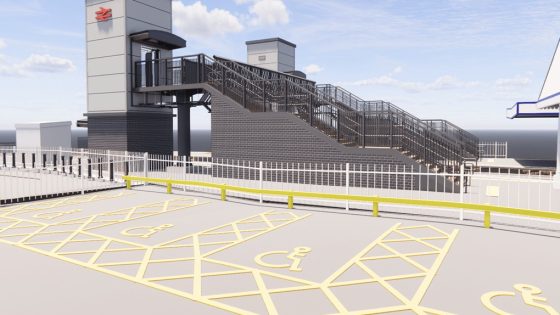
    Network Rail engineers have started installing sections of a new pedestrian bridge at Tenby railway station in Pembrokeshire as part of a major accessibility upgrade. The scheme is expected to deliver step-free access between platforms, likely involving new lifts and compliant ramp gradients to meet modern PRM-TSI and Building Regulations standards. For civil and structural teams, key issues will include working within the constrained historic station footprint, maintaining rail operations during possession windows, and managing foundations close to existing track and platform structures.

    Technical Brief

    • Construction is sequenced under rail possession regimes, constraining heavy lifting and hot works to tightly controlled windows.
    • Temporary works must maintain safe egress routes from both platforms at all times during bridge installation.
    • Lift shaft and stair core foundations are being formed immediately adjacent to live track, driving stringent exclusion zones and plant slew restrictions.
    • Interface management with existing platform edges and coping stones is critical to avoid creating new trip or stepping hazards.
    • Lessons on segregated work zones, passenger wayfinding during phased closures, and emergency access routing are directly transferable to similar brownfield station upgrades.

    Our Take

    Network Rail features frequently in recent Infrastructure and Safety coverage in our database, including near-miss incidents investigated by the Rail Accident Investigation Branch, which suggests that visible upgrades like the Tenby railway station bridge are being delivered in parallel with a tighter focus on workforce and passenger protection.

    The same period has seen Network Rail dealing with geotechnical and structural issues such as sinkholes on a bridge near Purley and commissioning £40M of Eastern Region Assessment Contracts with Amey, indicating that localised renewals at Tenby sit within a wider national push to get ahead of ageing-asset risks.

    With Ramboll and other consultants now on the UK government’s £3.5bn CPS 2 framework, which lists Network Rail as a key client, future phases of work at smaller stations like Tenby in Pembrokeshire are likely to draw more on centralised design and assurance capacity rather than purely route-level engineering teams.

    Geotechnical Software for Modern Teams

    Centralise site data, logs, and lab results with GEODB-io, CMRR-io, and HYDROGEO-io.

    No credit card required.

    • Save and export unlimited calculations
    • Advanced data visualisation
    • Generate professional PDF reports
    • Cloud storage for all your projects

    Prepared by collating external sources, AI-assisted tools, and Geomechanics.io’s proprietary mining database, then reviewed for technical accuracy & edited by our geotechnical team.

    Related Articles

    Strabag’s Pfaffensteig Tunnel contract: design and delivery notes for rail engineers
    Infrastructure
    about 2 months ago

    Strabag’s Pfaffensteig Tunnel contract: design and delivery notes for rail engineers

    Strabag and Group company Züblin have secured the design-and-build structural works for the ABS Gäubahn Nord/Pfaffensteig Tunnel in south-west Germany, centred on an 11km twin-bore rail tunnel linking Stuttgart Airport station directly to the Gäubahn line towards Switzerland. About 9.8km will be driven by two TBMs, with conventional tunnelling for the A8 motorway undercrossing and airport connection, plus a 240m cut-and-cover section, retaining structures, railway underpasses and a grade-separated crossing. A 3km surface section will be upgraded and partially realigned for 200km/h operation, delivered under an integrated project delivery model with Ed. Züblin, Wayss & Freytag and Strabag AG sharing tunnelling, structural and earthworks packages.

    National Grid TBM under the Thames: tunnelling design and risk notes for engineers
    Infrastructure
    4 months ago

    National Grid TBM under the Thames: tunnelling design and risk notes for engineers

    A 271.5‑tonne Herrenknecht Mixshield TBM, Caroline, has started driving a 2.2km electricity cable tunnel with a 4m internal diameter beneath the River Thames in Essex for National Grid’s Grain to Tilbury project, delivered by the Ferrovial BEMO joint venture. The drive will pass through variable Thames estuary ground conditions between 35m‑deep launch and reception shafts of 15m and 12m diameter, with tunnelling continuing into 2026 and overall scheme completion targeted for 2029. The new tunnel will replace the 1969 Thames Cable Tunnel and carry new high‑voltage circuits between Grain and Tilbury substations.

    Panama Canal Mixshield undercrossing: design and tunnelling lessons for engineers
    Infrastructure
    5 months ago

    Panama Canal Mixshield undercrossing: design and tunnelling lessons for engineers

    A 13.46m diameter Herrenknecht Mixshield TBM has broken through into the future Balboa station on Panama Metro Line 3 after completing the first-ever TBM undercrossing of the Panama Canal at depths exceeding 60m below sea level. The 5,600kW, 26,616kNm machine, fitted with an accessible cutterhead and more than 4,500 sensors linked via the Herrenknecht.Connected platform, has achieved peak advance of 150 segment rings (about 300m) per month through mixed sandstone, tuff, breccias and basalt. Around 1.5km of the 4.5km twin-track tunnel remains to final breakthrough.

    Related Industries & Products

    Construction

    Quality control software for construction companies with material testing, batch tracking, and compliance management.

    Mining

    Geotechnical software solutions for mining operations including CMRR analysis, hydrogeological testing, and data management.

    QCDB-io

    Comprehensive quality control database for manufacturing, tunnelling, and civil construction with UCS testing, PSD analysis, and grout mix design management.

    AllGeotechnicalMiningInfrastructureMaterialsHazardsEnvironmentalSoftwarePolicy