Geomechanics.io

  • Free Tools
Sign UpLog In
AllGeotechnicalMiningInfrastructureMaterialsHazardsEnvironmentalSoftwarePolicy

Geomechanics.io

Geomechanics, Streamlined.

© 2026 Geomechanics.io. All rights reserved.

Geomechanics.io

CMRR-ioGEODB-ioHYDROGEO-ioQCDB-ioFree Tools & CalculatorsBlogLatest Industry News

Industries

MiningConstructionTunnelling

Company

Terms of UsePrivacy PolicyLinkedIn
    Projects
    Sustainability

    Steel tariffs and quotas: cost and risk implications for UK project teams

    March 20, 2026|

    Reviewed by Joe Ashwell

    Steel tariffs and quotas: cost and risk implications for UK project teams

    First reported on The Construction Index

    30 Second Briefing

    Steel import quotas will be cut by 60% from 1 July 2026, with any volumes above the new limits facing a 50% tariff, as the UK government seeks to lift domestic steel’s share of national demand from 30% to 50%. While producers such as 7 Steel UK back the move as support for “high quality, low carbon” UK output, the British Constructional Steelwork Association warns it will raise input prices for fabricators and frame contractors. Chief executive Jonathan Clemens predicts higher costs on government and private projects, tighter margins for downstream steelwork firms already hit by volatile energy prices, and potential job losses.

    Technical Brief

    • Any steel imported above the reduced quotas will attract a 50% duty at the UK border.
    • Downstream fabrication and erection firms already exposed to volatile, “extortionate” energy prices face further margin compression.
    • BCSA links higher steel prices to potential job losses in constructional steelwork and fabrication workshops.
    • Policy tension identified between “sovereign capability” rhetoric and absence of binding local-procurement requirements along the full supply chain.

    Our Take

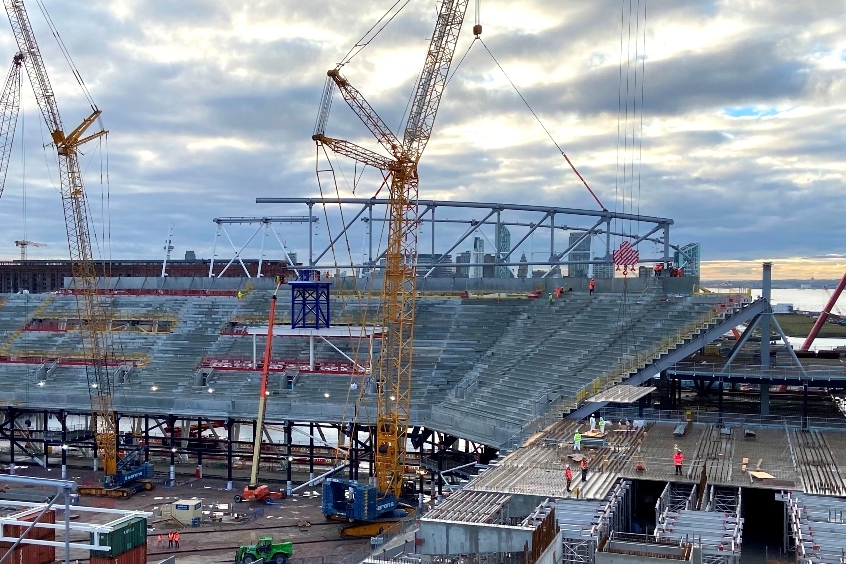
    The 50% above-quota tariff from July 2026 will make long-term pricing for projects like Everton FC’s new Hill Dickinson Stadium more sensitive to procurement timing and origin, pushing contractors towards earlier steel package locking and potentially more framework agreements with UK mills such as Tata Steel and Celsa Steel.

    Geotechnical Software for Modern Teams

    Centralise site data, logs, and lab results with GEODB-io, CMRR-io, and HYDROGEO-io.

    No credit card required.

    • Save and export unlimited calculations
    • Advanced data visualisation
    • Generate professional PDF reports
    • Cloud storage for all your projects

    Prepared by collating external sources, AI-assisted tools, and Geomechanics.io’s proprietary mining database, then reviewed for technical accuracy & edited by our geotechnical team.

    Related Articles
    US rare earth strategy shift: processing, price floors and risk for project teams
    Policy
    about 16 hours ago

    US rare earth strategy shift: processing, price floors and risk for project teams

    US rare earth strategy is shifting from securing ore to controlling processing, with Aclara Resources’ Virginia Tech pilot and planned Louisiana separation plant illustrating a policy pivot towards domestic heavy rare earth separation for dysprosium and terbium used in EVs, wind and defence. Patricio Faúndez, economics leader at GEM Mining Consulting, notes Washington is now deploying price floors, equity stakes and long-term offtakes—tools long associated with China—to de-risk capital-intensive plants. The emerging model favours allied feedstock plus US-based processing, redistributing supply risk across jurisdictions rather than eliminating it.

    HBF calls for BNG reforms: planning and viability impacts for project teams
    Policy
    about 19 hours ago

    HBF calls for BNG reforms: planning and viability impacts for project teams

    Difficulties implementing mandatory Biodiversity Net Gain (BNG) are slowing housing projects, with a Home Builders Federation survey of 80 firms finding 84% still struggle with BNG and 80% reporting planning delays while local authorities review biodiversity assessments. Sixty per cent said BNG has deterred them from pursuing sites that would previously have been viable, citing policy uncertainty, inconsistent application of requirements and cumulative regulatory cost. Some capacity issues are easing, with reported shortages of in-house expertise down from 79% to 66% and adequate off-site biodiversity unit supply up from 31% to 47%.

    WA fuel supply transparency: risk and contingency notes for mine planners
    Policy
    1 day ago

    WA fuel supply transparency: risk and contingency notes for mine planners

    Western Australia is moving to tighten transparency across its diesel and fuel supply chain to protect mine productivity, with new reporting obligations on wholesalers and critical infrastructure operators after recent shipping disruptions and refinery closures. The measures focus on real‑time visibility of stock levels, import routes and storage at key hubs such as Kwinana and Port Hedland, aiming to reduce unplanned shutdown risk for large open‑pit iron ore and gold operations that rely on continuous haul‑truck and power‑generation fuel. For mine planners and operators, the changes signal closer scrutiny of fuel contingency planning, on‑site storage capacity and contract diversification.

    Related Industries & Products

    Construction

    Quality control software for construction companies with material testing, batch tracking, and compliance management.

    Mining

    Geotechnical software solutions for mining operations including CMRR analysis, hydrogeological testing, and data management.

    QCDB-io

    Comprehensive quality control database for manufacturing, tunnelling, and civil construction with UCS testing, PSD analysis, and grout mix design management.