Geomechanics.io

  • Free Tools
Sign UpLog In
AllGeotechnicalMiningInfrastructureMaterialsHazardsEnvironmentalSoftwarePolicy

Geomechanics.io

Geomechanics, Streamlined.

© 2026 Geomechanics.io. All rights reserved.

Geomechanics.io

CMRR-ioGEODB-ioHYDROGEO-ioQCDB-ioFree Tools & CalculatorsBlogLatest Industry News

Industries

MiningConstructionTunnelling

Company

Terms of UsePrivacy PolicyLinkedIn
    Projects

    Silver price slide on index rebalancing: planning signals for mine projects

    January 8, 2026|

    Reviewed by Tom Sullivan

    Silver price slide on index rebalancing: planning signals for mine projects

    First reported on MINING.com

    30 Second Briefing

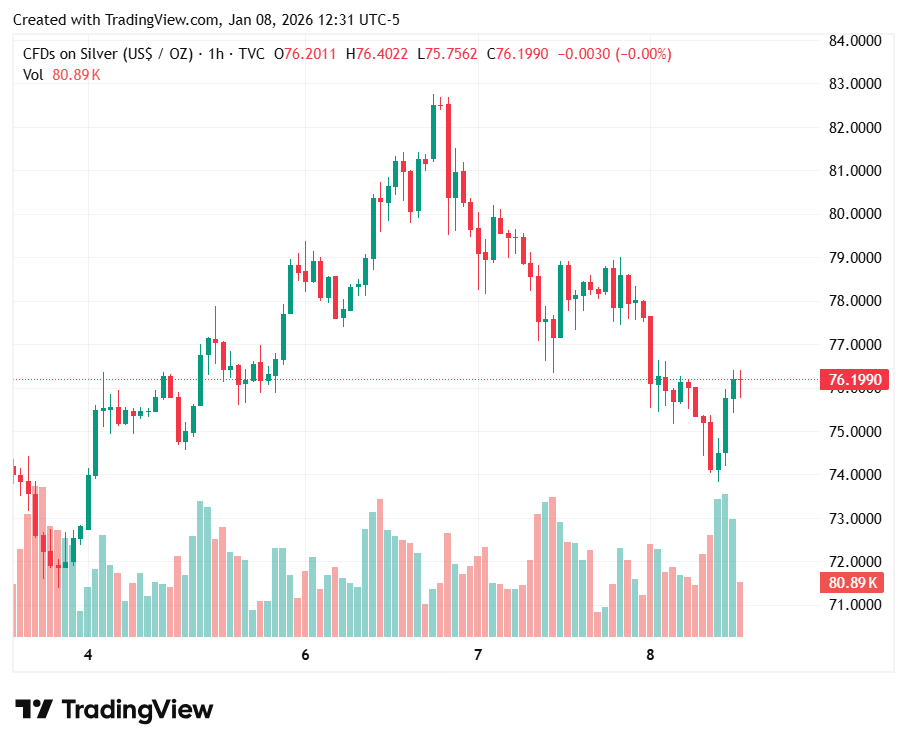
    Silver prices fell as much as 5% to $73.91/oz on Thursday, extending a 4% drop from the previous session after briefly breaking above $80/oz earlier in the week, as funds positioned for annual commodity index rebalancing. Citigroup estimates around $6.8 billion of silver futures – roughly 12% of Comex open interest – may be sold, with silver-backed ETFs already recording their largest one-day outflow since October. Despite the volatility and outsized index impact on silver versus gold, major banks remain bullish, with HSBC projecting gold at $5,000/oz in H1 2026 amid geopolitical risk and fiscal strain.

    Technical Brief

    • Citigroup forecasts silver futures selling equivalent to about 12% of total Comex open interest.
    • JPMorgan notes last year’s similar index-driven precious metals selloff produced no clear long-term market drag.
    • Silver-backed ETFs recorded their largest single-day outflow since October on the Wednesday before the slide.
    • Citi strategist Kenny Hu reports current silver flows are materially larger than any seen in prior rebalances.
    • Silver’s 150% annual gain was amplified by a historic short squeeze in October 2025.
    • Gold logged its strongest annual performance since 1979, with 50 separate record highs during 2025.
    • Central bank buying, ETF inflows and a weaker US dollar collectively underpinned gold’s 2025 price strength.
    • HSBC’s James Steel links his $5,000/oz gold call to escalating geopolitical risks and rising sovereign fiscal debts.

    Our Take

    The $6.8 billion in silver futures selling tied to Comex index rebalancing is unusually large relative to our recent silver coverage, and is likely to amplify short-term volatility well beyond what underlying mine supply–demand fundamentals would justify for producers and developers.

    In our database, most recent silver-tagged pieces have been framed against gold’s strength, and the same pattern appears here: gold’s record-high profile since 1979 means silver miners may face more erratic capital flows as generalist investors rotate between the two metals rather than allocate steadily to silver-specific stories.

    Mercuria and Glencore both feature across recent copper and silver coverage, and their trading and financing roles (including Mercuria’s $1.2 billion lending for a Kazakh deal) suggest that large merchants’ positioning in futures and physical markets will be a key secondary driver of realised prices for silver-linked project economics into the first half of 2026.

    Geotechnical Software for Modern Teams

    Centralise site data, logs, and lab results with GEODB-io, CMRR-io, and HYDROGEO-io.

    No credit card required.

    • Save and export unlimited calculations
    • Advanced data visualisation
    • Generate professional PDF reports
    • Cloud storage for all your projects

    Prepared by collating external sources, AI-assisted tools, and Geomechanics.io’s proprietary mining database, then reviewed for technical accuracy & edited by our geotechnical team.

    Related Articles

    Meta and Sprott in nuclear revival: demand signals and risks for uranium projects
    Mining
    44 minutes ago

    Meta and Sprott in nuclear revival: demand signals and risks for uranium projects

    Meta has signed nuclear power deals with Vistra, TerraPower and Oklo for up to 6.6 GW of capacity by 2035 to run its US data centres and the Prometheus AI supercluster in Ohio, adding to a 20‑year, 1.12 GW offtake from Constellation’s Clinton plant. In parallel, the Sprott Physical Uranium Trust has bought 300,000 lb of U₃O₈ in a week, lifting holdings to about 75.2 million lb worth US$6.17 billion, as spot prices hover around US$82/lb. For miners and project developers, this combination of long‑term nuclear PPAs and aggressive physical uranium accumulation signals firmer demand visibility despite persistent SMR cost and schedule risk.

    Mining
    about 12 hours ago

    Derrick Experience Center: fine screening test gains and risks for plant engineers

    Derrick Corporation has opened its Derrick Experience Center (DEX Center) in January 2026 to mark its 75th anniversary, creating a dedicated test hub for advanced fine screening technology. The “first-of-its-kind” facility is designed for current and prospective customers to run full-scale trials on Derrick high-frequency screens and Polyweb® urethane panels under controlled conditions, rather than relying solely on on-site pilots. The centre is intended to shorten test campaigns, de-risk screen selection, and optimise cut size and throughput for fine coal, iron ore, base metals and industrial minerals circuits.

    University of Arizona mine waste project: key processing insights for engineers
    Mining
    1 day ago

    University of Arizona mine waste project: key processing insights for engineers

    A $3.6 million Arbor-funded University of Arizona Tailings Center project, led by mining engineer Dr Isabel Barton, is evaluating whether 17.5 billion tons of historic copper tailings in Arizona—growing by ~100 million tonnes per year—can be reprocessed to recover critical minerals and reduce environmental risk. The team is combining statewide and UAV-based remote sensing, industry tailings datasets, drilling and surface sampling, mineralogical characterisation and techno-economic analysis using magnetic separation and basic leaching. Early work has identified unexpected mineral occurrences, including arsenic, zinc and possibly tungsten, which could justify flowsheet changes to keep these elements out of future tailings.

    Related Industries & Products

    Mining

    Geotechnical software solutions for mining operations including CMRR analysis, hydrogeological testing, and data management.

    CMRR-io

    Streamline coal mine roof stability assessments with our cloud-based CMRR software featuring automated calculations, multi-scenario analysis, and collaborative workflows.

    HYDROGEO-io

    Comprehensive hydrogeological testing platform for managing, analysing, and reporting on packer tests, lugeon values, and hydraulic conductivity assessments.

    GEODB-io

    Centralised geotechnical data management solution for storing, accessing, and analysing all your site investigation and material testing data.