Second HPC reactor arrives: schedule, constructability and logistics lens
Reviewed by Tom Sullivan
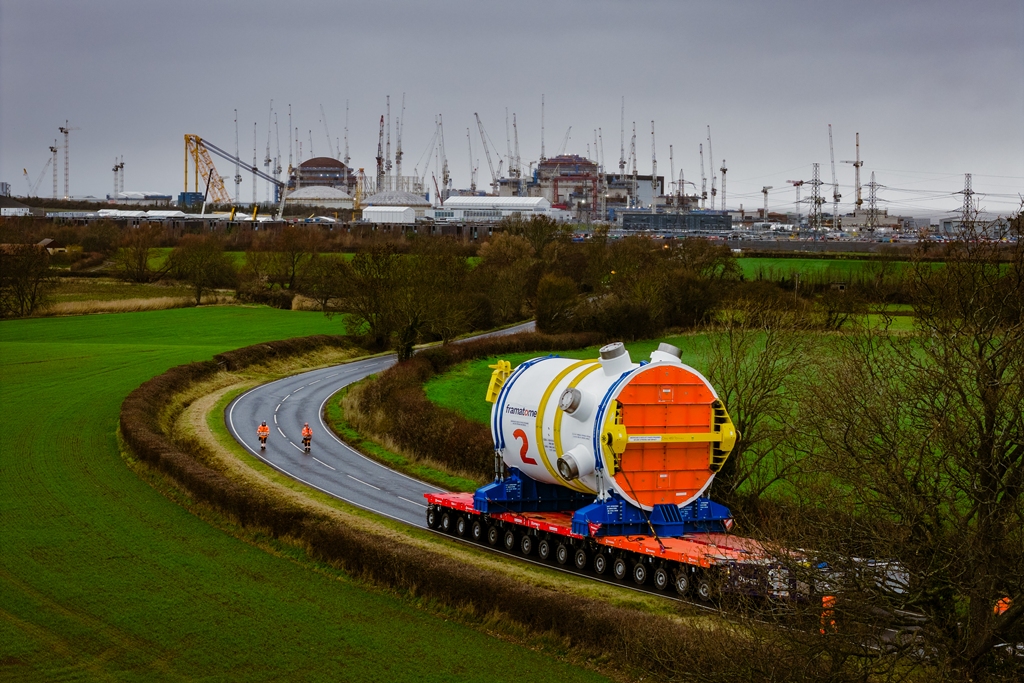
First reported on The Construction Index
30 Second Briefing
Delivery of Hinkley Point C’s second reactor pressure vessel marks a key milestone for Unit 2, with the 500‑tonne, 13‑metre‑long high‑strength steel cylinder shipped from Framatome’s Saint Marcel plant via Avonmouth and Combwich Wharf before a six‑hour, four‑mile heavy road move to site. Unit 1’s vessel, installed and welded in 2023, is now followed by intensive fit‑out of pipes, cables and equipment, while Unit 2 work centres on building completion after last July’s dome lift. EDF now expects Unit 1 to start generating in 2029–30, with Unit 2 a couple of years later, aided by 25% faster construction and about 60% prefabrication.
Technical Brief
- Reactor pressure vessel is a 500‑tonne, 13‑metre‑long high‑strength steel cylinder for Unit 2.
- Component was fabricated at Framatome’s Saint Marcel factory in France before UK transport logistics.
- Sea leg used Avonmouth Docks to Combwich Wharf barge transfer on the River Parrett.
- Final heavy haul was a six‑hour, four‑mile move by specialised multi-axle transporter.
- Unit 1’s identical vessel is already installed and fully welded in place on Unit 1 of the power station.
- Original Unit 1 generation date slipped from 2025 to 2027, now expected to be operation in 2029–30.
- Unit 2 completion is now planned roughly “a couple of years” after Unit 1’s operation date.
- Construction teams report Unit 2 build about 25% more quickly than Unit 1, with prefabrication now approaching 60%.
Our Take
The 25% faster build rate and roughly 60% prefabrication on Hinkley Point C Unit 2 signal that UK nuclear delivery is starting to capture learning-curve efficiencies, which will be closely watched as a benchmark for Sizewell C and any future EPR deployments.
Moving 500‑tonne, 13 m reactor pressure vessels via Avonmouth Docks and Combwich Wharf underlines how critical specialist port and heavy‑haul logistics are for large UK infrastructure; in our database, only a handful of Infrastructure pieces involve comparable abnormal load constraints.
The slip from the original 2025 generation target for Unit 1 to a 2027 reset, with talk of 2029–2030, puts schedule pressure on UK decarbonisation planning, likely increasing the system value of life‑extension and grid‑scale storage projects that appear elsewhere in recent Infrastructure coverage.
Prepared by collating external sources, AI-assisted tools, and Geomechanics.io’s proprietary mining database, then reviewed for technical accuracy & edited by our geotechnical team.
Related Articles


Related Industries & Products
Construction
Quality control software for construction companies with material testing, batch tracking, and compliance management.
Mining
Geotechnical software solutions for mining operations including CMRR analysis, hydrogeological testing, and data management.
QCDB-io
Comprehensive quality control database for manufacturing, tunnelling, and civil construction with UCS testing, PSD analysis, and grout mix design management.