Geomechanics.io

  • Free Tools
Sign UpLog In

Geomechanics.io

Geomechanics, Streamlined.

© 2026 Geomechanics.io. All rights reserved.

Geomechanics.io

CMRR-ioGEODB-ioHYDROGEO-ioQCDB-ioFree Tools & CalculatorsBlogLatest Industry News

Industries

MiningConstructionTunnelling

Company

Terms of UsePrivacy PolicyLinkedIn
    AllGeotechnicalMiningInfrastructureMaterialsHazardsEnvironmentalSoftwarePolicy
    Op-Ed
    Safety

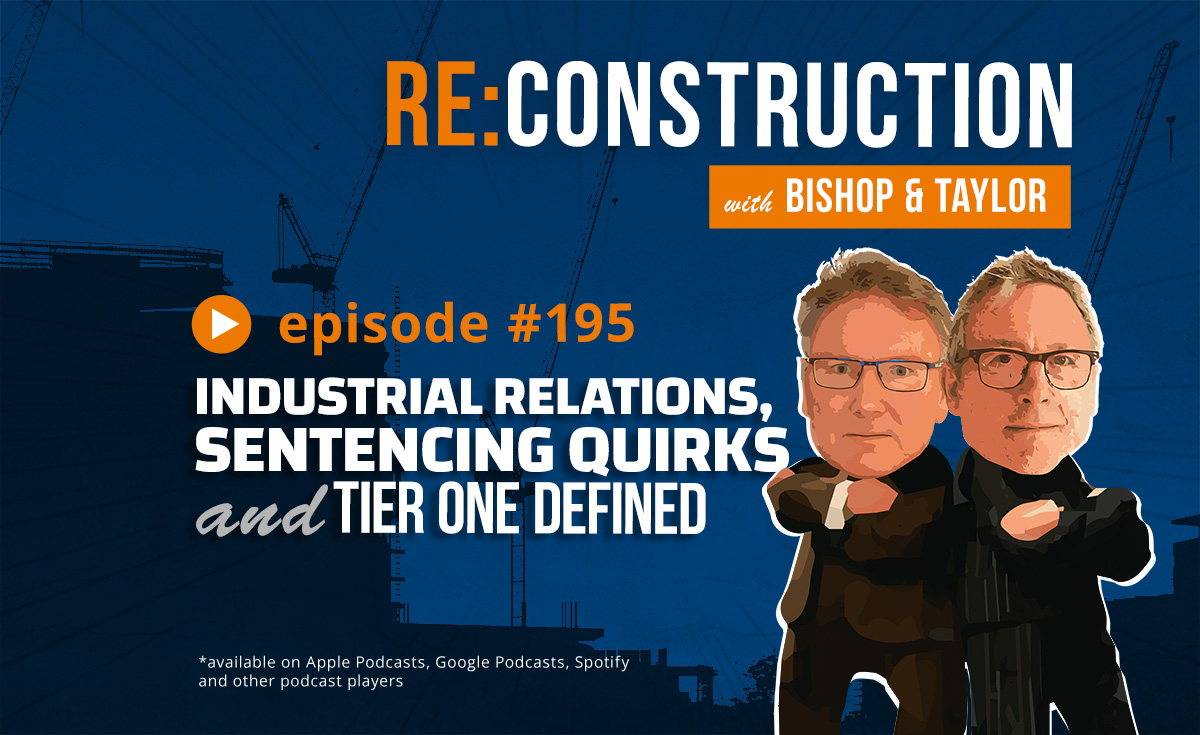
    Re:Construction podcast Episode 195: labour, safety sentencing and Tier One risk insights

    February 4, 2026|

    Reviewed by Joe Ashwell

    Re:Construction podcast Episode 195: labour, safety sentencing and Tier One risk insights

    First reported on The Construction Index

    30 Second Briefing

    Industrial relations in UK construction are under scrutiny as Bishop & Taylor examine current disputes, bargaining structures and how site-level behaviour is shaped by national agreements. The podcast also questions the consistency of health and safety sentencing, comparing penalties for similar breaches under the Sentencing Council’s guidelines and their impact on contractor risk management. A detailed discussion of what constitutes a “Tier One contractor” explores turnover thresholds, direct delivery capability and how these definitions affect framework eligibility and supply chain structuring.

    Technical Brief

    • Episode 195 is framed explicitly around health & safety sentencing rationality under current UK guidelines.
    • Discussion centres on how Sentencing Council guidance is applied to construction-site safety breaches in practice.
    • Bishop & Taylor examine disparity between fines and custodial sentences for ostensibly comparable duty-of-care failures.
    • They question how turnover-based fine calculations interact with contractors’ risk appetite on complex, hazardous works.
    • Commentary touches on whether current sentencing levels materially influence board-level investment in safety systems.
    • The episode also probes how “Tier One” status affects allocation of safety responsibilities through multi-layered supply chains.
    • Labour relations coverage includes how national agreements shape enforcement of site safety rules and stop-work decisions.

    Geotechnical Software for Modern Teams

    Centralise site data, logs, and lab results with GEODB-io, CMRR-io, and HYDROGEO-io.

    No credit card required.

    • Save and export unlimited calculations
    • Advanced data visualisation
    • Generate professional PDF reports
    • Cloud storage for all your projects

    Prepared by collating external sources, AI-assisted tools, and Geomechanics.io’s proprietary mining database, then reviewed for technical accuracy & edited by our geotechnical team.

    Related Articles

    Construction Leadership Council board expansion: policy and skills lens for engineers
    Policy
    about 16 hours ago

    Construction Leadership Council board expansion: policy and skills lens for engineers

    The Construction Leadership Council board is being expanded from nine to 15 members as government scraps its separate construction advisory panel, adding civil service figures including NISTA chief executive Becky Wood and Cabinet Office markets director Clare Gibbs alongside industry sponsor for people & skills Mark Farmer. New seats are allocated to each of the four strategic workstreams and four sector groups, bringing in ICE director general Janet Young for infrastructure, HBF chief executive Neil Jefferson for house-building, NHIC chief executive Anna Scothern for domestic RMI, and Scape chief executive Mark Robinson for places, assets and commissioning. A new health, safety & wellbeing group led by Berkeley Group’s Karl Whiteman and the planned 2026 CLC Strategy and Construction Industry Workforce Plan signal tighter central government influence over construction policy and skills planning.

    WA ‘Kelly’s Law’ hit-and-run reforms: policy signals for road engineers
    Policy
    1 day ago

    WA ‘Kelly’s Law’ hit-and-run reforms: policy signals for road engineers

    Western Australia will amend the Road Traffic Act 1974 under “Kelly’s Law” to impose tougher, longer licence disqualifications on hit-and-run drivers who flee serious or fatal crashes. The reforms will target offenders who fail to stop and render assistance, preventing them from regaining a licence for extended periods and, in some cases, permanently. For road and traffic engineers, the move signals continued policy emphasis on driver behaviour and enforcement rather than geometric or asset changes to improve network safety outcomes.

    Antidumping duties and China’s playbook: pricing implications for critical minerals
    Policy
    1 day ago

    Antidumping duties and China’s playbook: pricing implications for critical minerals

    Antidumping duties under the US Tariff Act of 1930 are proposed as a floating “price-gap” mechanism to counter China’s below-cost exports of rare earths and other USGS-designated critical minerals, with duties rising automatically as Chinese export prices fall. Erik Groves, corporate strategy and in-house counsel at Morgan Companies, argues this would extend the logic of the US Department of Defence’s floor-price agreement with MP Materials at Mountain Pass without Washington acting as buyer of last resort. Coordinated antidumping actions by the US, EU, Canada, Australia, Japan and South Korea could establish de facto price floors across multiple Western markets.

    Related Industries & Products

    Construction

    Quality control software for construction companies with material testing, batch tracking, and compliance management.

    Mining

    Geotechnical software solutions for mining operations including CMRR analysis, hydrogeological testing, and data management.

    QCDB-io

    Comprehensive quality control database for manufacturing, tunnelling, and civil construction with UCS testing, PSD analysis, and grout mix design management.