Perkins&Will Oxford labs conversion: design and retrofit notes for engineers
Reviewed by Joe Ashwell
First reported on The Construction Index
30 Second Briefing
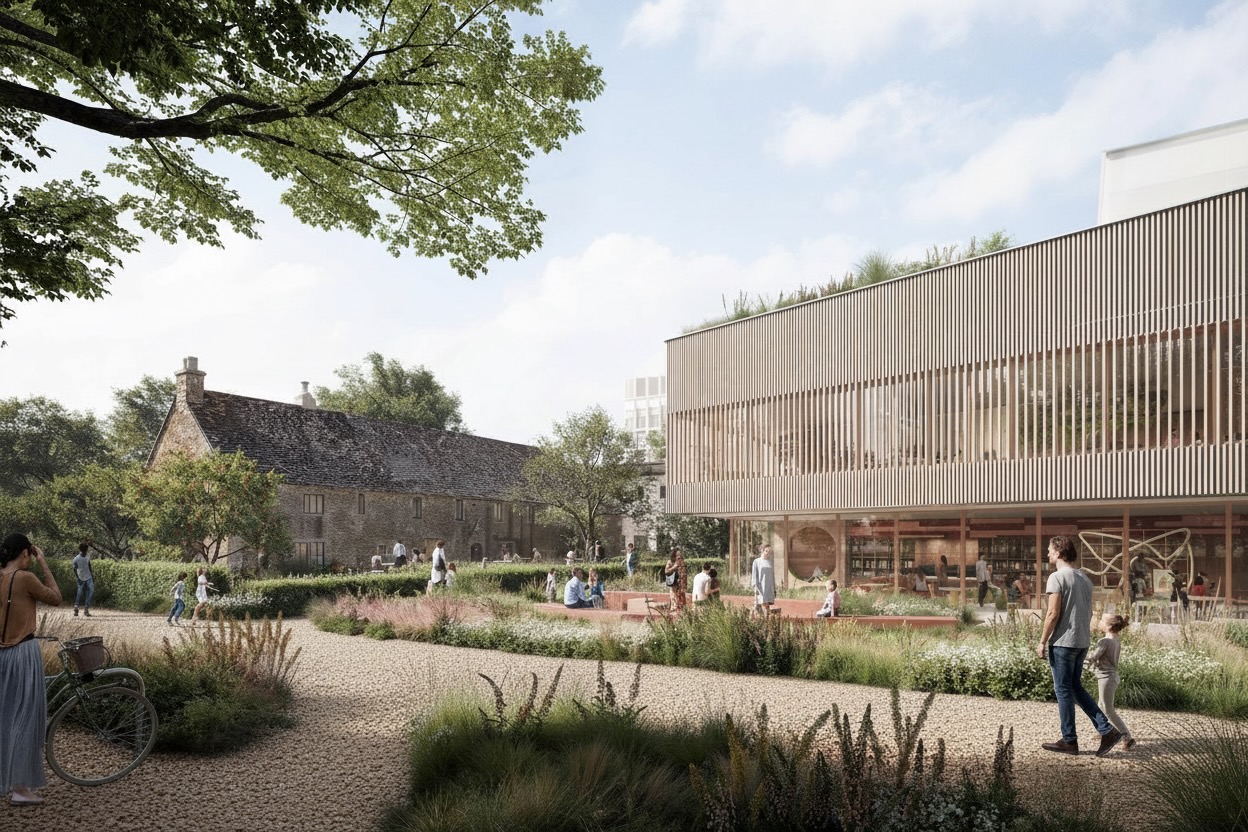
Perkins&Will has secured planning permission from Oxford City Council to redevelop the Ozone Leisure Park into a mixed‑use research, leisure, and community campus while retaining and integrating a 12th‑century farmhouse. The scheme converts existing retail and leisure units into laboratory and research space, alongside public amenities, rather than building on a greenfield site. For engineers, the project signals further demand for lab‑ready building services, vibration control, and sensitive heritage interfaces within brownfield commercial envelopes.
Technical Brief
- Planning consent enables conversion of large-span, column-free retail shells into subdivided, serviced lab plates.
- Existing cinema and leisure structures will require acoustic and vibration isolation upgrades compatible with research occupancies.
- Brownfield leisure park utilities must be reconfigured for high-load lab HVAC, fume extraction and redundancy.
- Car-dominated site layout will need regrading and resurfacing to prioritise pedestrian and cycle permeability.
- Drainage and SuDS retrofits must work within existing hardstanding, car parks and buried service corridors.
- Structural interventions likely focus on strengthening floor load capacity and penetrations for vertical lab risers.
- Similar UK retail-to-lab conversions are driving demand for retrofit-friendly vibration, MEP and contamination solutions.
Our Take
The preservation of a 12th Century farmhouse within the Ozone Leisure Park scheme fits a pattern in our sustainability-tagged coverage where heritage structures are retained as anchors in mixed-use redevelopment, which often simplifies planning consent but adds complexity to structural and services integration.
Oxford City Council’s role in a sustainability-tagged project of this type suggests local authorities are increasingly using planning leverage to secure low-carbon retrofits and heritage protection together, a combination that has featured in several recent UK urban regeneration pieces in our database.
Prepared by collating external sources, AI-assisted tools, and Geomechanics.io’s proprietary mining database, then reviewed for technical accuracy & edited by our geotechnical team.
Related Articles


Related Industries & Products
Construction
Quality control software for construction companies with material testing, batch tracking, and compliance management.
CMRR-io
Streamline coal mine roof stability assessments with our cloud-based CMRR software featuring automated calculations, multi-scenario analysis, and collaborative workflows.
HYDROGEO-io
Comprehensive hydrogeological testing platform for managing, analysing, and reporting on packer tests, lugeon values, and hydraulic conductivity assessments.
GEODB-io
Centralised geotechnical data management solution for storing, accessing, and analysing all your site investigation and material testing data.