MT-5 1.5 km tunnel breakthrough: design and schedule lessons for rail engineers
Reviewed by Joe Ashwell
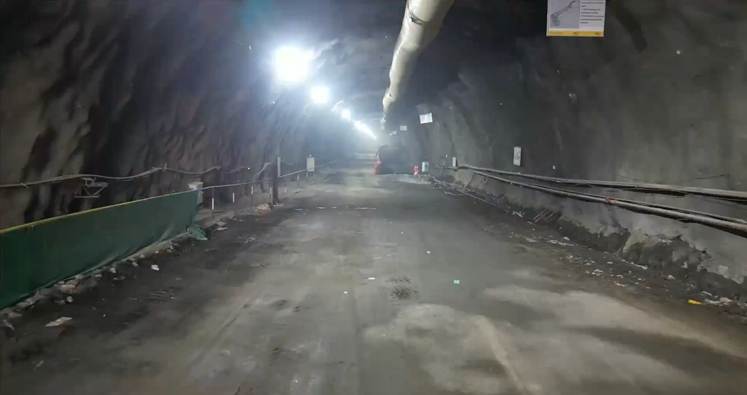
First reported on Geoengineer.org – News
30 Second Briefing
Breakthrough of the 1.5 km Mountain Tunnel‑5 (MT‑5) in Maharashtra’s Palghar district marks a key advance on India’s Mumbai–Ahmedabad high‑speed rail corridor, designed for 320 km/h “bullet train” operation. Excavated through mixed hard rock in hilly terrain, MT‑5 is one of three mountain tunnels on the alignment and required sequential excavation with controlled blasting and continuous geotechnical monitoring. The completion reduces a major schedule risk on the corridor and locks in critical design assumptions on rock mass behaviour, groundwater inflows and lining performance.
Technical Brief
- Excavation advanced from both Palghar and Valsad sides to shorten exposure time of unsupported headings.
- Controlled blasting cycles were limited to short rounds to manage overbreak and vibration impacts on surrounding slopes.
- Instrumentation reportedly included convergence monitoring and face mapping to update support classes in real time.
- Primary support used rock bolts and shotcrete, with cast in-situ concrete lining as permanent support.
- Experience on MT-5’s mixed rock conditions is expected to refine hazard zoning and support patterns on remaining mountain tunnels.
Our Take
Within our 333 Infrastructure stories, India features heavily on high-speed rail, and a 1.5 km tunnel like MT-5 in Palghar suggests the bullet train corridor is now moving from design and land issues into complex underground works where geotechnical risk and safety management become the main schedule drivers.
Palghar in Maharashtra has shown up in other linear-infrastructure coverage as a sensitive stretch for both terrain and communities, so a clean breakthrough at Mountain Tunnel-5 is likely to de-risk subsequent tunnelling packages along this section by validating the chosen excavation and support approach.
Safety-tagged pieces in our database increasingly highlight how long rail tunnels are being used to trial advanced monitoring and emergency-response systems; MT-5’s completion gives the Indian high-speed rail programme a live asset where such systems can be integrated and tested before full corridor commissioning.
Prepared by collating external sources, AI-assisted tools, and Geomechanics.io’s proprietary mining database, then reviewed for technical accuracy & edited by our geotechnical team.
Related Articles


Related Industries & Products
Tunnelling
Specialised solutions for tunnelling projects including grout mix design, hydrogeological analysis, and quality control.
Mining
Geotechnical software solutions for mining operations including CMRR analysis, hydrogeological testing, and data management.
QCDB-io
Comprehensive quality control database for manufacturing, tunnelling, and civil construction with UCS testing, PSD analysis, and grout mix design management.