M6 4,200t rail bridge installation: possession planning lessons for engineers
Reviewed by Tom Sullivan
First reported on New Civil Engineer
30 Second Briefing
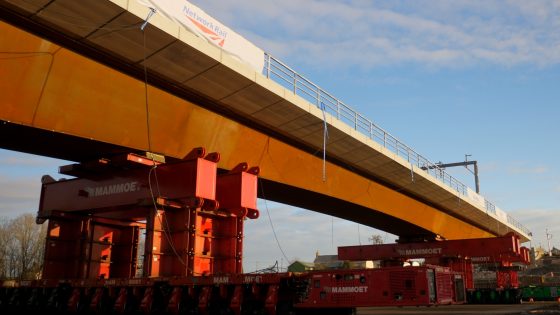
Installation of a 4,200t railway bridge over the M6 in Cumbria finished 13 hours ahead of programme, allowing the motorway to reopen on Sunday afternoon instead of Monday morning. The structure was installed during a full closure using heavy-lift equipment to position the pre-assembled span over live carriageways, minimising time working over traffic. For highway and rail engineers, the operation reinforces the value of off-site bridge assembly and tightly sequenced possession planning to cut disruption on strategic corridors.
Technical Brief
- New rail bridge superstructure weighed 4,200t, requiring heavy-lift plant and detailed lift planning.
- Works took place over the M6 in Cumbria under a full motorway closure for safety.
- Operation required coordinated rail possession and highway closure, reducing concurrent rail–road interface risks.
- Pre-assembly away from the carriageway limited work-at-height exposure directly above live traffic lanes.
- Early completion reduced duration of traffic management, lowering collision risk within temporary layouts.
- Heavy-lift methodology demanded strict exclusion zones, lifting permits and real-time communication between plant and banksmen.
- Safety planning would have included contingency for delayed reopening, avoiding pressure to compromise procedures.
- Similar motorway-rail crossings can adopt full-closure, pre-assembled bridge lifts to simplify safety management.
Our Take
Among the 405 Infrastructure stories in our database, very few involve single-lift bridge elements in the 4,000t-plus range, so this Cumbria rail bridge job sits at the heavier end of UK motorway overbridge interventions and will interest teams planning similar high-mass installations over live strategic roads.
A 13-hour early reopening on the M6 signals that possession planning and contingency for this scheme were conservative, which is often a prerequisite for National Highways approvals on critical corridors and can be used as a benchmark when negotiating closure windows on future UK motorway bridge replacements.
Safety-tagged project pieces in our coverage increasingly highlight how early hand-back after major lifts reduces worker exposure and traffic management risk, suggesting that the delivery model used here for the 4,200t bridge will be scrutinised as a template for compressing on-network construction durations elsewhere in the UK.
Prepared by collating external sources, AI-assisted tools, and Geomechanics.io’s proprietary mining database, then reviewed for technical accuracy & edited by our geotechnical team.


