Geomechanics.io

  • Free Tools
Sign UpLog In
AllGeotechnicalMiningInfrastructureMaterialsHazardsEnvironmentalSoftwarePolicy

Geomechanics.io

Geomechanics, Simplified.

© 2025 Geomechanics.io. All rights reserved.

Geomechanics.io

CMRR-ioGEODB-ioHYDROGEO-ioQCDB-ioFree Tools & CalculatorsBlogLatest Industry News

Industries

MiningConstructionTunnelling

Company

Terms of UsePrivacy PolicyLinkedIn
    Projects
    Sustainability

    IEF critical minerals trade warning: supply risk lens for project teams

    December 21, 2025|

    Reviewed by Joe Ashwell

    IEF critical minerals trade warning: supply risk lens for project teams

    First reported on MINING.com

    30 Second Briefing

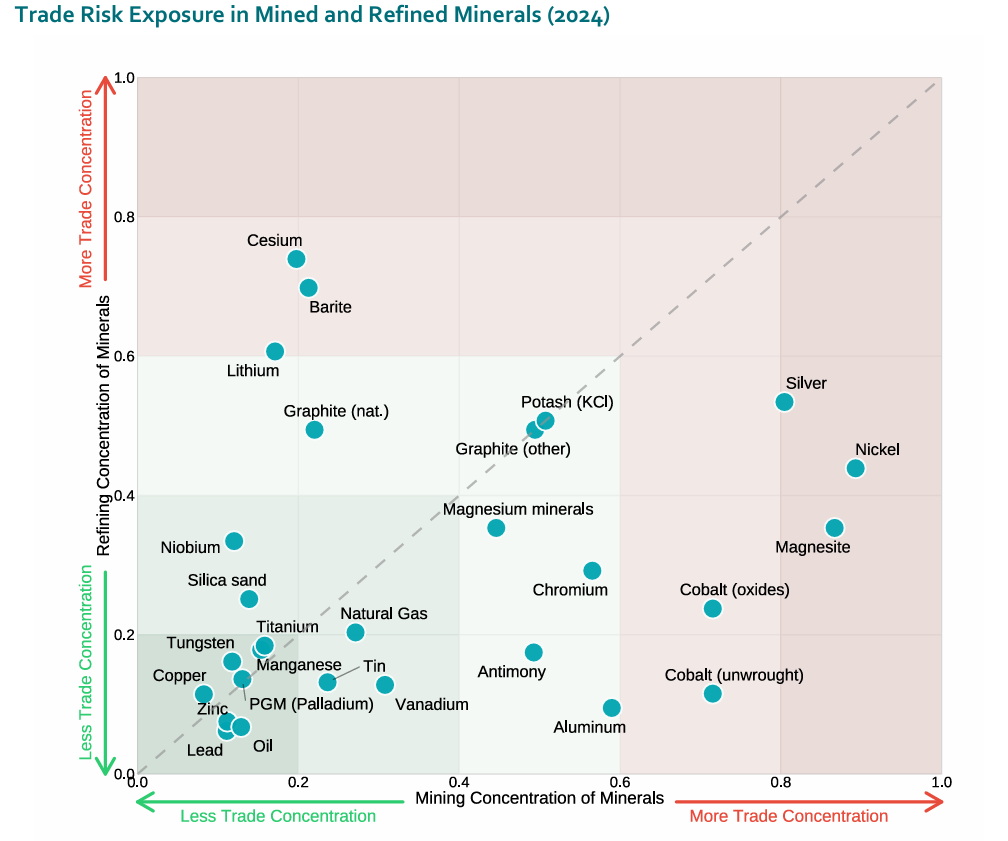
    More than 60% of global demand for critical minerals is now met via international trade, with the IEF warning that copper and nickel could face material shortfalls by the mid-2030s as total demand for copper, nickel, cobalt, lithium and rare earths climbs from 28 Mt in 2021 to nearly 41 Mt by 2040. EV copper use alone is forecast to jump from 200,000 t in 2020 to 3.4 Mt by 2035, while Indonesia supplies over half of nickel, the DRC about 70% of cobalt, and China over 90% of rare earth refining. More than 600 policies now target critical mineral supply chains, with the US, Canada and Australia incentivising exploration, refining and recycling, and Indonesia, Chile and Peru pushing in-country value addition and export controls.

    Technical Brief

    • IEF’s A Critical Minerals Enabled Energy Future report frames supply risk via quantified 2040 demand scenarios.
    • Clean energy uses push copper demand within this basket to more than 12 Mt by 2040.
    • Lithium and nickel show >10× demand growth, driven primarily by battery and grid‑storage manufacturing build‑out.
    • EVs are assumed to require roughly four times more copper than internal‑combustion vehicles in IEF modelling.
    • AI, data centres and semiconductor fabrication are identified as competing end‑uses for the same mineral streams.
    • Since 2020, critical‑minerals policies have nearly doubled the cumulative total issued in the previous 20 years.
    • For project developers, policy‑driven export controls and domestic processing mandates materially affect offtake, financing and plant siting.

    Our Take

    With more than 600 critical-mineral policies now on the books and demand for copper, nickel and lithium rising sharply through 2040, permitting and ESG standards in major producers such as Chile, Australia and Canada are likely to become as decisive for supply security as geology or capex.

    Projected copper shortfalls by the mid‑2030s, combined with EV copper use growing at an estimated 14% a year to 2035, suggest higher-cost or lower-grade copper projects in regions like Latin America and Africa could be pulled into the money earlier than their feasibility studies assumed.

    China’s control of over 90% of rare earth refining and the Democratic Republic of the Congo’s dominance in cobalt output mean that OECD‑country policies flagged in this piece will probably lean heavily on midstream investments (refining, recycling, alloying) rather than trying to replicate upstream concentration patterns.

    Geotechnical Software for Modern Teams

    Centralise site data, logs, and lab results with GEODB-io, CMRR-io, and HYDROGEO-io.

    No credit card required.

    • Save and export unlimited calculations
    • Advanced data visualisation
    • Generate professional PDF reports
    • Cloud storage for all your projects

    Prepared by collating external sources, AI-assisted tools, and Geomechanics.io’s proprietary mining database, then reviewed for technical accuracy & edited by our geotechnical team.

    Related Articles

    US critical mineral resilience in 2026: processing-first shift for project teams
    Policy
    about 15 hours ago

    US critical mineral resilience in 2026: processing-first shift for project teams

    US federal critical minerals policy in 2026 is set to move beyond rare earths to high‑risk inputs such as antimony and tungsten, where the US currently relies heavily on China, Tajikistan and Russia for supply into defence alloys, munitions and flame‑retardant applications. Washington is expected to prioritise domestic processing capacity over new mines, backing alternatives to traditional smelting and refining that cut emissions and withstand high US power prices. Intensifying competition for electricity from AI data centres will put aluminium, copper, magnesium and titanium processors under pressure, favouring technologies that materially lower energy use and total production costs.

    Planning and Infrastructure Act 2025: key takeaways for project teams
    Policy
    3 days ago

    Planning and Infrastructure Act 2025: key takeaways for project teams

    Landmark Planning and Infrastructure Act 2025 has received royal assent, giving ministers new powers to accelerate major roads, rail schemes, reservoirs, windfarms and grid connections, and underpinning Labour’s target of 1.5 million new homes. Key measures include a Nature Restoration Fund for centralised biodiversity offsetting, streamlined judicial review with only one court challenge allowed on meritless major project cases, and reformed local authority planning committees pushing smaller schemes to officers. The Act also simplifies EV charger approvals, eases compulsory purchase, and offers up to £250/year electricity bill discounts for 10 years to households near new pylons.

    Ontario–Ottawa ‘one project, one review’ deal: permitting lens for mine planners
    Policy
    3 days ago

    Ontario–Ottawa ‘one project, one review’ deal: permitting lens for mine planners

    Ontario and Canada have signed a “one project, one review” agreement to coordinate federal and provincial environmental and impact assessments, targeting long-delayed mining and infrastructure schemes in the Ring of Fire and other critical mineral districts. The deal dovetails with Ontario’s One Project, One Process (1P1P) framework, which aims to cut mine approval timelines from up to 15 years to a maximum of two years, with Frontier Lithium’s PAK project the first pilot. For geotechnical and mining teams, the move signals materially shorter permitting horizons for cobalt, lithium, nickel and copper projects backed by a C$500 million processing fund.

    Related Industries & Products

    Mining

    Geotechnical software solutions for mining operations including CMRR analysis, hydrogeological testing, and data management.

    Construction

    Quality control software for construction companies with material testing, batch tracking, and compliance management.

    QCDB-io

    Comprehensive quality control database for manufacturing, tunnelling, and civil construction with UCS testing, PSD analysis, and grout mix design management.