Human rights allegations at critical minerals mines: risk takeaways for project teams
Reviewed by Tom Sullivan
First reported on MINING.com
30 Second Briefing
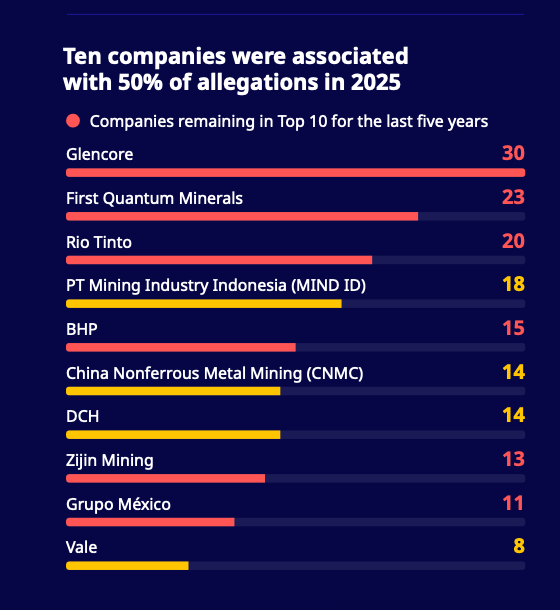
Human rights abuse allegations at transition-mineral mines jumped 73% in 2025 to 329 cases across 299 copper, cobalt, lithium, nickel, graphite and rare earth operations tracked by the Business and Human Rights Resource Centre, with copper sites accounting for about 60% of complaints. South America recorded the most allegations while Africa saw the fastest growth, and Indigenous Peoples featured in 17% of cases despite being about 6% of the global population. The tracker logged 61 protests, 10 strikes and 44 lawsuits or regulatory actions, with at least 27 mine suspensions, slowdowns or closures, signalling rising supply and permitting risk for project developers and offtakers.
Technical Brief
- Tracker logged 42 attacks on human rights and environmental defenders in 2025, over 50% higher year-on-year.
- Worker-related allegations reached 92 cases, specifically citing labour rights and occupational health and safety breaches.
- Within those worker cases, 22 reports involved work-related deaths, indicating severe fatality risk exposure.
- Only 56% of mines with allegations had publicly available human rights policies, signalling major governance gaps.
- Since 2010, 1,226 allegations have been recorded across 299 transition-mineral operations globally, indicating persistent systemic issues.
- Recorded social conflict included 61 protests and 10 strikes, plus 44 lawsuits or regulatory actions tied to operations.
- For future projects, integrating robust human rights safeguards and benefit-sharing into ESIA and mine design is becoming a de facto risk-control requirement.
Our Take
With about 60% of 2025 allegations tied to copper, the surge sits alongside a wave of new copper and copper-equivalent project coverage in our database, such as NexMetals’ Selkirk project in Botswana, signalling that ESG risk is concentrating in the same metals seeing the strongest growth push.
The prominence of the DRC in this tracker aligns with other recent pieces on Congo’s critical minerals, including the digitisation of colonial-era geological records, suggesting that better subsurface data may arrive in parallel with heightened scrutiny of cobalt and copper operators’ social performance.
Given that at least 27 allegation cases in 2025 led to mine suspensions or slowdowns, the pattern reinforces what arbitration specialists in our coverage have flagged: for African cobalt and copper assets, social licence failures are now a material project-risk driver on par with resource nationalism disputes.
Prepared by collating external sources, AI-assisted tools, and Geomechanics.io’s proprietary mining database, then reviewed for technical accuracy & edited by our geotechnical team.
Related Articles
Related Industries & Products
Mining
Geotechnical software solutions for mining operations including CMRR analysis, hydrogeological testing, and data management.
CMRR-io
Streamline coal mine roof stability assessments with our cloud-based CMRR software featuring automated calculations, multi-scenario analysis, and collaborative workflows.
HYDROGEO-io
Comprehensive hydrogeological testing platform for managing, analysing, and reporting on packer tests, lugeon values, and hydraulic conductivity assessments.
GEODB-io
Centralised geotechnical data management solution for storing, accessing, and analysing all your site investigation and material testing data.