HS2’s longest Chiltern tunnel complete: design and fit-out notes for engineers
Reviewed by Joe Ashwell
First reported on The Construction Index
30 Second Briefing
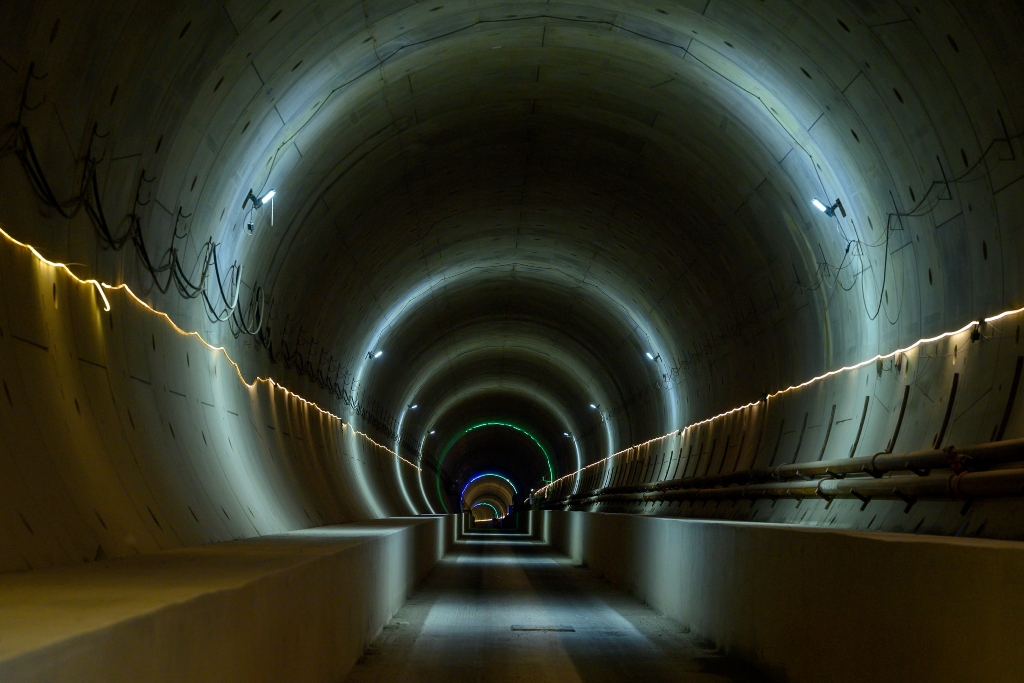
Construction of HS2’s 10-mile (16 km) twin-bore Chiltern tunnel has finished, with five ventilation and access shafts sunk to depths of up to 78 m and 40 cross passages now complete, allowing rail systems installation to begin. Align JV – Bouygues Travaux Publics, Sir Robert McAlpine and Volker Fitzpatrick – drove two 2,000-tonne TBMs from near the M25 at Maple Cross at an average 16 m/day, breaking through near Great Missenden in early 2024. The tunnel, HS2’s longest and second structurally complete twin-bore, now moves into track, overhead line and MEP fit-out despite the wider project’s delays and cost overruns.
Technical Brief
- Civil works phase ran nearly five years from initial shaft works to portal completion.
- Main tunnelling construction by Align JV commenced May 2021 with staggered TBM launches from Maple Cross.
- Shaft headhouses, by Grimshaw Architects, are architecturally treated to visually blend with the Chiltern hills.
- Post-breakthrough activities included constructing porous portal extensions at both north and south ends for pressure relief.
- Internal walkways have been installed along both bores to provide maintenance and emergency egress routes.
- Forty cross passages have been structurally completed and fitted out to interconnect the twin bores for safety access.
Our Take
HS2 Ltd appears repeatedly across our 484 Infrastructure stories, and the Chiltern tunnels milestone sits alongside recent coverage of the Delta junction and M6 viaduct works, signalling that the London–Birmingham section is now moving from heavy civils into a more systems‑ and integration‑dominated phase.
The 10‑mile twin‑bore Chiltern tunnels with 40 cross passages and 78 m‑deep shafts put Align JV (Bouygues Travaux Publics, Sir Robert McAlpine, Volker Fitzpatrick) in the same complexity bracket as the most demanding underground works in our database, which is likely to strengthen their credentials for future long‑tunnel bids in constrained environmental settings.
With HS2 also trialling advanced materials such as graphene‑reinforced 3D‑printed concrete in other sections (per the Versarien/SCS JV item), the conventional segmental lining and shaft construction on the Chilterns will provide a useful performance and durability benchmark against which those newer methods can be evaluated over time.
Prepared by collating external sources, AI-assisted tools, and Geomechanics.io’s proprietary mining database, then reviewed for technical accuracy & edited by our geotechnical team.
Related Articles


Related Industries & Products
Construction
Quality control software for construction companies with material testing, batch tracking, and compliance management.
Tunnelling
Specialised solutions for tunnelling projects including grout mix design, hydrogeological analysis, and quality control.
QCDB-io
Comprehensive quality control database for manufacturing, tunnelling, and civil construction with UCS testing, PSD analysis, and grout mix design management.