HS2 Burton Green tunnel roof: design and settlement notes for engineers
Reviewed by Tom Sullivan
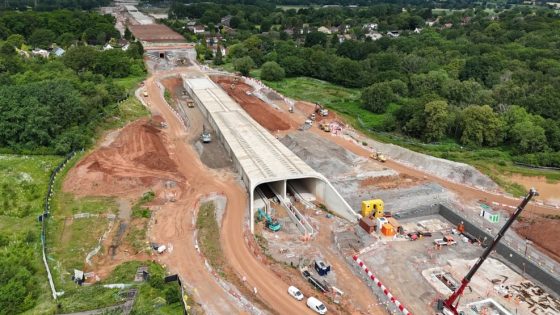
First reported on New Civil Engineer
30 Second Briefing
Engineers have installed the final roof segment on HS2’s 700m Burton Green cut-and-cover tunnel in the West Midlands, completing the primary structural shell. The tunnel, designed to carry high-speed rail beneath existing communities near Kenilworth, uses a reinforced concrete roof to support the realigned A452 and local utilities while maintaining ground stability. Attention now shifts to internal fit-out, waterproofing and trackbed construction, where settlement control and long-term structural performance will be critical for designers and contractors.
Technical Brief
- Final roof segment placement required precise lifting over live local roads and properties.
- Cut-and-cover construction demanded tight control of temporary excavation support to protect adjacent housing foundations.
- Utility diversions were staged onto the new roof deck early, reducing time services ran on temporary supports.
- Night and weekend possession windows limited high-risk lifting and concreting operations near residents.
- Continuous structural monitoring of the roof pour sequence mitigated differential movement risks at portal interfaces.
Our Take
Our database shows multiple recent HS2 tunnel milestones (Burton Green, Copthall, Chipping Warden) being reached within weeks of each other, signalling that the programme’s cut-and-cover and ‘green’ tunnel portfolio is moving from heavy civils into fit-out and systems at several sites in parallel.
With Burton Green in the West Midlands joining Copthall and Chipping Warden completions, HS2’s tunnel delivery risk is increasingly concentrated at the remaining bored and urban interfaces such as Euston, where integration with Network Rail and London Underground adds far more staging and safety complexity than these rural box structures.
For contractors and designers like Mott MacDonald/SYSTRA and Balfour Beatty VINCI referenced in related coverage, the 700 m Burton Green tunnel adds to a growing body of HS2 cut-and-cover work that can be used as a reference set for temporary works, lifting logistics and precast handling methods on later phases.
Prepared by collating external sources, AI-assisted tools, and Geomechanics.io’s proprietary mining database, then reviewed for technical accuracy & edited by our geotechnical team.
Related Articles


Related Industries & Products
Construction
Quality control software for construction companies with material testing, batch tracking, and compliance management.
Mining
Geotechnical software solutions for mining operations including CMRR analysis, hydrogeological testing, and data management.
QCDB-io
Comprehensive quality control database for manufacturing, tunnelling, and civil construction with UCS testing, PSD analysis, and grout mix design management.