Heidelberg cable backfill: thermal design implications for civil engineers
Reviewed by Joe Ashwell
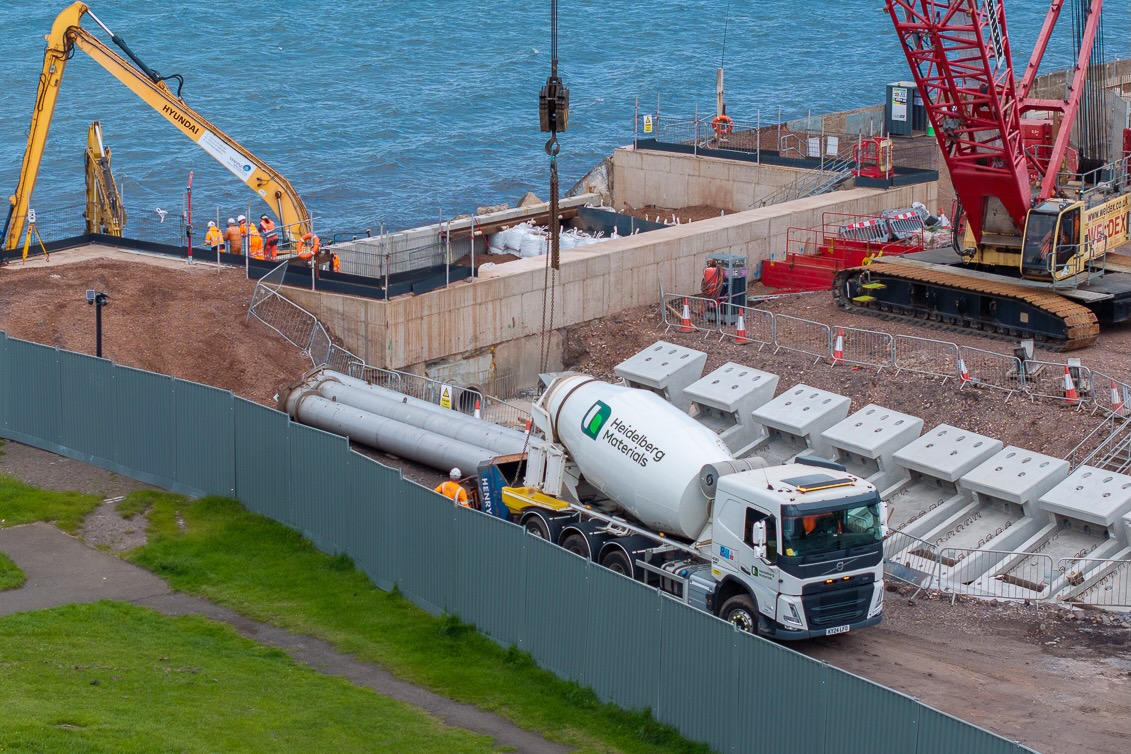
First reported on The Construction Index
30 Second Briefing
Heidelberg has launched a new range of high-thermal-conductivity, low-resistivity backfill and bedding materials specifically engineered for high and ultra-high voltage underground power cables. The products are formulated to improve heat dissipation from cable systems, reducing localised temperature rise and associated ampacity constraints compared with conventional granular or cementitious surrounds. For civil and geotechnical designers, this allows tighter cable spacing, potentially shallower trench sections, and more reliable performance in dense urban corridors where thermal bottlenecks often limit circuit capacity.
Technical Brief
- Materials are engineered as both backfill and bedding, implying controlled gradation and compaction behaviour around ducts.
- Low electrical resistivity is tuned to minimise sheath voltage gradients and stray current concentration.
- High thermal conductivity mix design likely constrains fines content and moisture sensitivity to maintain stable k-values.
- Purpose-designed surrounds reduce reliance on native soils, important where urban excavations expose heterogeneous or poor backfill.
- Products are aimed at underground power corridors, indicating compatibility with joint bays, transition pits and cable crossings.
- Civil designers gain an additional material class beyond standard sand/cementitious surrounds for cable rating calculations.
- Wider adoption would drive closer integration between cable thermal modelling and geotechnical trench/backfill specifications.
Our Take
Heidelberg’s role in easing pressure on the power sector aligns with its recent deployment of Epiroc’s LinkOA autonomous haulage at an Australian quarry, signalling a broader push to cut both energy use and labour exposure in its heavy materials operations.
Across our Materials coverage, Heidelberg and Heidelberg Materials UK recur frequently in low‑carbon asphalt and cement stories, suggesting that any new heat‑management or power‑sector offering is likely to be framed as part of its decarbonisation toolset rather than a standalone product line.
The use of evoZero cement and CarbonLock bio‑binders in UK road projects indicates Heidelberg is already monetising carbon‑capture and bio‑based technologies, so a solution that ‘takes the heat off’ the power sector could give it leverage in grid‑constrained infrastructure tenders where embodied‑carbon and peak‑load impacts are scrutinised together.
Prepared by collating external sources, AI-assisted tools, and Geomechanics.io’s proprietary mining database, then reviewed for technical accuracy & edited by our geotechnical team.
Related Articles



Related Industries & Products
Mining
Geotechnical software solutions for mining operations including CMRR analysis, hydrogeological testing, and data management.
Construction
Quality control software for construction companies with material testing, batch tracking, and compliance management.
CMRR-io
Streamline coal mine roof stability assessments with our cloud-based CMRR software featuring automated calculations, multi-scenario analysis, and collaborative workflows.
HYDROGEO-io
Comprehensive hydrogeological testing platform for managing, analysing, and reporting on packer tests, lugeon values, and hydraulic conductivity assessments.
GEODB-io
Centralised geotechnical data management solution for storing, accessing, and analysing all your site investigation and material testing data.