Geomechanics.io

  • Free Tools
Sign UpLog In

Geomechanics.io

Geomechanics, Simplified.

© 2025 Geomechanics.io. All rights reserved.

Geomechanics.io

CMRR-ioGEODB-ioHYDROGEO-ioQCDB-ioFree Tools & CalculatorsBlogLatest Industry News

Industries

MiningConstructionTunnelling

Company

Terms of UsePrivacy PolicyLinkedIn
    AllGeotechnicalMiningInfrastructureMaterialsHazardsEnvironmentalSoftwarePolicy
    Projects
    Contract Award

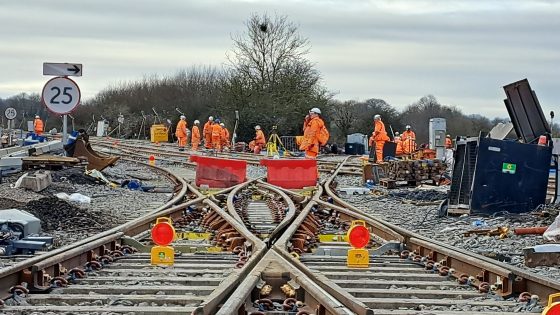
    Great British Railways Bill and Wales: funding and delivery lens for engineers

    December 10, 2025|

    Reviewed by Joe Ashwell

    Great British Railways Bill and Wales: funding and delivery lens for engineers

    First reported on New Civil Engineer

    30 Second Briefing

    Welsh MPs have warned that the Great British Railways (GBR) Bill, which centralises rail planning and operations under a new GBR body, fails to address Wales’s specific infrastructure and funding needs. They argue that the legislation does not correct historic underinvestment in Welsh rail, where enhancements such as electrification and capacity upgrades on key corridors like the South Wales Main Line lag behind those in England. For civil engineers, the dispute signals continued uncertainty over long-term funding envelopes and governance for major Welsh rail renewals and enhancements.

    Technical Brief

    • Great British Railways Bill centralises timetable, infrastructure and operations decisions in a single GB-wide body.
    • Welsh MPs argued in committee that devolved powers for rail infrastructure, similar to Scotland, are absent.
    • Funding flows for enhancements would continue via UK-wide control periods, with no ringfenced Welsh allocation.
    • Witness evidence referenced Network Rail’s current route-based structure, questioning how Welsh route priorities will be set.
    • Concerns were raised that cross-border routes could see England-focused optimisation of capacity and renewals.
    • MPs warned that franchise-style passenger service contracts under GBR may not reflect low-density rural Welsh demand patterns.
    • The Bill’s governance model was criticised for lacking statutory Welsh Government representation in long-term rail planning.
    • For major Welsh rail upgrades, engineers face continued reliance on UK Treasury approvals rather than devolved capital programmes.

    Our Take

    Within our 35 Policy stories, Wales appears far less frequently than England or Scotland in rail-governance pieces, which suggests that concerns about how Great British Railways will reflect devolved priorities are emerging from a relatively under-represented region in current coverage.

    For UK-wide Projects and Contract Award items in our database, most rail-related decisions are still framed at the Westminster or Great British Railways level, so any structural misalignment with Welsh transport policy could complicate procurement pipelines and long-term framework agreements for contractors operating in Wales.

    Because Great British Railways is being positioned as a central organising body for the United Kingdom network, unresolved questions about its remit in Wales are likely to affect how future enhancement schemes are scoped, funded and handed over, especially where interfaces with devolved road and metro projects are tight.

    Geotechnical Software for Modern Teams

    Centralise site data, logs, and lab results with GEODB-io, CMRR-io, and HYDROGEO-io.

    No credit card required.

    • Save and export unlimited calculations
    • Advanced data visualisation
    • Generate professional PDF reports
    • Cloud storage for all your projects

    Prepared by collating external sources, AI-assisted tools, and Geomechanics.io’s proprietary mining database, then reviewed for technical accuracy & edited by our geotechnical team.

    Related Articles
    Ivanhoe Atlantic’s China ties: logistics and offtake implications for US projects
    Policy
    about 16 hours ago

    Ivanhoe Atlantic’s China ties: logistics and offtake implications for US projects

    US Representative John Moolenaar is pressing the State Department over what he calls “well-documented” links between Ivanhoe Atlantic and Chinese state-owned enterprises, citing CITIC and Zijin Mining’s combined 39.5% stake in related company Ivanhoe Mines as of 2020 and a $1.8 billion Ivanhoe Mines–Liberia rail rehabilitation deal for Guinean iron ore. Ivanhoe Atlantic insists it is a separate entity from Ivanhoe Mines and says its Guinea iron ore project will supply only US and allied markets, avoiding China’s Trans-Guinean Railway. The dispute signals closer US scrutiny of indirect Chinese stakes in African iron ore and copper logistics.

    De facto nuclear deregulation: design and safety implications for UK engineers
    Policy
    about 17 hours ago

    De facto nuclear deregulation: design and safety implications for UK engineers

    The “independent” Nuclear Regulatory Taskforce commissioned by UK prime minister Keir Starmer has issued its final report calling for a “radical reset of [an] overly complex nuclear regulatory system”, signalling de facto deregulation of new build and life-extension projects. Proposals include streamlining multi‑stage Office for Nuclear Regulation licensing, compressing generic design assessment timelines, and reducing overlap with Environment Agency permitting. For civil and geotechnical designers on projects such as Sizewell C and future SMR sites, this could shorten consent and design-freeze periods but increase pressure to lock in safety‑critical assumptions earlier with less iterative regulatory scrutiny.

    CITB cuts funding and grants: skills and capex impacts for UK contractors
    Policy
    2 days ago

    CITB cuts funding and grants: skills and capex impacts for UK contractors

    CITB is cutting several training grants from 8 January 2026 after a 36% rise in demand for services over four years outstripped static levy income, including removal of the short course training grant, ending funding for level 7 qualifications and long-course attendance, and standardising all non-apprentice achievement grants at £600. Employer networks will shift to 50% match funding with a narrower scope, and from 1 April 2026 large employers will move to a single funding offer and lose access to employer networks. Civil engineering and specialist contractors such as MB Roche, Balfour Beatty and Gypsum Limited warn the changes will hit SMEs’ ability to navigate grants and maintain skills pipelines in an already tight labour market.

    Related Industries & Products

    Construction

    Quality control software for construction companies with material testing, batch tracking, and compliance management.

    CMRR-io

    Streamline coal mine roof stability assessments with our cloud-based CMRR software featuring automated calculations, multi-scenario analysis, and collaborative workflows.

    HYDROGEO-io

    Comprehensive hydrogeological testing platform for managing, analysing, and reporting on packer tests, lugeon values, and hydraulic conductivity assessments.

    GEODB-io

    Centralised geotechnical data management solution for storing, accessing, and analysing all your site investigation and material testing data.