Geomechanics.io

  • Free Tools
Sign UpLog In

Geomechanics.io

Geomechanics, Streamlined.

© 2026 Geomechanics.io. All rights reserved.

Geomechanics.io

CMRR-ioGEODB-ioHYDROGEO-ioQCDB-ioFree Tools & CalculatorsBlogLatest Industry News

Industries

MiningConstructionTunnelling

Company

Terms of UsePrivacy PolicyLinkedIn
    AllGeotechnicalMiningInfrastructureMaterialsHazardsEnvironmentalSoftwarePolicy
    Projects

    Government policies to drive mining investment in 2026: key takeaways for project teams

    January 22, 2026|

    Reviewed by Joe Ashwell

    Government policies to drive mining investment in 2026: key takeaways for project teams

    First reported on MINING.com

    30 Second Briefing

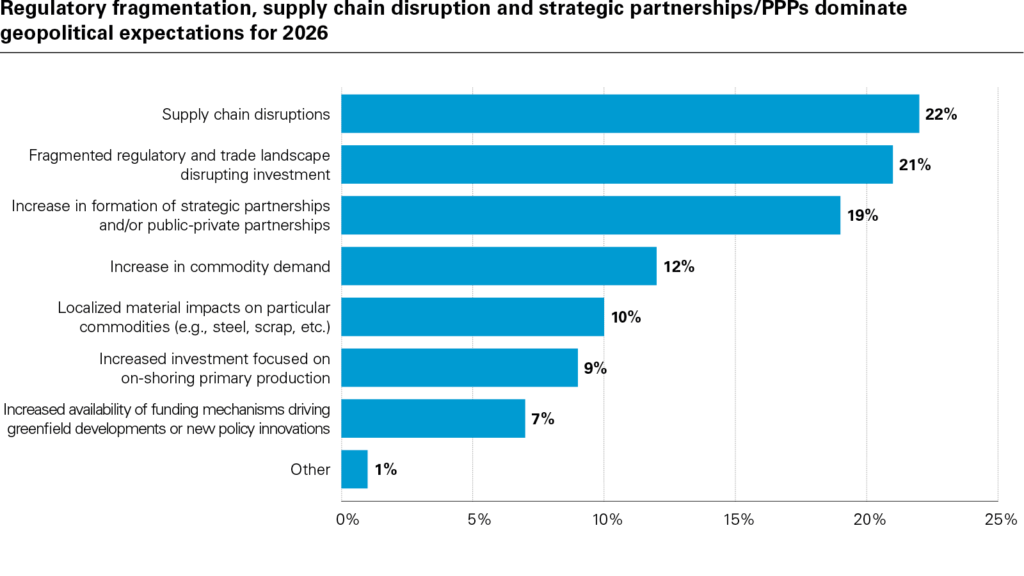
    Government policy is set to dominate mining investment in 2026, with 47% of respondents to White & Case’s Mining & Metals 2026 survey citing political variables and nearly 40% expecting state‑backed financing to be the main tool in developed markets. Some 73% foresee widening divergence between US and Chinese critical minerals policy, while a funding gap between the US and Europe is seen as a key opportunity, alongside risks of over‑expansion and a two‑to‑three‑year “gold rush” bubble. Copper and gold are viewed as the “sure bet” price risers, with gold miners seen as prime consolidation targets and strategic partnerships favoured over traditional M&A.

    Technical Brief

    • White & Case’s Mining & Metals 2026 survey identifies supply chain disruptions in 2025 as a leading ongoing risk.
    • Fragmentation of national critical mineral policies is cited by a similar share of respondents as a key concern.
    • Respondents link unprecedented policy support and volatile trade rules directly to critical mineral supply security strategies.
    • Survey participants see the US–Europe gap in government-backed funding as a concrete transactional opportunity window.
    • White & Case warns policy-driven over-expansion could create an investment bubble, with a 2–3 year “gold rush” phase.
    • Demand fundamentals are described as market-led, with policy support unable to fully offset weak end-use consumption.

    Our Take

    With 73% of respondents expecting greater US–China divergence on critical minerals policy, North American copper and lithium projects in our database increasingly reference reshoring or ‘friend-shoring’ strategies, which is already influencing where M&A bidders are willing to take jurisdictional risk.

    The survey’s expectation that state-backed financing will be the dominant policy tool in developed markets aligns with recent coverage of brownfield copper and gold expansions, where public credit agencies are emerging as key participants in capex stacks rather than leaving funding solely to commercial banks.

    Respondents flagging gold miners as the likeliest consolidation candidates dovetails with our broader Policy coverage, where gold appears more often in deal-making and restructuring stories than other commodities such as coal or rare earths, suggesting boards see M&A as a primary lever rather than greenfield build-out.

    Geotechnical Software for Modern Teams

    Centralise site data, logs, and lab results with GEODB-io, CMRR-io, and HYDROGEO-io.

    No credit card required.

    • Save and export unlimited calculations
    • Advanced data visualisation
    • Generate professional PDF reports
    • Cloud storage for all your projects

    Prepared by collating external sources, AI-assisted tools, and Geomechanics.io’s proprietary mining database, then reviewed for technical accuracy & edited by our geotechnical team.

    Related Articles

    Gateway 3 delays and 5,000 empty homes: regulatory lessons for project teams
    Policy
    about 7 hours ago

    Gateway 3 delays and 5,000 empty homes: regulatory lessons for project teams

    Delays at the Building Safety Regulator’s Gateway 3 stage are linked by law firm Irwin Mitchell to 44 undecided schemes and 5,594 completed higher-risk residential units remaining unoccupied, with one case waiting 550 days against an eight‑week target. Of 158 Gateway 3 applications in 2023, 55 took more than three months for a decision, raising concerns over cashflow impacts on developers and handover timing for residents. The BSR disputes the interpretation, stating no new-build higher-risk building that passed Gateway 2 has yet applied for Gateway 3 and that current cases are mainly transitional legacy projects with significant safety issues.

    Passengers’ Council powers debate: implications for UK rail designers and asset teams
    Policy
    3 days ago

    Passengers’ Council powers debate: implications for UK rail designers and asset teams

    MPs on Parliament’s transport select committee are questioning whether the Railways Bill’s proposed Passengers’ Council will have any real enforcement powers to deliver a fully accessible national rail network. Concerns centre on the council’s ability to compel infrastructure managers and train operators to retrofit step-free access, tactile paving and compliant boarding interfaces across thousands of stations and platforms. For designers and asset owners, the outcome will influence how strongly accessibility standards are mandated in future station upgrades, platform works and rolling stock procurement.

    NI 43-101 and online disclosure: policy takeaways for project teams
    Policy
    3 days ago

    NI 43-101 and online disclosure: policy takeaways for project teams

    NI 43-101’s standardised technical reports and qualified person requirements stabilised disclosure after Bre-X, but Erik Groves, corporate strategy and in-house counsel at Morgan Companies, argues they now mask chronic diluters whose projects never advance despite repeated financings and high G&A. With Canadian National Policy 51-201 still warning against “sporadic” online rumour correction on chat rooms and bulletin boards, legal advice often keeps issuers off X, YouTube and Reddit while retail investors crowdsource geology and drill-interval analysis. Groves calls for a defined safe harbour allowing video documentation of fieldwork, plain-language geological reasoning and public misinformation correction, without pre-releasing material results or implying unsupported resources.

    Related Industries & Products

    Mining

    Geotechnical software solutions for mining operations including CMRR analysis, hydrogeological testing, and data management.

    Construction

    Quality control software for construction companies with material testing, batch tracking, and compliance management.

    CMRR-io

    Streamline coal mine roof stability assessments with our cloud-based CMRR software featuring automated calculations, multi-scenario analysis, and collaborative workflows.

    HYDROGEO-io

    Comprehensive hydrogeological testing platform for managing, analysing, and reporting on packer tests, lugeon values, and hydraulic conductivity assessments.

    GEODB-io

    Centralised geotechnical data management solution for storing, accessing, and analysing all your site investigation and material testing data.