Folkestone Warren coastal defence works: slope stability lens for rail engineers
Reviewed by Tom Sullivan
First reported on New Civil Engineer
30 Second Briefing
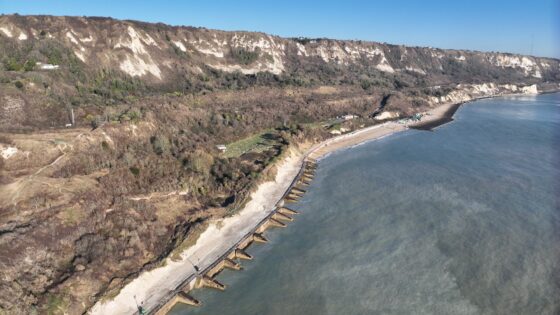
Work has started on stabilisation works to protect the coastal railway through Folkestone Warren in Kent, with contractors delivering the first consignments of rock armour to strengthen sea defences directly beneath the track. The scheme targets a historically unstable chalk and gault clay landslip zone where wave attack and toe erosion threaten the formation and embankment supporting the line. Engineers will focus on reinforcing the coastal toe to reduce slope movement risk and maintain resilience of this constrained coastal rail corridor under increasing storm and tidal loading.
Technical Brief
- Initial mobilisation involves delivery of quarried rock by road to the narrow coastal worksite.
- Access is constrained by the single-track alignment between cliffs and shoreline, limiting plant size and sequencing.
- Works must be planned around live railway operations, requiring possessions and strict safety controls.
- Tidal windows and wave conditions govern daily working hours and dictate placement methodology for armour units.
- Environmental consents will restrict noise, lighting and working times near the designated coastal habitats.
- Long history of landslips at the site will drive conservative monitoring, inspection and emergency response planning.
- Lessons on toe protection and access logistics here are directly applicable to other constrained UK coastal railways.
Our Take
Within the 352 Infrastructure stories in our database, coastal defence tied directly to rail safety in the United Kingdom is relatively sparse, so Folkestone Warren stands out as one of the few cases where shoreline works are primarily justified by mainline resilience rather than property protection.
Kent’s coastal geology and history of landslip at Folkestone Warren mean that failure modes are often compound (wave attack, cliff instability and track formation movement), so designers here are likely to be working to more conservative inspection and monitoring regimes than for typical sea wall refurbishments elsewhere in the UK.
Among the 977 tag-matched ‘Projects’ and ‘Safety’ pieces, most UK rail safety items focus on level crossings or signalling; a coastal defence scheme protecting the alignment itself suggests Network Rail and local authorities are treating climate-driven coastal erosion as a primary asset risk rather than a secondary environmental issue.
Prepared by collating external sources, AI-assisted tools, and Geomechanics.io’s proprietary mining database, then reviewed for technical accuracy & edited by our geotechnical team.
Related Articles


Related Industries & Products
Mining
Geotechnical software solutions for mining operations including CMRR analysis, hydrogeological testing, and data management.
Construction
Quality control software for construction companies with material testing, batch tracking, and compliance management.
CMRR-io
Streamline coal mine roof stability assessments with our cloud-based CMRR software featuring automated calculations, multi-scenario analysis, and collaborative workflows.
HYDROGEO-io
Comprehensive hydrogeological testing platform for managing, analysing, and reporting on packer tests, lugeon values, and hydraulic conductivity assessments.
GEODB-io
Centralised geotechnical data management solution for storing, accessing, and analysing all your site investigation and material testing data.