Geomechanics.io

  • Free Tools
Sign UpLog In
Built byBoxcut Studio

Geomechanics.io

Geomechanics, Streamlined.

© 2026 Geomechanics.io. All rights reserved.

Geomechanics.io

CMRR-ioGEODB-ioHYDROGEO-ioQCDB-ioFree Tools & CalculatorsBlogLatest Industry News

Industries

MiningConstructionTunnelling

Company

Terms of UsePrivacy PolicyLinkedIn
    Projects
    Product

    FLS Knelson and gravity gold recovery: circuit design notes for plant engineers

    February 26, 2026|

    Reviewed by Joe Ashwell

    FLS Knelson and gravity gold recovery: circuit design notes for plant engineers

    First reported on International Mining – News

    30 Second Briefing

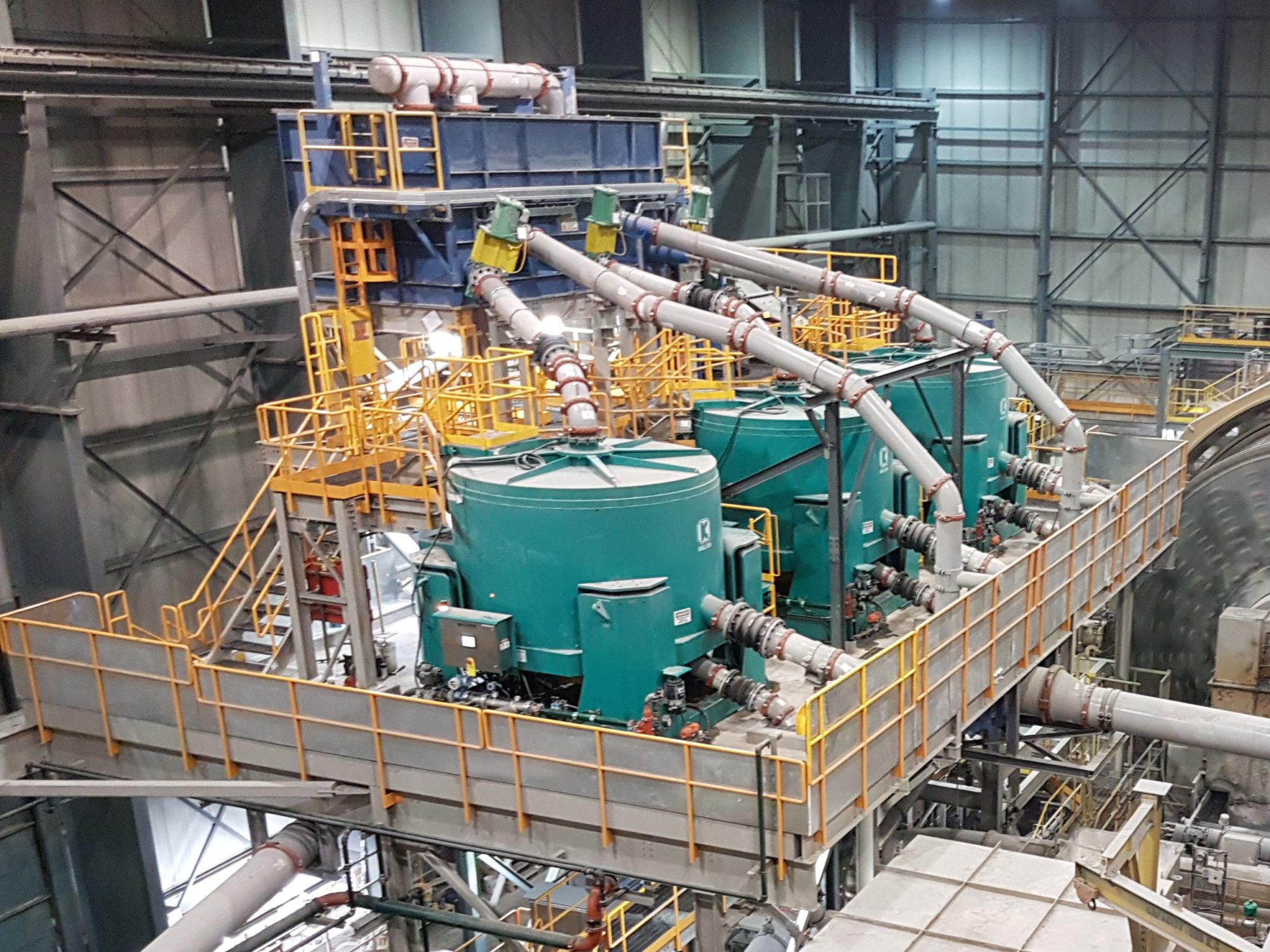
    FLS product manager Chris Arnold says high gold prices are driving miners to maximise gravity-recoverable gold (GRG) using Knelson Concentrators in mill circuits rather than relying solely on cyanide leaching. Plants that previously treated only a small bleed of the mill circulating load are now considering full-stream or multiple Knelson installations, targeting GRG often above 50–70% of total gold in suitable ores. The shift demands tighter cyclone control, upgraded pump capacity and careful integration of intensive leach reactors for the Knelson concentrate.

    Technical Brief

    • Knelson Concentrators use high-g centrifugal fields to separate dense GRG from mill discharge slurry.
    • Units operate as fluidised-bed concentrators, with water injection maintaining bed stratification and minimising blinding.
    • Concentrate is periodically or continuously discharged as a high-grade, low-mass stream for intensive leaching.
    • Cyclone underflow is typically the preferred Knelson feed, exploiting coarser, denser particle residence.
    • Circuit layouts often include dedicated gravity-recovery pump boxes and bypass lines for maintenance flexibility.
    • GRG testing is used to quantify gravity-recoverable fractions before design.
    • Knelson installations are commonly retrofitted into existing mills with minimal footprint, using modular skid-mounted packages.
    • For brownfields, gravity circuit upgrades offer relatively low capital intensity compared with new leach or flotation capacity.

    Our Take

    FLS’s focus on Knelson gravity gold recovery sits alongside a broader push into high-value processing equipment in our database, with recent pieces covering its semi-mobile crushing station at Vale’s S11D iron ore mine and a major comminution package for a South American copper concentrator.

    The current article is one of relatively few gold-specific items within our mining coverage compared with iron ore and copper, suggesting FLS is using the high gold price environment to rebalance its portfolio messaging toward precious metals as well as bulk and base commodities.

    With FLS’s new CEO, Toni Laaksonen, coming from the service business line, the emphasis on Knelson concentrators for gold likely aligns with a strategy to grow aftermarket and optimisation services around installed gravity circuits rather than just one-off equipment sales.

    Geotechnical Software for Modern Teams

    Centralise site data, logs, and lab results with GEODB-io, CMRR-io, and HYDROGEO-io.

    No credit card required.

    • Save and export unlimited calculations
    • Advanced data visualisation
    • Generate professional PDF reports
    • Cloud storage for all your projects

    Prepared by collating external sources, AI-assisted tools, and Geomechanics.io’s proprietary mining database, then reviewed for technical accuracy & edited by our geotechnical team.

    Related Articles

    Buffalo Potash permit at Disley: design, risk and process notes for mine engineers
    Mining
    2 days ago

    Buffalo Potash permit at Disley: design, risk and process notes for mine engineers

    Buffalo Potash has secured Saskatchewan approval to complete construction and operate its Disley initial production module, a 125,000 t/y soluble-grade potash facility 50 km northwest of Regina using a patented horizontal line-drive brine circulation method through parallel horizontal wells. The C$41.5 million module will test selective underground dissolution of potassium chloride with sodium-chloride-saturated brine and supply local agriculture, drilling-fluid markets and potassium-chloride brine for regional oilfields, ahead of planned 500,000 t/y Disley East and West expansions to about 1.13 Mt/y. The permit, which runs to 30 April and excludes future modules, requires groundwater characterisation, air-quality compliance and financial assurance, while the project proceeds without a feasibility study or declared reserves, elevating technical and economic risk.

    Exiro-led takeover of Vale’s Manitoba nickel complex: key points for mine planners
    Mining
    2 days ago

    Exiro-led takeover of Vale’s Manitoba nickel complex: key points for mine planners

    Exiro Minerals, Orion Resource Partners and Canada Growth Fund have acquired an 81.1% stake in Vale’s Thompson nickel operations in northern Manitoba, committing up to US$200 million to sustain and develop the six-decade-old complex. The new vehicle, Exiro Nickel, takes over day-to-day control of two operating underground mines, the adjacent concentrator and exploration ground along the 135 km Thompson Nickel Belt, while Vale Base Metals retains an 18.9% interest. A multi-year offtake agreement keeps Vale buying nickel concentrate from the Thompson mill, providing a defined outlet for future production.

    Mining
    2 days ago

    Moeve–Emerita 100% renewable diesel deal in Spain: decarbonisation notes for mines

    Moeve and Emerita Resources have signed Spain’s first mining-sector agreement to deploy 100% renewable diesel (HVO) at industrial scale, designating Moeve as preferred supplier of this second-generation biofuel. The HVO, derived from waste and residue feedstocks rather than food crops, is claimed to cut lifecycle CO2 emissions by up to 90% compared with conventional diesel. For mine operators, the drop-in fuel compatibility with existing diesel engines offers a near-term route to decarbonise haul trucks and auxiliary fleets without major equipment changes.

    Related Industries & Products

    Mining

    Geotechnical software solutions for mining operations including CMRR analysis, hydrogeological testing, and data management.

    CMRR-io

    Streamline coal mine roof stability assessments with our cloud-based CMRR software featuring automated calculations, multi-scenario analysis, and collaborative workflows.

    HYDROGEO-io

    Comprehensive hydrogeological testing platform for managing, analysing, and reporting on packer tests, lugeon values, and hydraulic conductivity assessments.

    GEODB-io

    Centralised geotechnical data management solution for storing, accessing, and analysing all your site investigation and material testing data.

    AllGeotechnicalInfrastructureHazardsEnvironmental