Geomechanics.io

  • Free Tools
Sign UpLog In

Geomechanics.io

Geomechanics, Simplified.

© 2025 Geomechanics.io. All rights reserved.

Geomechanics.io

CMRR-ioGEODB-ioHYDROGEO-ioQCDB-ioFree Tools & CalculatorsBlogLatest Industry News

Industries

MiningConstructionTunnelling

Company

Terms of UsePrivacy PolicyLinkedIn
    AllGeotechnicalMiningInfrastructureMaterialsHazardsEnvironmentalSoftwarePolicy
    Projects
    Sustainability

    Dogger Bank Wind Farm foundations: design and installation notes for engineers

    December 1, 2025|

    Reviewed by Joe Ashwell

    Dogger Bank Wind Farm foundations: design and installation notes for engineers

    First reported on New Civil Engineer

    30 Second Briefing

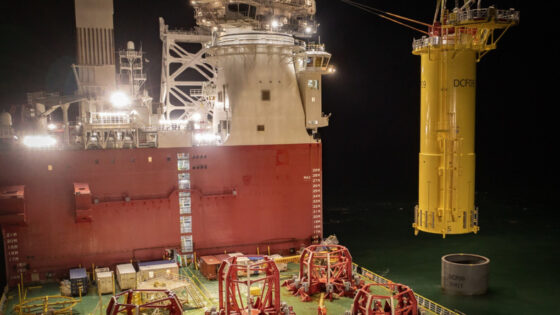
    Dogger Bank offshore wind farm has completed installation of all foundation components, with contractors fitting the final transition piece to bring the total to 277 units across the three phases in the North Sea. The transition pieces, which connect monopile foundations to turbine towers, are critical for tolerances, corrosion protection and access systems in water depths and metocean conditions typical of the central North Sea. Completion of the foundation phase clears the way for full-scale turbine erection and cable hook-up, locking in geotechnical and structural design assumptions for the remaining works.

    Technical Brief

    • Foundation phase completion fixes seabed interface conditions, enabling detailed planning of turbine erection vessel campaigns.
    • With all transition pieces in place, permanent access systems and temporary works interfaces can now be standardised.
    • Geotechnical performance of monopiles is now locked in for subsequent dynamic tuning of turbine support structures.
    • Electrical design can proceed on as-built foundation coordinates, refining array cable lengths and pull-in configurations.
    • Completion of offshore foundation works reduces marine spread demand, freeing heavy-lift vessels for parallel North Sea projects.

    Our Take

    Within our 110 Infrastructure stories, the Dogger Bank offshore wind project stands out as one of the few North Sea items tagged under both Projects and Sustainability, signalling that large-scale marine works here are increasingly framed through a low-carbon lens rather than purely as marine civils.

    Installing 277 transition pieces across three phases underlines the scale of serial fabrication and marine logistics now normalised in North Sea wind; contractors bidding future phases or adjacent projects will be expected to demonstrate similar industrialised installation capability and weather-risk management.

    For civil and marine engineers, the completion of the foundation phase at Dogger Bank effectively sets a new benchmark for multi-year offshore piling and transition-piece campaigns in the region, likely influencing design choices and risk allowances on upcoming North Sea infrastructure schemes.

    Geotechnical Software for Modern Teams

    Centralise site data, logs, and lab results with GEODB-io, CMRR-io, and HYDROGEO-io.

    No credit card required.

    • Save and export unlimited calculations
    • Advanced data visualisation
    • Generate professional PDF reports
    • Cloud storage for all your projects

    Prepared by collating external sources, AI-assisted tools, and Geomechanics.io’s proprietary mining database, then reviewed for technical accuracy & edited by our geotechnical team.

    Related Articles

    DSIT’s CNI cybersecurity drive: design and monitoring lessons for engineers
    Infrastructure
    3 days ago

    DSIT’s CNI cybersecurity drive: design and monitoring lessons for engineers

    The Department for Science, Innovation and Technology has expanded its Cyber Runway Critical National Infrastructure programme with innovation accelerator Plexal to bring more cybersecurity SMEs into protecting UK energy, transport, water and digital networks. The scheme targets operational technology and industrial control systems used in assets such as substations, treatment works and tunnels, where legacy SCADA and remote monitoring are increasingly exposed to cyber-physical attacks. For civil and infrastructure engineers, this signals closer integration of cyber risk into asset design, condition monitoring and resilience planning.

    Gatwick PAS 2080 certification: whole-life carbon lessons for project teams
    Infrastructure
    3 days ago

    Gatwick PAS 2080 certification: whole-life carbon lessons for project teams

    London Gatwick has become the first airport globally to achieve PAS 2080:2023 certification for carbon management across its buildings and infrastructure assets. The BSI-verified standard requires quantified whole-life carbon baselines, option appraisal and reduction pathways for capital works, including terminals, piers, pavements and associated civil engineering. For designers and contractors working at Gatwick, future schemes will need to evidence embodied and operational carbon performance alongside cost, influencing material choices, construction methods and asset renewal strategies.

    Northern Ireland DfI AI road stock-take: asset management lessons for engineers
    Infrastructure
    3 days ago

    Northern Ireland DfI AI road stock-take: asset management lessons for engineers

    Northern Ireland’s Department for Infrastructure has commissioned mapping specialist Gaist to deliver a network-wide digital stock-take of its road assets using AI-based condition assessment. High-resolution imaging and machine-learning classification will be used to catalogue carriageway defects, drainage features and street furniture, creating a georeferenced inventory to support maintenance planning amid a mounting roads backlog. For asset managers and pavement engineers, the move signals a shift towards data-driven prioritisation of resurfacing, patching and drainage interventions across the regional network.

    Related Industries & Products

    Construction

    Quality control software for construction companies with material testing, batch tracking, and compliance management.

    Mining

    Geotechnical software solutions for mining operations including CMRR analysis, hydrogeological testing, and data management.

    CMRR-io

    Streamline coal mine roof stability assessments with our cloud-based CMRR software featuring automated calculations, multi-scenario analysis, and collaborative workflows.

    HYDROGEO-io

    Comprehensive hydrogeological testing platform for managing, analysing, and reporting on packer tests, lugeon values, and hydraulic conductivity assessments.

    GEODB-io

    Centralised geotechnical data management solution for storing, accessing, and analysing all your site investigation and material testing data.