De Beers’ Gen Z diamond rebound: demand signals and price outlook for miners
Reviewed by Tom Sullivan
First reported on MINING.com
30 Second Briefing
Gen Z buyers are driving a rebound in US natural diamond demand, accounting for 23% of value while only 18% of the population, with average spend per purchase of $4,080 versus $2,250 for Baby Boomers and average stone sizes rising to 1.86 carats. De Beers’ data from 950 independent US jewellers show natural diamonds still command 85% of diamond jewellery sales value, despite lab-grown competition and total natural supply falling towards 90 million carats, the lowest since 1987. For Botswana, Angola, Namibia, South Africa and Lesotho, stabilising US demand and the Luanda Accord’s 1% rough-revenue marketing fund could support mine revenues and rough prices after several weak years.
Technical Brief
- De Beers’ US Diamond Acquisition Study surveyed 18,500 women, giving unusually granular demand segmentation data.
- Natural diamonds were the top-ranked luxury gift for 11% of respondents, ahead of lab-grown at 8%.
- Coloured gemstones and plain gold trailed far behind in stated desirability, at 5% and 4% respectively.
- Average natural diamond jewellery ticket prices rose 25% year-on-year, from $3,242 to $4,063.
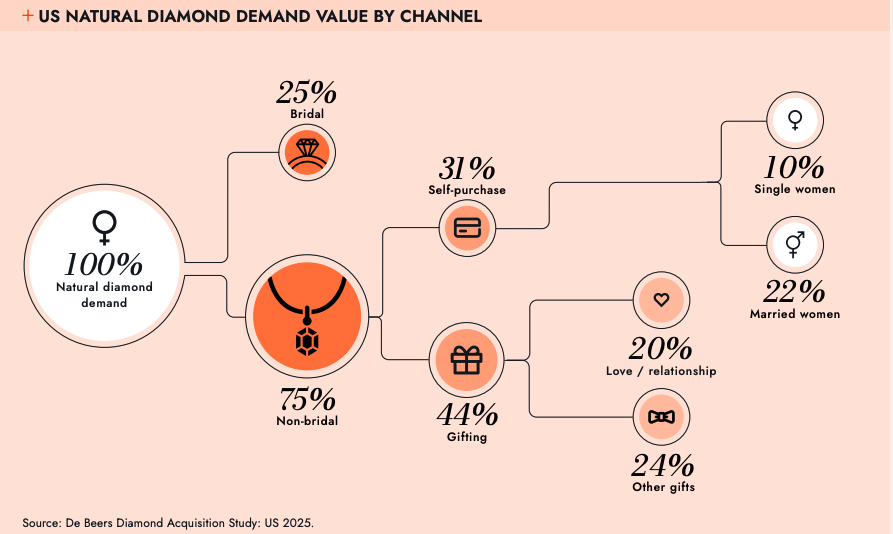
- Bridal still dominates but only accounts for 45% of Gen Z natural diamond demand, indicating diversification of use-cases.
- Non-bridal purchases now include promotions, career milestones, birthdays and self-reward, smoothing demand beyond engagement seasonality.
- De Beers–Signet “Worth the Wait” campaign (launched October 2024) targets Zillennials with milestone-focused messaging.
- Luanda Accord allocates 1% of rough diamond revenues to a Natural Diamond Council marketing fund.
- Analyst Paul Zimnisky estimates 2026 natural diamond supply at ~90 million carats, the lowest since 1987.
- Zimnisky reports early rough-price support, suggesting tightening supply–demand balance after four years of contraction.
Our Take
The rebound in natural diamond demand that De Beers is attributing to Gen Z comes as Anglo American has written De Beers down to $2.3 billion and is exploring an exit, so sustained US bridal and gifting demand will be central to any valuation case for potential buyers such as Botswana’s proposed sovereign-backed vehicle.
With natural diamond supply estimated around 90 million carats versus 150 million carats historically, De Beers’ upstream technology push noted in our recent coverage suggests a parallel strategy: squeeze more value from a structurally tighter supply base through higher average prices and improved recovery rather than chasing volume growth.
In our database of diamond-tagged mining pieces, only a handful link consumer behaviour metrics (like Gen Z’s 23% share of US natural diamond demand) directly to upstream strategy, which signals De Beers is unusually explicit in tying mine-side decisions and marketing spend (e.g. the 1% Luanda Accord contribution) to retail demographic data.
Prepared by collating external sources, AI-assisted tools, and Geomechanics.io’s proprietary mining database, then reviewed for technical accuracy & edited by our geotechnical team.
Related Articles
Related Industries & Products
Mining
Geotechnical software solutions for mining operations including CMRR analysis, hydrogeological testing, and data management.
CMRR-io
Streamline coal mine roof stability assessments with our cloud-based CMRR software featuring automated calculations, multi-scenario analysis, and collaborative workflows.
HYDROGEO-io
Comprehensive hydrogeological testing platform for managing, analysing, and reporting on packer tests, lugeon values, and hydraulic conductivity assessments.
GEODB-io
Centralised geotechnical data management solution for storing, accessing, and analysing all your site investigation and material testing data.