Cuba’s cobalt weak spot: supply chain and refining risks for mining projects
Reviewed by Joe Ashwell
First reported on MINING.com
30 Second Briefing
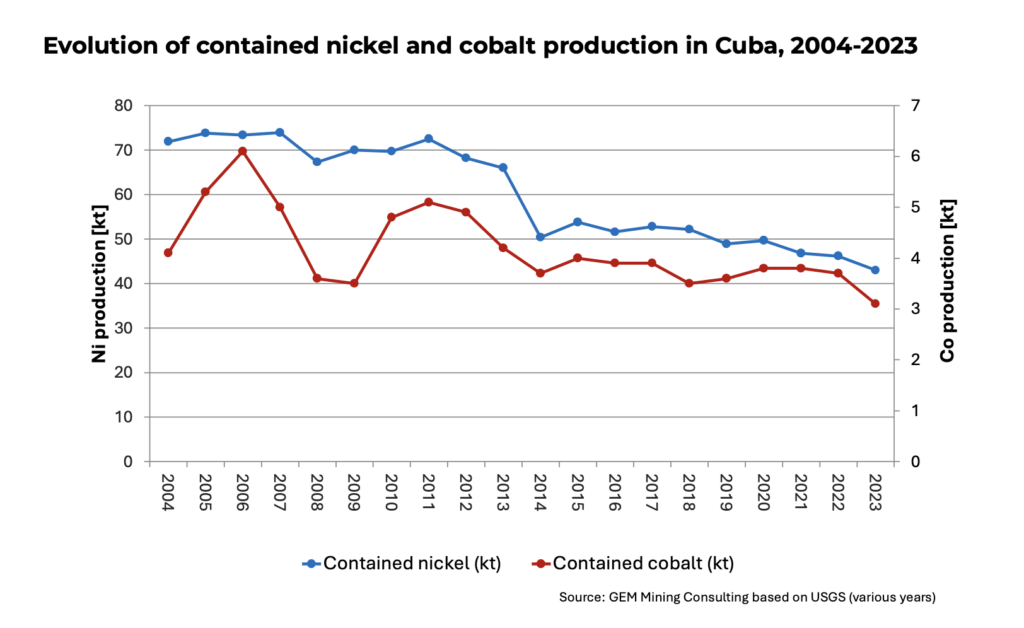
Canada’s only cobalt refinery, Sherritt International’s Fort Saskatchewan plant in Alberta, has been idled after a May US executive order widened sanctions on Cuba’s metals and mining sector, cutting off mixed sulphide precipitate feed from the Moa nickel-cobalt HPAL operation. Analyst Patricio Faúndez of GEM Mining Consulting warns that Western critical mineral strategy remains exposed because refineries in allied jurisdictions still depend on politically and legally “financeable” upstream supply. With China producing about 79% of refined cobalt and Cuba’s nickel output down to roughly 43,000 tonnes in 2023, the disruption shows how sanctions within Western frameworks can strand both Cuban resources and scarce Western refining capacity.
Technical Brief
- Fort Saskatchewan’s feedstock is mixed sulphide precipitate from the Moa HPAL laterite operation in eastern Cuba.
- Moa integrates open pit mining with high-pressure acid leaching, exporting an intermediate rather than raw ore.
- Cuban nickel output declined from stable 2004–2013 levels to about 43,000 tonnes by 2023.
- Cobalt production in Cuba fell from mid‑2000s peaks near 6,000 tonnes to roughly half that.
- Cuba’s key lateritic nickel‑cobalt districts are clustered around Moa, Nicaro, Mayarí and Holguín.
- Castellanos is cited as a smaller zinc‑lead‑barite project, indicating some diversification beyond nickel‑cobalt.
- China produced ~79% of refined cobalt in 2025, while Canada contributed only about 3%.
- Democratic Republic of Congo and Indonesia together supplied nearly 90% of global cobalt mine output in 2025.
- BMO projects nickel prices recovering into a US$18,000–20,000/t medium‑term range, improving laterite project economics.
- Sanctions act via banking, insurance, auditing and trade compliance channels, even without directly blocking plant operations.
Our Take
With the Fort Saskatchewan refinery now shut under US sanctions, as covered in our 23 June piece, Canada’s 3% share of refined cobalt is likely to erode further, tightening North American access to non-Chinese battery materials processing capacity.
GEM Mining Consulting’s recent work on integrated mining districts and alternative chemistries suggests that while cobalt remains critical, OEMs and cell makers are already modelling substitution pathways that reduce exposure to high‑risk sources such as the DRC, Indonesia and now Cuba-linked flows.
Prepared by collating external sources, AI-assisted tools, and Geomechanics.io’s proprietary mining database, then reviewed for technical accuracy & edited by our geotechnical team.
Related Articles


Related Industries & Products
Mining
Geotechnical software solutions for mining operations including CMRR analysis, hydrogeological testing, and data management.
CMRR-io
Streamline coal mine roof stability assessments with our cloud-based CMRR software featuring automated calculations, multi-scenario analysis, and collaborative workflows.
HYDROGEO-io
Comprehensive hydrogeological testing platform for managing, analysing, and reporting on packer tests, lugeon values, and hydraulic conductivity assessments.
GEODB-io
Centralised geotechnical data management solution for storing, accessing, and analysing all your site investigation and material testing data.