Geomechanics.io

  • Free Tools
Sign UpLog In
AllGeotechnicalMiningInfrastructureMaterialsHazardsEnvironmentalSoftwarePolicy

Geomechanics.io

Geomechanics, Streamlined.

© 2026 Geomechanics.io. All rights reserved.

Geomechanics.io

CMRR-ioGEODB-ioHYDROGEO-ioQCDB-ioFree Tools & CalculatorsBlogLatest Industry News

Industries

MiningConstructionTunnelling

Company

Terms of UsePrivacy PolicyLinkedIn
    Projects

    Copper rally and 2026 earnings: project and capex implications for mine planners

    January 28, 2026|

    Reviewed by Joe Ashwell

    Copper rally and 2026 earnings: project and capex implications for mine planners

    First reported on MINING.com

    30 Second Briefing

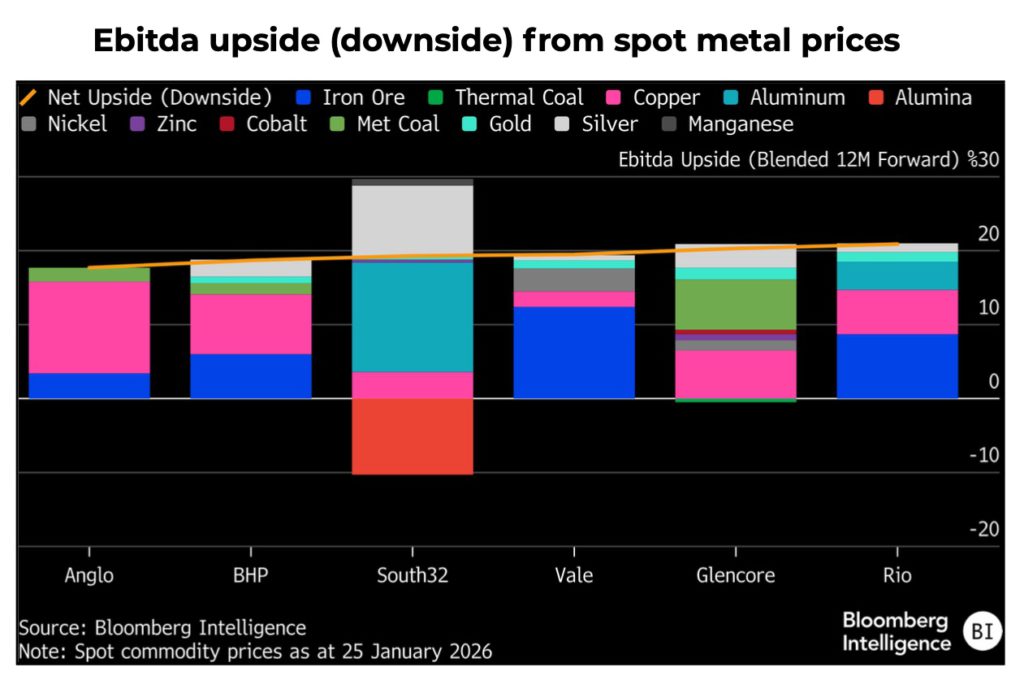
    Copper’s price rally is setting up one of the strongest earnings years since early 2025 for diversified miners, with spot levels implying 18%–21% upside to 2026 consensus Ebitda and Rio Tinto and Glencore each showing about 20%–21% potential. Copper is projected to generate over 35% of diversified miners’ 2026 Ebitda, with Anglo American’s Teck deal pushing its copper share above 70%, BHP nearing 50%, Glencore about 35% and Rio at roughly 26% versus 47% from iron ore. Execution risk looms as Glencore advances Coroccohuayco and the Alumbrera restart, BHP progresses Jansen and the Vicuna study, and Vale pursues a plan to double copper output by 2030.

    Technical Brief

    • Spot prices imply 18%–21% upside to one‑year forward consensus Ebitda for major diversified miners.
    • Rio Tinto’s 2026 Ebitda forecasts have already risen 18% in six months, yet spot still implies +21%.
    • Glencore’s 2026 Ebitda has only increased 5% over the same period, leaving more headroom for upgrades.
    • About two‑thirds of Glencore’s spot‑implied Ebitda upside comes from metallurgical coal and copper price strength.
    • Precious metals are non‑core for Glencore yet gold and silver add over 4% to its implied upside.
    • Copper’s Ebitda share for diversified miners is up ~14 percentage points versus eight years ago, driven mainly by prices and portfolio pruning.
    • Rio Tinto has lifted copper output 54% since 2019 via Oyu Tolgoi ramp‑up, versus BHP’s 11% increase.
    • Stronger earnings revisions may encourage scrip‑funded M&A, but raise execution risk on unde‑risked copper growth pipelines.

    Our Take

    The projected 24–28% 2026 Ebitda growth for copper‑heavy Glencore and Anglo American aligns with our recent coverage of Rio Tinto–Glencore merger talks, where analysts argued that consolidating large copper portfolios would be one of the main value drivers rather than coal or iron ore exposure.

    Anglo American’s pro‑forma copper earnings share above 70% and BHP’s near‑50% tilt mean both are structurally more leveraged to the 16–25% copper price uplift scenarios than Rio Tinto, which our database still shows as primarily iron ore‑weighted despite the Oyu Tolgoi ramp‑up.

    Vale’s plan to double copper output by 2030 positions it as a late but aggressive entrant into the copper‑weighted diversified peer set tracked across our 784 Mining stories, potentially narrowing the strategic gap with BHP and Anglo on energy‑transition metals exposure.

    Geotechnical Software for Modern Teams

    Centralise site data, logs, and lab results with GEODB-io, CMRR-io, and HYDROGEO-io.

    No credit card required.

    • Save and export unlimited calculations
    • Advanced data visualisation
    • Generate professional PDF reports
    • Cloud storage for all your projects

    Prepared by collating external sources, AI-assisted tools, and Geomechanics.io’s proprietary mining database, then reviewed for technical accuracy & edited by our geotechnical team.

    Related Articles

    King’s Japan visit: fuel security and critical minerals lens for project teams
    Mining
    about 11 hours ago

    King’s Japan visit: fuel security and critical minerals lens for project teams

    Fuel security concerns will dominate Federal Resources Minister Madeleine King’s visit to Japan this weekend, with talks expected to focus on diesel and LNG supply chains and Australia’s role as a long-term energy exporter. King is also set to discuss Japanese investment in Australian critical minerals projects, including lithium, nickel and rare earths, amid pressure to diversify away from single-country processing hubs. Outcomes could influence future offtake agreements, funding for new mines and refineries, and infrastructure for secure fuel storage and shipping routes.

    Gold and silver price weakness: planning implications for mine project teams
    Mining
    about 19 hours ago

    Gold and silver price weakness: planning implications for mine project teams

    Gold slipped below $5,100/oz on Friday, touching about $5,020 and heading for a second straight weekly loss as the Middle East war drives up oil and gas prices and keeps interest rate cut expectations low. The metal has traded in a tight $5,000–$5,200/oz range since an early-month spike after the US-Israeli strike on Iran, and is now almost 9% off its late-January record near $5,600/oz, though still 17% higher year-to-date. Silver fell almost 5% to just above $80/oz, with only a 10% gain so far in 2026.

    Rio Tinto’s Nemaska lithium plant slowdown: schedule and feed risks for mine planners
    Mining
    about 20 hours ago

    Rio Tinto’s Nemaska lithium plant slowdown: schedule and feed risks for mine planners

    Rio Tinto is slowing construction of the Nemaska lithium hydroxide conversion plant at Bécancour, Quebec, cutting its contractual workforce by about 50% while keeping several hundred workers on site, but still targets commissioning this decade and first production in 2028. The plant is roughly 70% complete, designed for 32,000 tonnes per year of lithium hydroxide, with Rio planning US$300 million of investment alongside a C$200 million commitment from the Quebec government, which retains 46.1%. Nemaska’s integrated project is based on a 26‑year Whabouchi open‑pit/underground mine producing 200,000 tonnes of spodumene concentrate annually, though Rio is reassessing feed against its Galaxy hard rock project, with a decision due in H2 2026.

    Related Industries & Products

    Mining

    Geotechnical software solutions for mining operations including CMRR analysis, hydrogeological testing, and data management.

    CMRR-io

    Streamline coal mine roof stability assessments with our cloud-based CMRR software featuring automated calculations, multi-scenario analysis, and collaborative workflows.

    HYDROGEO-io

    Comprehensive hydrogeological testing platform for managing, analysing, and reporting on packer tests, lugeon values, and hydraulic conductivity assessments.

    GEODB-io

    Centralised geotechnical data management solution for storing, accessing, and analysing all your site investigation and material testing data.