Geomechanics.io

  • Free Tools
Sign UpLog In

Geomechanics.io

Geomechanics, Simplified.

© 2026 Geomechanics.io. All rights reserved.

Geomechanics.io

CMRR-ioGEODB-ioHYDROGEO-ioQCDB-ioFree Tools & CalculatorsBlogLatest Industry News

Industries

MiningConstructionTunnelling

Company

Terms of UsePrivacy PolicyLinkedIn
    AllGeotechnicalMiningInfrastructureMaterialsHazardsEnvironmentalSoftwarePolicy
    Projects
    Contract Award

    Clifton Bridge demolition on the M6: staging, plant and programme notes for engineers

    January 5, 2026|

    Reviewed by Joe Ashwell

    Clifton Bridge demolition on the M6: staging, plant and programme notes for engineers

    First reported on The Construction Index

    30 Second Briefing

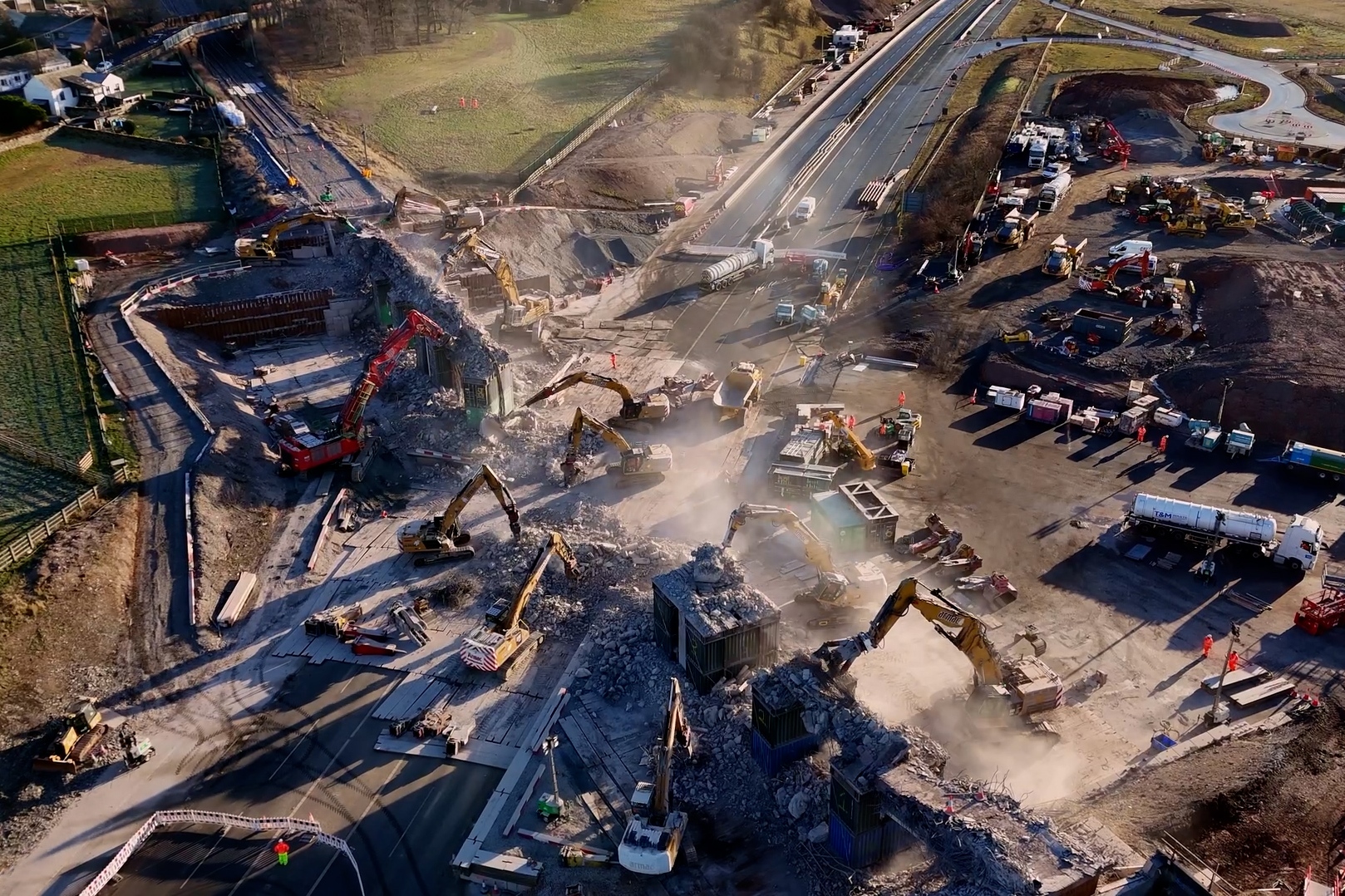
    Demolition of the 130-metre-long Clifton Bridge carrying the West Coast Main Line over the six-lane M6 near Penrith was completed in a 55-hour closure using some of the UK’s largest excavators, allowing the motorway to reopen 70 minutes ahead of schedule. The £60m Network Rail–Skanska scheme retained the existing support structures to receive a 4,200-tonne composite steel-and-concrete replacement bridge, to be installed during a further 57-hour closure from 9–12 January 2026. Overall, nearly £200m of West Coast Main Line works proceeded over the festive period, including a £26m track renewal between Northampton and Milton Keynes.

    Technical Brief

    • Demolition targeted a 1960s reinforced-concrete rail bridge spanning the full six lanes of the M6.
    • Works were executed under a full closure between junctions 39 and 40, tightly constrained to one weekend.
    • Network Rail acted as client with Skanska as principal contractor, coordinating with National Highways for motorway possession.
    • Excavation fleet comprised some of the UK’s largest high-reach machines, working continuous 24/7 shifts for duration.
    • Support structures for the new 4,200‑tonne composite bridge were deliberately retained, avoiding new substructure construction.
    • Clifton Bridge removal forms part of a defined £60m renewal programme focused on this West Coast Main Line crossing.
    • In parallel, a separate £26m track renewal between Northampton and Milton Keynes was delivered over the festive blockade.

    Our Take

    Cementation Skanska’s earlier completion of ground engineering and piling for Clifton Bridge, noted in our November 2025 coverage, means the current demolition and rapid possession strategy is part of a tightly sequenced programme aimed at minimising repeated disruption on the M6 and West Coast Main Line.

    With nearly £200m of festive-season upgrades along the West Coast Main Line between London and Cumbria, this £60m Clifton Bridge scheme positions Network Rail’s North West and Central region as one of the more intensively worked corridors in our 338-item infrastructure database, which has implications for access planning and contractor availability into early 2026.

    National Highways’ role here, alongside its involvement in the Lower Thames Crossing RAB-funded megaproject, suggests it is increasingly coordinating motorway possessions for both major new-build and life-expired asset replacement, giving contractors like Skanska a pipeline that mixes complex brownfield interfaces with long-duration strategic schemes.

    Geotechnical Software for Modern Teams

    Centralise site data, logs, and lab results with GEODB-io, CMRR-io, and HYDROGEO-io.

    No credit card required.

    • Save and export unlimited calculations
    • Advanced data visualisation
    • Generate professional PDF reports
    • Cloud storage for all your projects

    Prepared by collating external sources, AI-assisted tools, and Geomechanics.io’s proprietary mining database, then reviewed for technical accuracy & edited by our geotechnical team.

    Related Articles

    Xihe on Tung Chung Line down-track: TBM turnback method and risks for tunnel engineers
    Infrastructure
    in 5 months

    Xihe on Tung Chung Line down-track: TBM turnback method and risks for tunnel engineers

    TBM Xihe, a 7.3m-diameter, 100m-long, 1,000-tonne Herrenknecht slurry machine, has completed the up-track drive to the future Tung Chung West Station and has begun boring the down-track tunnel towards Tung Chung Station for MTR’s Tung Chung Line Extension in Hong Kong. The Bouygues Travaux Publics–Dragages Hong Kong JV turned the TBM underground within the launch shaft using a push-pull method and self-propelled modular transporter, avoiding full disassembly and surface transport. About 1.3km of new twin-bore tunnels are being driven close to existing rail and urban structures, with commissioning targeted for 2029.

    Sydney Metro Stations Package West: design and delivery notes for engineers
    Infrastructure
    in 4 months

    Sydney Metro Stations Package West: design and delivery notes for engineers

    Gamuda Engineering has secured the Sydney Metro Stations Package West as principal contractor, covering design and construction of five new underground stations at Westmead, North Strathfield, Burwood North, Five Dock and The Bays on the 24km Sydney Metro West line between Greater Parramatta and the CBD. The scope includes deep station boxes, entrances and access points, full station fit-out and integration with surrounding precincts, with Laing O’Rourke and DT Infrastructure joining as MetroVista delivery partners. Site works are scheduled to start on Monday, 5 January 2026.

    Nottingham Forest City Ground expansion: design and crowd-flow notes for engineers
    Infrastructure
    about 21 hours ago

    Nottingham Forest City Ground expansion: design and crowd-flow notes for engineers

    Nottingham Forest has submitted new plans to expand the City Ground from 30,445 to about 52,000 seats, replacing last year’s approved but smaller 35,000-capacity scheme focused on rebuilding the Peter Taylor Stand. The revised project team is led by KSS Design Group, with Buro Happold, Gleeds and Savills advising, and owner Evangelos Marinakis committing “significant investment” for a “sustainable and iconic” redevelopment. For civil and structural engineers, the jump to a 52,000-seat bowl signals substantially larger crowd loading, egress, services and transport interface requirements on an already constrained riverside site.

    Related Industries & Products

    Construction

    Quality control software for construction companies with material testing, batch tracking, and compliance management.

    Mining

    Geotechnical software solutions for mining operations including CMRR analysis, hydrogeological testing, and data management.

    QCDB-io

    Comprehensive quality control database for manufacturing, tunnelling, and civil construction with UCS testing, PSD analysis, and grout mix design management.