Geomechanics.io

  • Free Tools
Sign UpLog In
AllGeotechnicalMiningInfrastructureMaterialsHazardsEnvironmentalSoftwarePolicy

Geomechanics.io

Geomechanics, Simplified.

© 2025 Geomechanics.io. All rights reserved.

Geomechanics.io

CMRR-ioGEODB-ioHYDROGEO-ioQCDB-ioFree Tools & CalculatorsBlogLatest Industry News

Industries

MiningConstructionTunnelling

Company

Terms of UsePrivacy PolicyLinkedIn
    Projects

    Cash flow tax rethink: implications for Australian mine project economics

    December 22, 2025|

    Reviewed by Joe Ashwell

    Cash flow tax rethink: implications for Australian mine project economics

    First reported on Australian Mining

    30 Second Briefing

    A Productivity Commission proposal to replace company tax with a hybrid cash flow tax has drawn a lukewarm response from the Minerals Council of Australia and the Association of Mining and Exploration Companies, which warn it could deter long-life, capital-intensive projects. Industry groups argue that immediate expensing of capital and tighter limits on interest deductibility may not suit multi-decade mines with heavy upfront spend on shafts, processing plants and rail links. They are calling for detailed modelling of impacts on marginal projects, junior explorers and existing royalty and PRRT settings before any shift proceeds.

    Technical Brief

    • Proposal centres on a “hybrid” cash flow tax combining features of income and expenditure-based systems.
    • Broader implication is that tax design must align with long-lead, capital-heavy resource project financing structures.

    Our Take

    Among the 59 Policy stories in our database, Australia features frequently in debates over resource taxation and royalties, so a cash flow tax proposal here will be read by operators as a potential bellwether for other fiscal changes rather than a one-off idea.

    For project developers tracked under our 812 Projects-tagged pieces, a shift towards cash flow–based taxation in Australia would mainly affect project finance models and debt covenants, as lenders typically key off post-tax cash flows and payback timing.

    The Productivity Commission’s involvement signals that any redesign of mining taxation in Australia is likely to be framed around long-run efficiency and investment incentives, which could favour capital-intensive projects if deductions for upfront spend are accelerated.

    Geotechnical Software for Modern Teams

    Centralise site data, logs, and lab results with GEODB-io, CMRR-io, and HYDROGEO-io.

    No credit card required.

    • Save and export unlimited calculations
    • Advanced data visualisation
    • Generate professional PDF reports
    • Cloud storage for all your projects

    Prepared by collating external sources, AI-assisted tools, and Geomechanics.io’s proprietary mining database, then reviewed for technical accuracy & edited by our geotechnical team.

    Related Articles

    Engineers Against Poverty chair: governance, carbon and cost lessons for project teams
    Policy
    about 6 hours ago

    Engineers Against Poverty chair: governance, carbon and cost lessons for project teams

    Engineers Against Poverty chair Richard Threlfall calls for the engineering, infrastructure and construction profession to lead on cutting whole‑life emissions and controlling capital cost overruns in major civils programmes. He argues that effective infrastructure governance must move beyond compliance to active stewardship of carbon, cost and social outcomes, with engineers shaping procurement models and performance metrics rather than leaving them to financiers and policymakers. For practitioners, this signals greater responsibility for transparent cost baselines, carbon accounting and value-for-money evidence on large public works.

    IEF critical minerals trade warning: supply risk lens for project teams
    Policy
    about 18 hours ago

    IEF critical minerals trade warning: supply risk lens for project teams

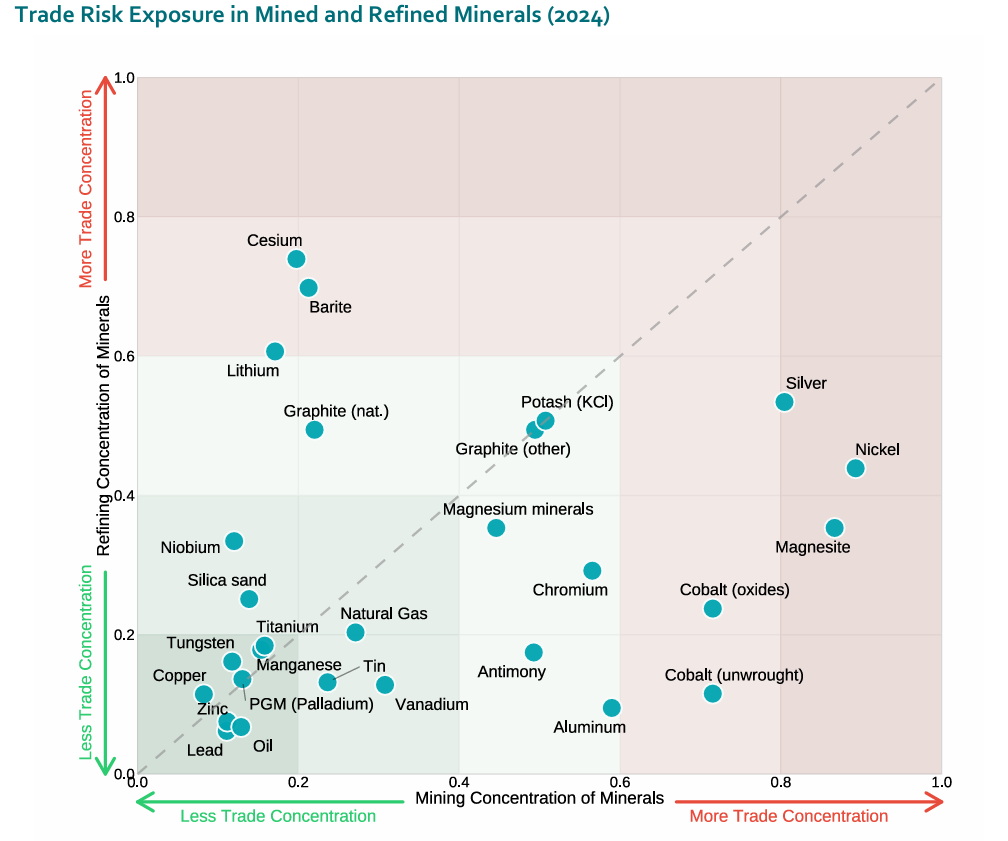
    More than 60% of global demand for critical minerals is now met via international trade, with the IEF warning that copper and nickel could face material shortfalls by the mid-2030s as total demand for copper, nickel, cobalt, lithium and rare earths climbs from 28 Mt in 2021 to nearly 41 Mt by 2040. EV copper use alone is forecast to jump from 200,000 t in 2020 to 3.4 Mt by 2035, while Indonesia supplies over half of nickel, the DRC about 70% of cobalt, and China over 90% of rare earth refining. More than 600 policies now target critical mineral supply chains, with the US, Canada and Australia incentivising exploration, refining and recycling, and Indonesia, Chile and Peru pushing in-country value addition and export controls.

    US critical mineral resilience in 2026: processing-first shift for project teams
    Policy
    about 22 hours ago

    US critical mineral resilience in 2026: processing-first shift for project teams

    US federal critical minerals policy in 2026 is set to move beyond rare earths to high‑risk inputs such as antimony and tungsten, where the US currently relies heavily on China, Tajikistan and Russia for supply into defence alloys, munitions and flame‑retardant applications. Washington is expected to prioritise domestic processing capacity over new mines, backing alternatives to traditional smelting and refining that cut emissions and withstand high US power prices. Intensifying competition for electricity from AI data centres will put aluminium, copper, magnesium and titanium processors under pressure, favouring technologies that materially lower energy use and total production costs.

    Related Industries & Products

    Mining

    Geotechnical software solutions for mining operations including CMRR analysis, hydrogeological testing, and data management.

    CMRR-io

    Streamline coal mine roof stability assessments with our cloud-based CMRR software featuring automated calculations, multi-scenario analysis, and collaborative workflows.

    HYDROGEO-io

    Comprehensive hydrogeological testing platform for managing, analysing, and reporting on packer tests, lugeon values, and hydraulic conductivity assessments.

    GEODB-io

    Centralised geotechnical data management solution for storing, accessing, and analysing all your site investigation and material testing data.