Cardiff geothermal heat network: design and funding insights for engineers
Reviewed by Joe Ashwell
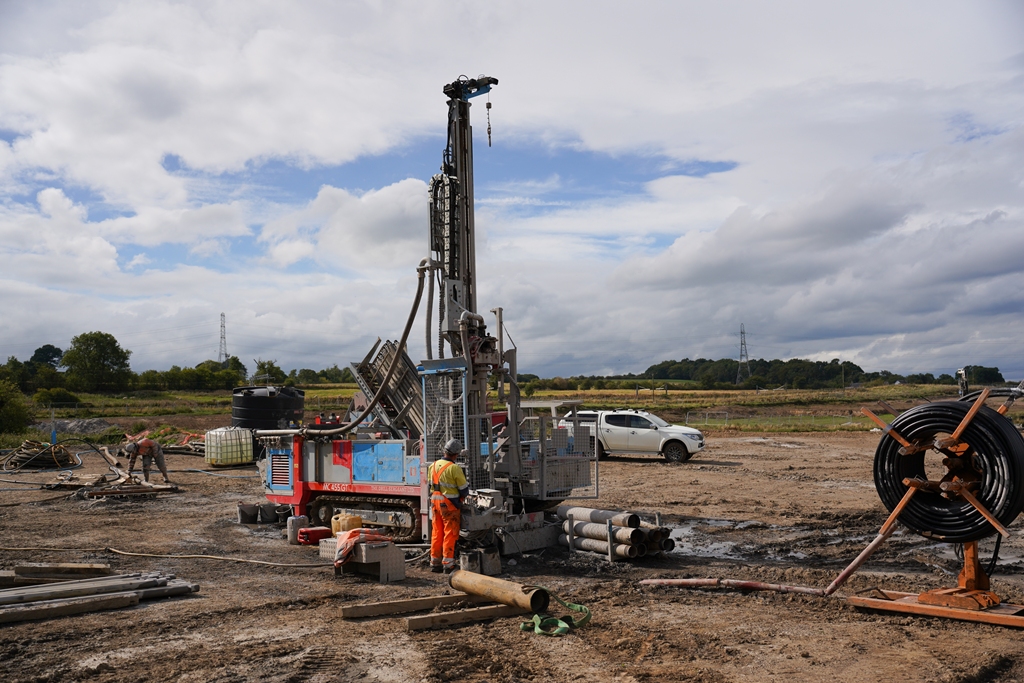
First reported on The Construction Index
30 Second Briefing
Wates Residential has appointed UK Power Solutions and subcontractor Rendesco to install a centralised ground source heat network with 47 geothermal boreholes serving 235 homes on the 27‑acre former Michaelston Community College site in Cardiff. The system, to be adopted and operated by Last Mile Heat, uses individual heat interface units and is projected to cut carbon emissions by up to 80% versus gas boilers and 54% versus air source heat pumps, while lowering residents’ running costs. Wates will recover nearly half of the network’s capital cost via forward‑funded rebate payments, easing upfront financing constraints on low‑emission heat infrastructure.
Technical Brief
- Centralised energy centre connects 47 production boreholes to 235 dwellings via buried distribution pipework.
- Borehole field and energy centre must be integrated within a constrained 27‑acre brownfield school footprint.
- UK Power Solutions leads design and installation; Rendesco delivers specialist drilling and ground source infrastructure.
- Last Mile Heat will ultimately adopt, own and operate the buried network assets post‑construction.
- Housing mix drives diversified load profile: 115 open‑market units, 120 council homes plus non‑residential buildings.
- Community centre, café and medical centre introduce higher domestic hot‑water and variable occupancy heating demands.
- Cardiff Living partnership structure (Wates Residential and Cardiff Council) aligns planning, funding and long‑term operation.
- Forward‑funded rebate model offers a replicable template for district ground source schemes on UK residential sites.
Our Take
Among the 741 Infrastructure stories in our database, very few UK schemes combine a mid-density housing estate of over 200 units with a dedicated geothermal borefield, so the Michaelston Community College site will be a useful performance benchmark for future local-authority heat networks.
The split between 120 council homes and 115 open-market units means Cardiff Council is effectively trialling a single low-carbon heat solution across both tenure types, which could simplify future regulatory and metering frameworks compared with mixed-technology estates.
Achieving an 80% emissions reduction versus gas and a material gain even over air-source heat pumps suggests the ground conditions in Cardiff are favourable for closed-loop geothermal; if monitoring confirms the modelled gains, this will strengthen the case for similar borehole arrays on other brownfield school sites in the UK.
Prepared by collating external sources, AI-assisted tools, and Geomechanics.io’s proprietary mining database, then reviewed for technical accuracy & edited by our geotechnical team.
Related Articles


Related Industries & Products
Construction
Quality control software for construction companies with material testing, batch tracking, and compliance management.
Mining
Geotechnical software solutions for mining operations including CMRR analysis, hydrogeological testing, and data management.
QCDB-io
Comprehensive quality control database for manufacturing, tunnelling, and civil construction with UCS testing, PSD analysis, and grout mix design management.