Geomechanics.io

  • Free Tools
Sign UpLog In
AllGeotechnicalMiningInfrastructureMaterialsHazardsEnvironmentalSoftwarePolicy

Geomechanics.io

Geomechanics, Simplified.

© 2025 Geomechanics.io. All rights reserved.

Geomechanics.io

CMRR-ioGEODB-ioHYDROGEO-ioQCDB-ioFree Tools & CalculatorsBlogLatest Industry News

Industries

MiningConstructionTunnelling

Company

Terms of UsePrivacy PolicyLinkedIn
    Projects

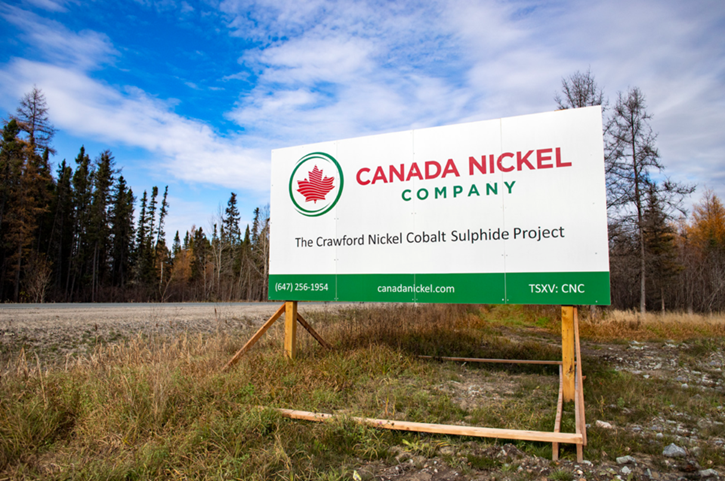
    Canada Nickel’s Timmins Nickel District: scale, grades and project lens for engineers

    December 18, 2025|

    Reviewed by Joe Ashwell

    Canada Nickel’s Timmins Nickel District: scale, grades and project lens for engineers

    First reported on MINING.com

    30 Second Briefing

    Canada Nickel has declared its Timmins Nickel District in northern Ontario the country’s largest undeveloped nickel district, with contained metal rising about 12% to 20.9 million tonnes after new initial resources at Bannockburn and Midlothian. Bannockburn now hosts 63 million indicated tonnes at 0.28% nickel plus 129 million inferred tonnes at 0.27%, while Midlothian adds 595 million inferred tonnes at 0.28% nickel from drilling totalling 9,268 metres in 22 holes. The district, anchored by the 9.7‑million‑tonne Crawford deposit and seven other defined resources, now exceeds The Metals Company’s Clarion‑Clipperton seabed nickel resource.

    Technical Brief

    • Midlothian’s resource covers only ~45% of its geophysical target footprint, implying substantial upside drilling.
    • Texmont and Mann Central additions in July lifted district resources by almost 2 Mt contained nickel in five months.
    • Timmins Nickel District’s contained nickel is now comparable to the total historically mined in Sudbury, per Canada Nickel.

    Our Take

    With 20.9 Mt of contained nickel across the Timmins Nickel District and a market value of about C$257 million, Canada Nickel is trading at a contained-metal multiple that is markedly lower than many single-asset peers in our database, which may give larger producers a low-cost option to secure long-life nickel units in Canada.

    The Ontario–Canada “one project, one review” framework flagged in our recent coverage for critical minerals projects could materially de-risk timelines for Canada Nickel’s Timmins-area assets, as most of its deposits sit in northern Ontario where permitting bottlenecks have historically delayed bulk-tonnage nickel projects.

    Macquarie’s flagged potential reduction in Indonesian nickel ore supply in 2026, noted in another related piece, would make large-scale sulphide resources such as Crawford, Bannockburn and Midlothian more strategically important for OEMs seeking non-Indonesian supply, even at relatively low head grades around 0.27–0.28% Ni.

    Geotechnical Software for Modern Teams

    Centralise site data, logs, and lab results with GEODB-io, CMRR-io, and HYDROGEO-io.

    No credit card required.

    • Save and export unlimited calculations
    • Advanced data visualisation
    • Generate professional PDF reports
    • Cloud storage for all your projects

    Prepared by collating external sources, AI-assisted tools, and Geomechanics.io’s proprietary mining database, then reviewed for technical accuracy & edited by our geotechnical team.

    Related Articles
    MEGAMINES’ top 10 most capital intensive bulk mines: capex and risk notes for engineers
    Mining
    about 8 hours ago

    MEGAMINES’ top 10 most capital intensive bulk mines: capex and risk notes for engineers

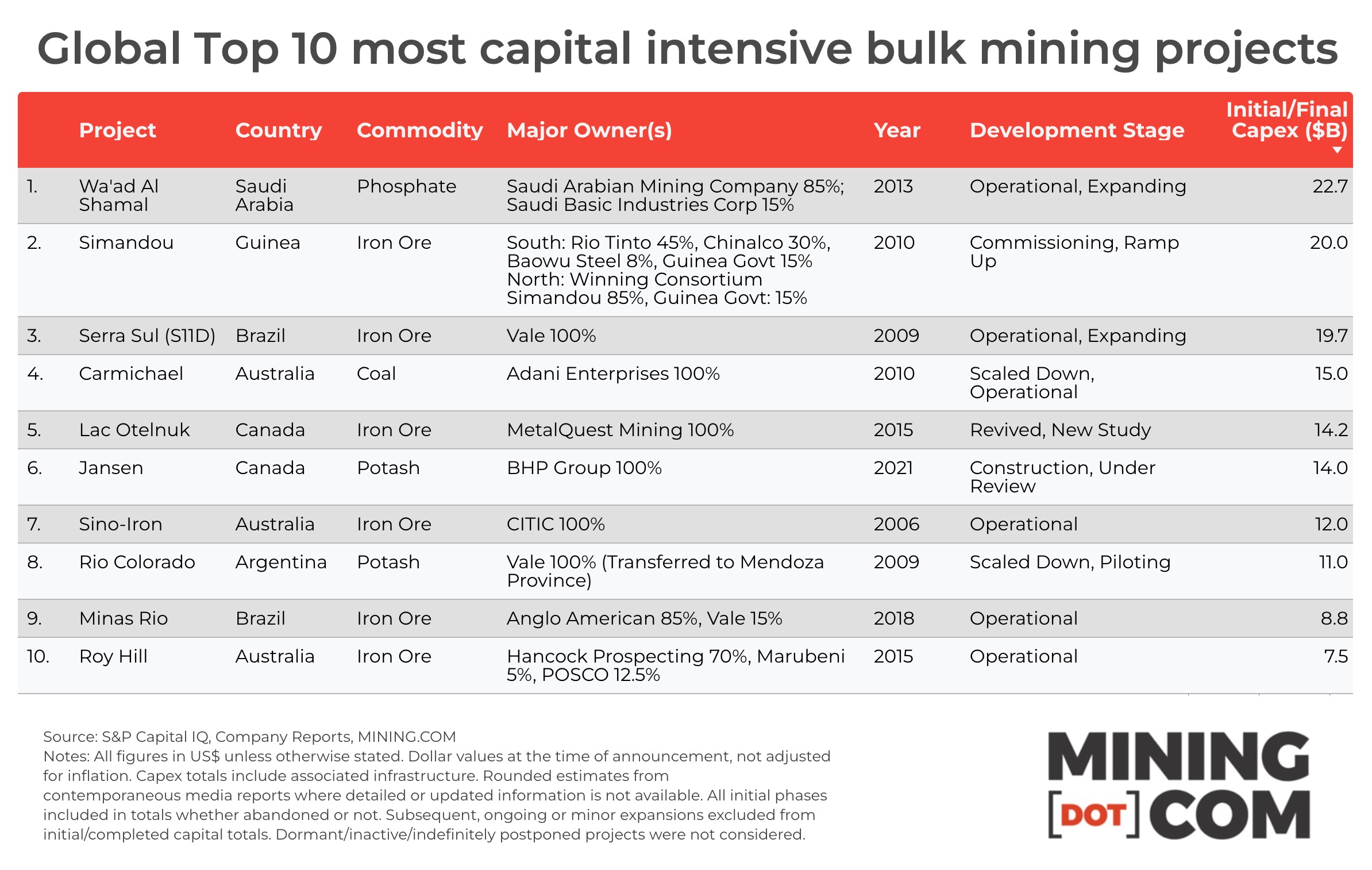
    MEGAMINES ranks Saudi Arabia’s Wa’ad Al Shamal phosphate complex as the world’s costliest mining project, with total industrial-city investment of $22.7 billion and Ma’aden’s mine-and-refining CAPEX estimated at $15.5 billion, including an $8 billion original plant and a $7.7 billion Phosphate 3 expansion due by 2027. Guinea’s Simandou iron ore development follows with more than $20 billion in shared mine–rail–port spend, a 600 km trans-Guinean railway to a new deepwater port, and targeted output of 120 Mtpa of ~66% Fe ore by 2028. Brazil’s Serra Sul (S11D) at $19.5 billion plus a $2.8 billion brownfield expansion to 120 Mtpa, and Adani’s Carmichael coal project, originally scoped at 60 Mtpa with A$16.5–A$22 billion CAPEX but now operating at 10 Mtpa with a 200 km rail link, illustrate the scale, long timelines and redesign risk inherent in bulk mining megaprojects.

    Trilogy–South32 Arctic copper permit push: design and geotech notes for engineers
    Mining
    about 12 hours ago

    Trilogy–South32 Arctic copper permit push: design and geotech notes for engineers

    Trilogy Metals and South32’s 50/50 Ambler Metals JV has approved a $35 million 2026 work programme at Alaska’s Upper Kobuk Mineral Projects, targeting mine-permit submissions for the high-grade Arctic copper deposit under federal FAST-41. Drilling will focus on geotechnical and condemnation holes for mine design and infrastructure siting, while the Bornite camp is upgraded for multi-year geotechnical and exploration campaigns and an independent UKMP management team is re-established. Arctic’s 2023 feasibility study outlines a 13-year operation producing 149 Mlb/y copper plus zinc, lead, gold and silver, with an after-tax NPV8 of $1.1 billion and 22.8% IRR.

    Almonty’s Sangdong tungsten mine: commercial start and stoping plan notes for engineers
    Mining
    about 13 hours ago

    Almonty’s Sangdong tungsten mine: commercial start and stoping plan notes for engineers

    Almonty Industries has begun commercial mining at the Sangdong tungsten mine in Yeongwol, Gangwon Province, with the first truckload of ore delivered to the run-of-mine (ROM) pad, signalling the shift from development to active extraction. The project is centred on redeveloping one of the world’s historically significant tungsten deposits, aiming to supply high-grade ore into Asian and global hardmetal and alloy markets. For mine planners and geotechnical teams, the move commits the site to full-scale stoping, ground support, and backfill sequencing rather than purely development headings.

    Related Industries & Products

    Mining

    Geotechnical software solutions for mining operations including CMRR analysis, hydrogeological testing, and data management.

    CMRR-io

    Streamline coal mine roof stability assessments with our cloud-based CMRR software featuring automated calculations, multi-scenario analysis, and collaborative workflows.

    HYDROGEO-io

    Comprehensive hydrogeological testing platform for managing, analysing, and reporting on packer tests, lugeon values, and hydraulic conductivity assessments.

    GEODB-io

    Centralised geotechnical data management solution for storing, accessing, and analysing all your site investigation and material testing data.