Burnley skip yard crush incident: vehicle–pedestrian control lessons for engineers
Reviewed by Tom Sullivan
First reported on The Construction Index
30 Second Briefing
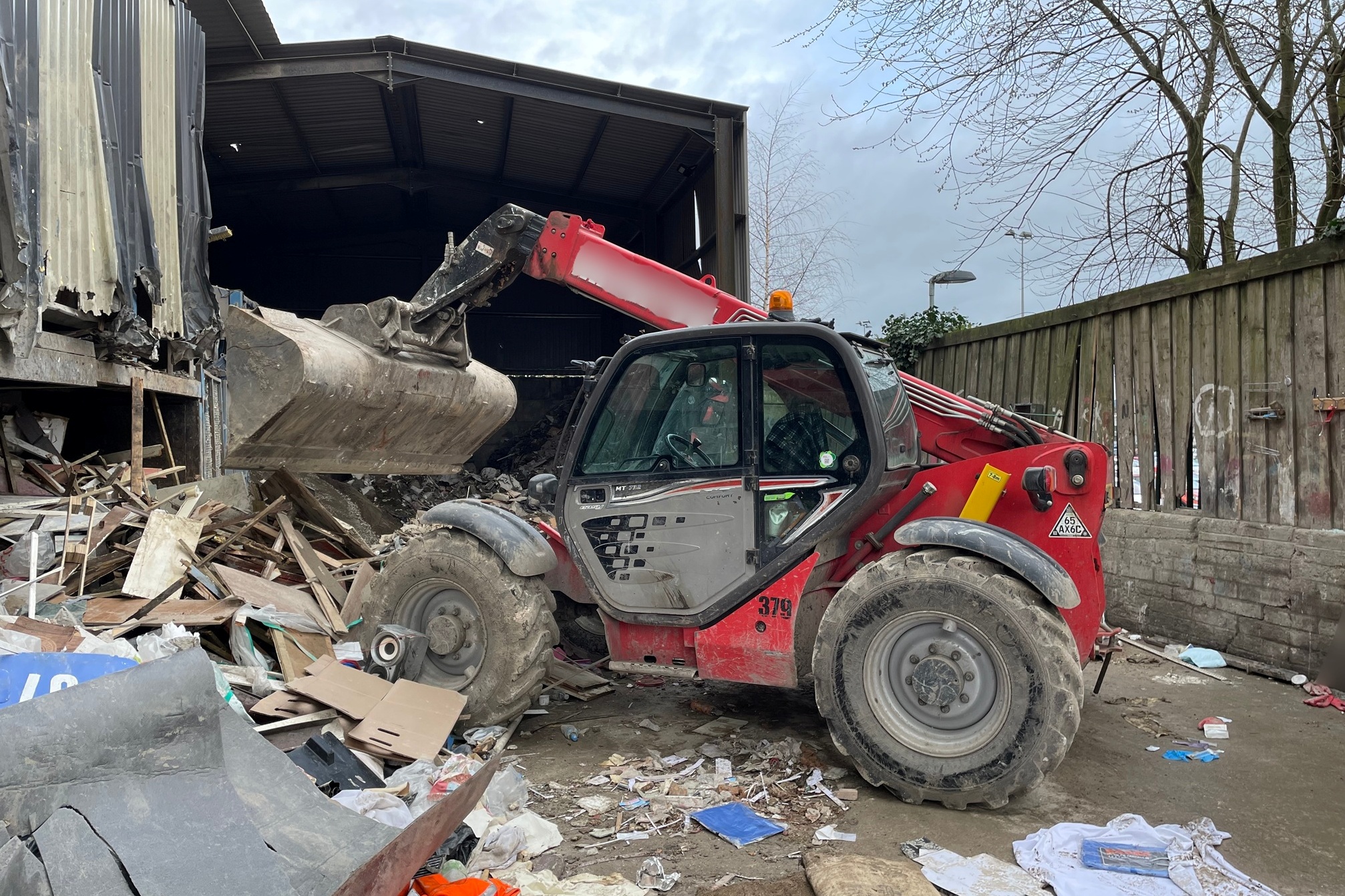
A 19-year-old worker at Sheridan Skips Burnley’s Smiths Yard site in Burnley suffered life-changing crush injuries on 12 March 2024 when a reversing telescopic handler, operating without rear-view mirrors, pinned him against a brick wall while he was hand-sorting waste. A Health & Safety Executive investigation found no effective vehicle–pedestrian segregation, no physical barriers or refuges, and routine concurrent yard operations with mobile plant and manual pickers. Sheridan Skips Burnley Limited pleaded guilty to breaching Section 2(1) of the Health and Safety at Work etc. Act 1974 and was fined £24,000 plus £4,777 costs at Blackburn Magistrates’ Court.
Technical Brief
- Telehandler was operated with missing reversing mirrors, eliminating a primary engineering control for rear visibility.
- Impact occurred with the victim pinned against a brick boundary wall, creating a zero-clearance crush zone.
- Four workers were hand-sorting waste in the yard concurrently with mobile plant movements in the same space.
- HSE found no physical barriers, kerbs, or designated refuges to separate pedestrians from yard traffic routes.
- Risk assessment for workplace transport at Sheridan Skips Burnley was deemed not “suitable and sufficient” by HSE.
- Injuries included multiple fractures, internal organ trauma, nerve damage, partial hearing loss and permanent blindness in one eye.
- Hospitalisation lasted nearly two weeks, indicating high-energy impact and significant trauma load from the telehandler.
- Prosecution under Section 2(1) HSWA 1974 led to a £24,000 fine plus £4,777 costs at Blackburn Magistrates’ Court.
- HSE explicitly referenced the waste industry, signalling targeted scrutiny of workplace transport and segregation in skip yards.
Our Take
Among the 34 Hazards stories in our database, incidents involving very young workers like the 19‑year‑old at Smiths Yard are relatively uncommon, which is likely to sharpen regulator and insurer scrutiny of how small waste operators manage induction, supervision and competence for new starters.
Sheridan Skips Burnley Limited operates in a part of Lancashire with a dense cluster of small waste and recycling yards, and previous UK safety cases in similar settings show that vehicle–pedestrian interface and ad‑hoc traffic routes are recurring weak points when HSE reconstructs fatal crush incidents.
With no commodity exposure and a single named yard (Smiths Yard), this case sits in the group of Safety‑tagged pieces where the main risk driver is materials handling and mobile plant rather than process hazards, a pattern that often leads HSE to push for physical segregation, banksmen protocols and redesign of loading zones rather than purely procedural fixes.
Prepared by collating external sources, AI-assisted tools, and Geomechanics.io’s proprietary mining database, then reviewed for technical accuracy & edited by our geotechnical team.
Related Articles


Related Industries & Products
Mining
Geotechnical software solutions for mining operations including CMRR analysis, hydrogeological testing, and data management.
Construction
Quality control software for construction companies with material testing, batch tracking, and compliance management.
CMRR-io
Streamline coal mine roof stability assessments with our cloud-based CMRR software featuring automated calculations, multi-scenario analysis, and collaborative workflows.
HYDROGEO-io
Comprehensive hydrogeological testing platform for managing, analysing, and reporting on packer tests, lugeon values, and hydraulic conductivity assessments.
GEODB-io
Centralised geotechnical data management solution for storing, accessing, and analysing all your site investigation and material testing data.