Bouygues post-tensioned timber wildlife bridge: design lessons for engineers
Reviewed by Joe Ashwell
First reported on New Civil Engineer
30 Second Briefing
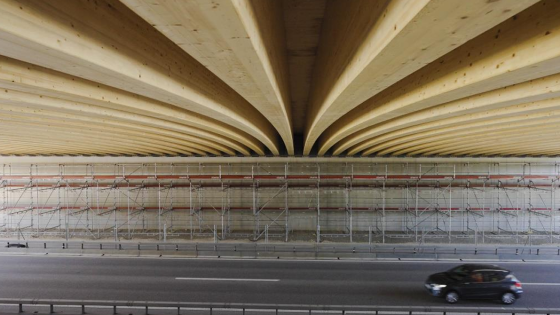
Bouygues has completed a post-tensioned timber wildlife bridge over the Zurich–Bern motorway, reconnecting fragmented habitats while separating animal movements from high-speed traffic. The structure uses longitudinal post-tensioning in engineered timber elements instead of conventional reinforced concrete, reducing self-weight and material-related embodied carbon while enabling a slender deck profile. For designers, the scheme signals growing acceptance of large-span timber with prestressing on primary highway infrastructure, with implications for dynamic performance, durability detailing and fire design.
Technical Brief
- Longitudinal post-tensioning in timber demands precise duct alignment and anchorage detailing to control long-term creep.
- Reduced self-weight from engineered timber lessens foundation loads and may allow smaller substructure elements.
- Slender deck geometry tightens deflection and vibration serviceability criteria under both traffic and animal loading.
- Timber moisture protection detailing becomes critical at deck–abutment interfaces and post-tensioning anchor zones.
- Fire design must address concealed tendon ducts in combustible sections and potential loss of prestress under heating.
- Wildlife bridge function drives wide, soil-covered deck build-up, influencing global stability and lateral load design.
- Similar prestressed-timber applications on highways will hinge on robust inspection regimes for tendons and timber condition.
Our Take
Bouygues’ work on this Swiss wildlife bridge sits in contrast to its appearance in several safety- and litigation-focused pieces in our database (notably around Hinkley Point C), signalling the group’s parallel push to highlight lower-risk, sustainability-led infrastructure.
Across the 592 Infrastructure stories in our coverage, Bouygues crops up most often on large, complex works such as HS2’s Chiltern tunnel and Hong Kong’s Tung Chung West TBM drives, so a post-tensioned timber structure in Switzerland showcases its attempt to diversify into visibly low-carbon, nature-positive assets.
With Switzerland’s Zurich–Bern corridor already dense with transport infrastructure, a Bouygues-built wildlife bridge there is likely to be watched by other European authorities as a reference for integrating engineered timber into mitigation structures over busy linear assets.
Prepared by collating external sources, AI-assisted tools, and Geomechanics.io’s proprietary mining database, then reviewed for technical accuracy & edited by our geotechnical team.
Related Articles


Related Industries & Products
Construction
Quality control software for construction companies with material testing, batch tracking, and compliance management.
Tunnelling
Specialised solutions for tunnelling projects including grout mix design, hydrogeological analysis, and quality control.
CMRR-io
Streamline coal mine roof stability assessments with our cloud-based CMRR software featuring automated calculations, multi-scenario analysis, and collaborative workflows.
HYDROGEO-io
Comprehensive hydrogeological testing platform for managing, analysing, and reporting on packer tests, lugeon values, and hydraulic conductivity assessments.
GEODB-io
Centralised geotechnical data management solution for storing, accessing, and analysing all your site investigation and material testing data.