Belfast medical research building approved: design and sustainability notes for engineers
Reviewed by Tom Sullivan
First reported on The Construction Index
30 Second Briefing
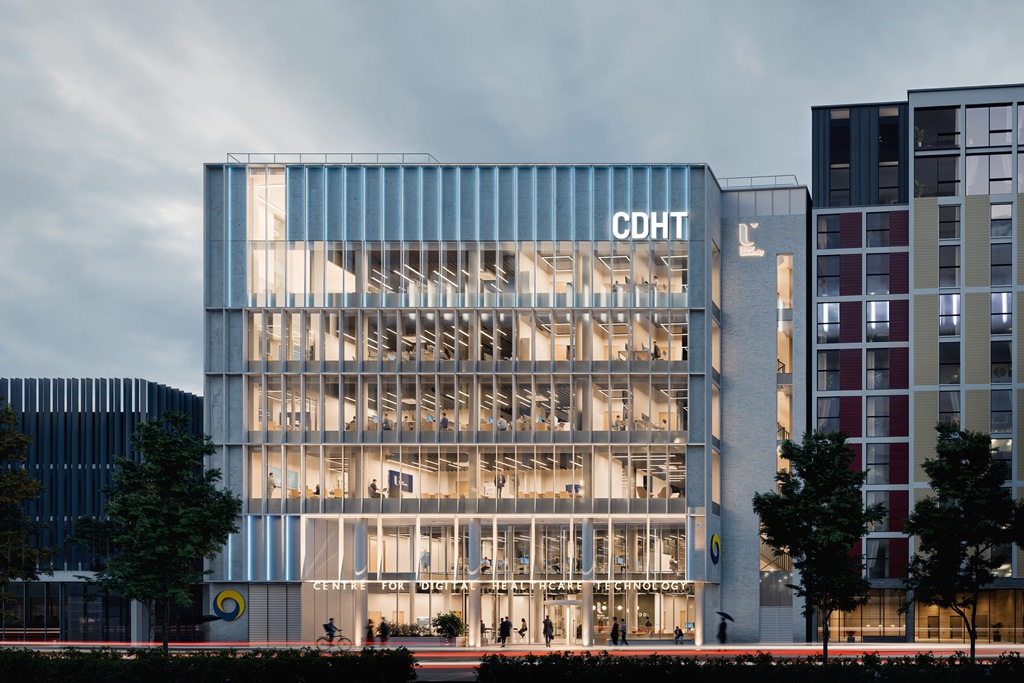
Planning approval has been granted for Ulster University’s six-storey Centre for Digital Healthcare Technology on Frederick Street, Belfast, replacing the recently demolished Northland House on a site cleared by B Small Contractors. The £18m main construction contract sits within an overall £42m project to deliver laboratories, office space, communal areas and public realm works, designed by Todd Architects with Arup and Turner & Townsend. The building targets BREEAM Excellent using low-energy systems, climate-resilient materials, roof-mounted solar PV and a green roof terrace.
Technical Brief
- Building massing uses a robust brick base tying into existing Ulster University campus architectural language.
- Frederick Street elevation incorporates an articulated filigree screen with high-quality curtain walling and natural stone panels.
- Glass reinforced concrete fins add secondary articulation, refining façade grain and providing depth and shadow.
- Feature fins to key upper-level internal spaces are oriented to respond to solar and environmental conditions.
- Variable fin orientation provides passive solar control while creating a “playful” primary street-facing elevation.
- Design intent positions the facility as a dedicated hub for medical device and diagnostics development within Belfast.
Our Take
At £42m, the Centre for Digital Healthcare Technology sits in the mid-range of university-led infrastructure in our database, suggesting Ulster University is prioritising a specialised, technology-heavy facility rather than a large general teaching block.
The involvement of Arup and Turner & Townsend on a six-storey health-tech building in Belfast aligns with their recurring roles on complex, sustainability-tagged UK university projects in our coverage, which typically target higher environmental performance standards and more intricate MEP integration.
Among the 524 Infrastructure stories in our database, relatively few focus on digital healthcare facilities, so this Belfast project positions Ulster University and Todd Architects in a niche segment where building services resilience, data infrastructure and clinical-grade environmental controls are likely to drive design decisions.
Prepared by collating external sources, AI-assisted tools, and Geomechanics.io’s proprietary mining database, then reviewed for technical accuracy & edited by our geotechnical team.
Related Articles


Related Industries & Products
Construction
Quality control software for construction companies with material testing, batch tracking, and compliance management.
Mining
Geotechnical software solutions for mining operations including CMRR analysis, hydrogeological testing, and data management.
QCDB-io
Comprehensive quality control database for manufacturing, tunnelling, and civil construction with UCS testing, PSD analysis, and grout mix design management.