Barnfield appointed for Blackburn business centre: design and delivery notes for engineers
Reviewed by Tom Sullivan
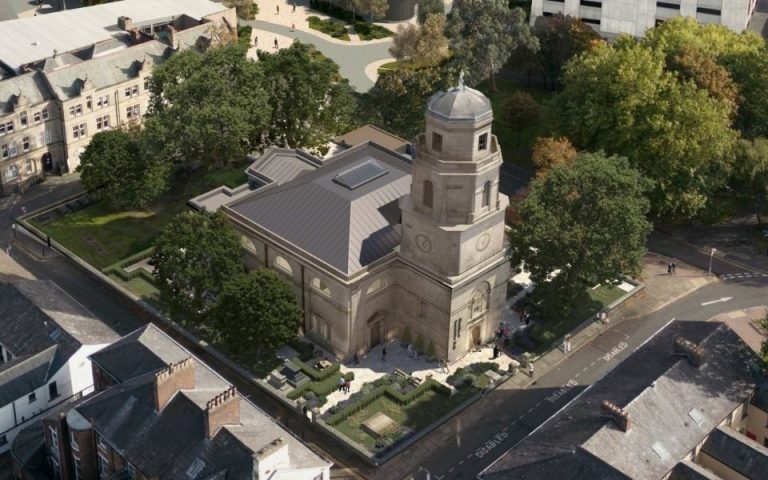
First reported on The Construction Index
30 Second Briefing
Blackburn with Darwen Borough Council has appointed Barnfield Construction as main contractor for an £8.5m conversion of the fire‑damaged, Grade II listed St John’s Church into a digital and cyber business centre. Designs by Manchester-based OMI Architects provide 9,500 sq ft of flexible workspace within the 239-year-old structure, linked to the planned Blackburn Skills Campus and opportunities from the National Cyber Force at Samlesbury Enterprise Zone. Enabling works start in March, main construction begins in summer, with completion targeted for early 2028.
Technical Brief
- £8.5m contract value frames budget for heritage stabilisation, fit-out and digital-ready services.
- Grade II listing constrains structural interventions, requiring retention of key historic fabric and façades.
- Fire damage from April 2019 implies extensive remediation of compromised masonry, roof structure and internal floors.
- Planning permission secured November 2023 fixes design envelope and heritage mitigation commitments for Barnfield.
- OMI Architects’ scheme must integrate modern M&E and data infrastructure within a 239-year-old shell.
- Council-led procurement places Barnfield as single main contractor, simplifying interface risk on a complex retrofit.
- Proximity to Blackburn Skills Campus and Samlesbury Enterprise Zone drives specification for high-spec digital connectivity.
Our Take
Within our 712 Infrastructure stories, relatively few UK pieces combine heritage conservation with new-build business space at this sort of mid-range £5–10m scale, so Blackburn with Darwen Borough Council is effectively using St John’s Church as a test case for balancing levelling-up style regeneration with listed-building constraints.
Linking the Blackburn Skills Campus to the National Cyber Force development at the Samlesbury Enterprise Zone positions this project in the skills-and-innovation corridor emerging around defence and cyber in Lancashire, which is likely to influence tenant mix and fit-out requirements towards higher-spec digital and security-grade space.
An early 2028 horizon for completion on a 239‑year‑old structure signals a relatively long programme for a sub-£10m scheme, which practitioners will recognise as reflecting the risk allowances typically built into complex fire-damaged heritage refurbishments in dense urban settings in the United Kingdom.
Prepared by collating external sources, AI-assisted tools, and Geomechanics.io’s proprietary mining database, then reviewed for technical accuracy & edited by our geotechnical team.


