Baltic Wharf Bristol redevelopment: brownfield design notes for project teams
Reviewed by Tom Sullivan
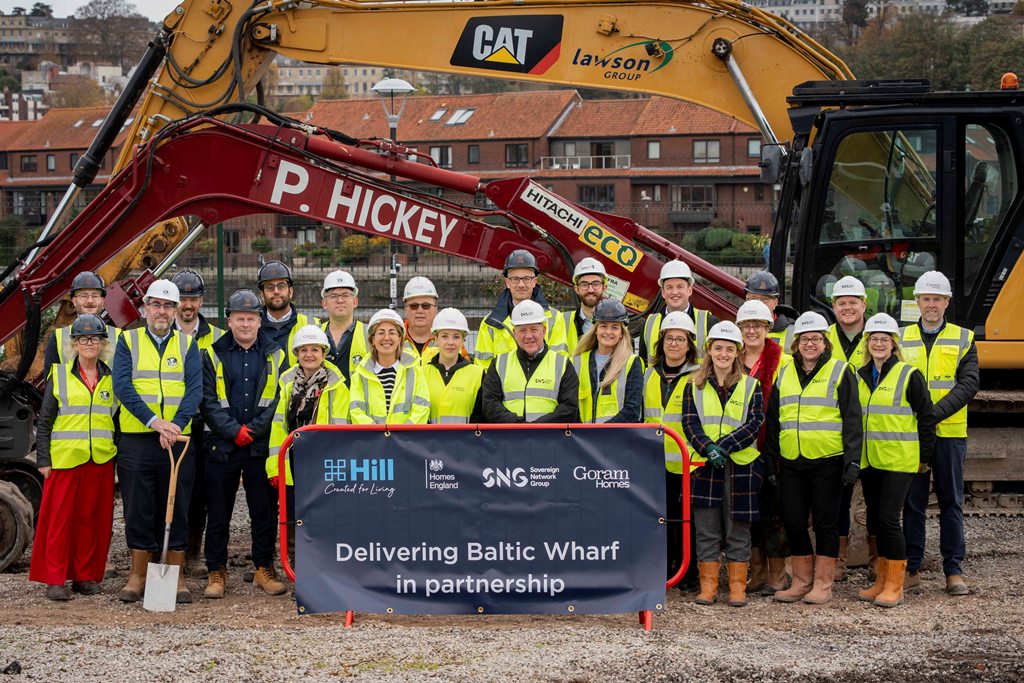
First reported on The Construction Index
30 Second Briefing
Work has started on Baltic Wharf in Bristol, where The Hill Group and Goram Homes will build 166 harbourside homes on a complex brownfield site on Spike Island, backed by a £2.4m Brownfield Land Release Fund grant. The scheme delivers 66 affordable units owned by Sovereign Network Group, including 50 for social rent and 16 for shared ownership, giving a 40% affordable housing mix. Plans also reopen a previously restricted waterfront, reconnecting the River Avon to the Floating Harbour with new pedestrian links, public realm, café and flexible commercial space, with first homes due spring 2027.
Technical Brief
- Brownfield Land Release Fund is contributing £2.4m via the national One Public Estate programme.
- Hill Group is delivering the scheme in partnership with Goram Homes, Bristol City Council’s house-building company.
- Sovereign Network Group will own and manage all 66 affordable units within the mixed-tenure block configuration.
- Site lies on Spike Island, requiring integration with existing harbour structures and constrained waterfront geometry.
- Reconnection of the River Avon to the Floating Harbour demands careful hydraulic, flood risk and bank stability design.
- New pedestrian links and public realm introduce additional loading, access and safety constraints along the quay edge.
- Café and flexible commercial spaces require separate servicing, fire strategy and acoustic treatment from residential elements.
- Example of complex inner-city brownfield regeneration where housing, public realm and waterfront engineering are tightly interdependent.
Our Take
Within the 58 Infrastructure stories in our database, few UK schemes match Baltic Wharf’s 40% affordable housing share, which signals Bristol City Council and Goram Homes are pushing the upper end of viability expectations for mixed-tenure waterfront sites.
The £2.4m Homes England/One Public Estate brownfield land release grant suggests the ground conditions at Baltic Wharf are likely to involve abnormal remediation or enabling costs that would otherwise undermine the 166-unit density on a constrained harbourside plot.
For contractors and consultants, a spring 2027 horizon on a central Bristol brownfield like Baltic Wharf implies tight programming around existing quay structures and utilities, a pattern seen across other urban UK regeneration schemes in our infrastructure coverage.
Prepared by collating external sources, AI-assisted tools, and Geomechanics.io’s proprietary mining database, then reviewed for technical accuracy & edited by our geotechnical team.
Related Articles


Related Industries & Products
Construction
Quality control software for construction companies with material testing, batch tracking, and compliance management.
Mining
Geotechnical software solutions for mining operations including CMRR analysis, hydrogeological testing, and data management.
CMRR-io
Streamline coal mine roof stability assessments with our cloud-based CMRR software featuring automated calculations, multi-scenario analysis, and collaborative workflows.
HYDROGEO-io
Comprehensive hydrogeological testing platform for managing, analysing, and reporting on packer tests, lugeon values, and hydraulic conductivity assessments.
GEODB-io
Centralised geotechnical data management solution for storing, accessing, and analysing all your site investigation and material testing data.