Geomechanics.io

  • Free Tools
Sign UpLog In

Geomechanics.io

Geomechanics, Streamlined.

© 2026 Geomechanics.io. All rights reserved.

Geomechanics.io

CMRR-ioGEODB-ioHYDROGEO-ioQCDB-ioFree Tools & CalculatorsBlogLatest Industry News

Industries

MiningConstructionTunnelling

Company

Terms of UsePrivacy PolicyLinkedIn
    AllGeotechnicalMiningInfrastructureMaterialsHazardsEnvironmentalSoftwarePolicy
    Projects

    Australian lithium miners plot expansions: capex and volume signals for planners

    January 30, 2026|

    Reviewed by Tom Sullivan

    Australian lithium miners plot expansions: capex and volume signals for planners

    First reported on MINING.com

    30 Second Briefing

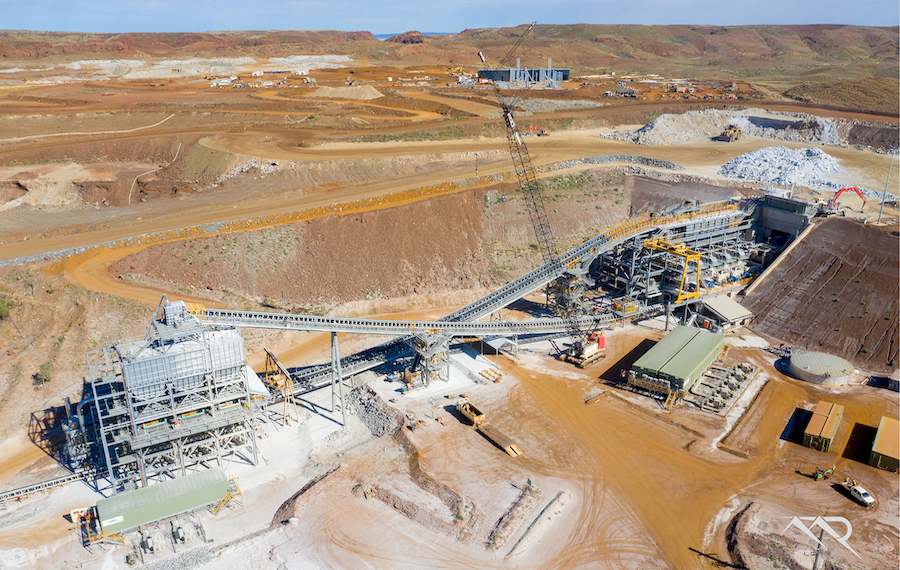
    Australian hard rock lithium producers are moving to restart and expand capacity after spodumene prices rebounded from about $600/t in July 2025 to intraday highs near $2,500/t in January, with Barrenjoey now forecasting $3,250/t in 2026. Pilbara Minerals is weighing a four‑month restart of its 200,000tpa Ngungaju plant and a A$1.2 billion expansion of Pilgangoora to 2Mtpa, while Mineral Resources has lifted FY26 guidance at Wodgina and Mt Marion to 450,000–490,000t and is assessing a four‑month restart of Bald Hill. Longer‑dated supply includes Greenbushes’ CGP3 adding 500,000tpa, Liontown studying a 4Mtpa expansion at Kathleen Valley, and Develop’s Pioneer Dome targeting six‑month DSO start‑up for A$35–40 million.

    Technical Brief

    • PLS reported Q4 realised prices of $1,161/t at 5.2% Li₂O, equivalent to $1,336/t at 6%.
    • Ngungaju restart planning includes “early operational readiness” work to enable production within four months of FID.
    • Pilgangoora’s FY26 guidance of 820,000–870,000t sits below its 1Mtpa installed nameplate capacity.
    • Mineral Resources’ Bald Hill restart would require substantial plant remobilisation, with up to four months lead time.
    • Wodgina and Mt Marion FY26 guidance was upgraded from 380,000–420,000t to 450,000–490,000t combined.

    Our Take

    Within our 86 lithium- and spodumene-tagged pieces, Western Australia dominates hard-rock supply discussions, so expansion moves at Pilgangoora, Wodgina and Greenbushes reinforce WA’s role as the marginal cost and volume setter for seaborne spodumene into China.

    The relatively modest A$35–40 million capex to bring Pioneer Dome into production, compared with the A$1.2 billion study figure for the Pilgangoora expansion, suggests juniors with smaller, fast-to-market projects could react more nimbly to the six- to nine-month price outlook windows operators like PLS are now using.

    Four‑month restart timeframes at Ngungaju and Bald Hill indicate that much of WA’s lithium capacity is now effectively ‘swing production’, which is likely to amplify price cyclicality as operators can toggle significant tonnage on or off in response to short-run spodumene price moves.

    Geotechnical Software for Modern Teams

    Centralise site data, logs, and lab results with GEODB-io, CMRR-io, and HYDROGEO-io.

    No credit card required.

    • Save and export unlimited calculations
    • Advanced data visualisation
    • Generate professional PDF reports
    • Cloud storage for all your projects

    Prepared by collating external sources, AI-assisted tools, and Geomechanics.io’s proprietary mining database, then reviewed for technical accuracy & edited by our geotechnical team.

    Related Articles
    Dellner Bubenzer mining brakes: integrated drivetrain design notes for engineers
    Mining
    about 10 hours ago

    Dellner Bubenzer mining brakes: integrated drivetrain design notes for engineers

    Dellner Bubenzer is supplying a wide range of industrial brakes and couplings for mining hoists, slewing drives and belt conveyors, developed in long-term collaboration with OEMs. The company focuses on both service and emergency braking solutions tailored to heavy-duty mining duty cycles and harsh environments, addressing controlled hoisting, precise slewing and high-tension conveyor stopping. For engineers, the key point is an integrated approach to drivetrain and braking design, rather than bolt-on safety systems, across multiple critical mining applications.

    SKRI ‘phytocapture’ at Raygorodok: dust control performance insights for mine engineers
    Mining
    about 23 hours ago

    SKRI ‘phytocapture’ at Raygorodok: dust control performance insights for mine engineers

    China’s Zijin Mining is expanding RG Gold’s Raygorodok operation in Kazakhstan with a $500 million processing plant while deploying SKRI’s ‘phytocapture’ system, planting over 100,000 Scots pines across more than 20 hectares about 1.7 km downwind of the open pit. Supercomputer modelling using regional wind-rose data sets tree species and spacing to form multilayered vegetative barriers, not simple landscaping. SKRI reports particulate-matter reductions above 40%, with the forest belt expected to capture roughly one-third of dust emissions as mining advances towards the barrier.

    Barrick’s Reko Diq copper project delays: capex and schedule lens for mine planners
    Mining
    about 24 hours ago

    Barrick’s Reko Diq copper project delays: capex and schedule lens for mine planners

    Barrick Mining has warned of “significant increases” to the capital budget and schedule for the 50%-owned Reko Diq copper-gold project in Balochistan, where Phase 1 was previously costed at US$5.6–6.0 billion and Phase 2 at US$3.3–3.6 billion, with first production targeted by end-2028. Citing escalating security risks in Pakistan and the wider region, Barrick will slow field development and extend the technical and financing review to mid‑2027, while keeping the project under “active management” with reduced capital spend. The porphyry deposit, holding an estimated 15 million tonnes of copper reserves and modelled for a 37‑year mine life, remains central to Barrick’s Tier 1 copper strategy and its long-term community commitments in Balochistan.

    Related Industries & Products

    Mining

    Geotechnical software solutions for mining operations including CMRR analysis, hydrogeological testing, and data management.

    CMRR-io

    Streamline coal mine roof stability assessments with our cloud-based CMRR software featuring automated calculations, multi-scenario analysis, and collaborative workflows.

    HYDROGEO-io

    Comprehensive hydrogeological testing platform for managing, analysing, and reporting on packer tests, lugeon values, and hydraulic conductivity assessments.

    GEODB-io

    Centralised geotechnical data management solution for storing, accessing, and analysing all your site investigation and material testing data.