Aarsleff Ground Engineering’s integrated ground solutions: key design notes for project teams
Reviewed by Joe Ashwell
First reported on The Construction Index
30 Second Briefing
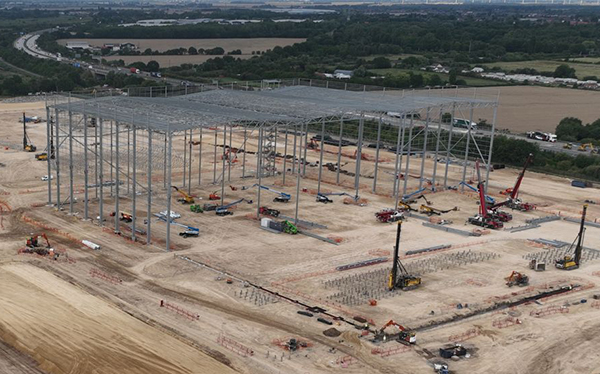
Aarsleff Ground Engineering is promoting an integrated ground solution offer that combines vibro stone columns, rigid and hybrid inclusions, and driven precast piles into a single engineered package for each site. The firm targets projects with variable or weak soils, using mixed systems across a footprint to manage differential stiffness and keep floor slabs flat and frames within tolerance without multiple specialist contractors. For geotechnical and structural teams, the pitch is one design responsibility, coordinated load paths and programme certainty on brownfield or heterogeneous sites.
Technical Brief
- Vibro stone columns are deployed as granular inclusions to densify loose soils and improve drainage.
- Rigid inclusions are used where higher stiffness is required, decoupling slab performance from weak strata.
- Hybrid inclusions bridge stiffness gaps between stone columns and rigid inclusions over short plan distances.
- Driven precast piles provide end-bearing or friction capacity where improvement alone cannot meet design loads.
- Detailed ground characterisation underpins selection of inclusion type, spacing and depth across each footprint.
- Variable pockets of weak soil are treated locally, avoiding over-designing the entire platform to worst-case conditions.
- Coordinated design focuses on maintaining slab flatness and frame tolerances under differential settlement demands.
- Single-package delivery reduces interface risk between ground improvement and piling contractors on constrained programmes.
Our Take
Aarsleff Ground Engineering’s UK focus stands out in our geotechnical coverage, which otherwise leans heavily towards continental European contractors on large transport and energy schemes, suggesting Aarsleff is positioning to capture mid- to large-scale UK civils work where specialist piling and ground improvement are being re-bundled into design-and-build packages.
Within the 24 Geotechnical stories in our database, relatively few are tagged both ‘Product’ and ‘Projects’, so a piece on Aarsleff Ground Engineering Ltd in the United Kingdom likely signals that proprietary techniques or equipment are being showcased directly through live project delivery rather than as standalone product launches.
For UK-based clients, Aarsleff’s presence in our project-tagged geotechnical items suggests they are increasingly being treated as an early-stage partner on ground risk rather than a late-stage subcontractor, which typically leads to more design–build or performance-based contracting models on complex foundations and retaining works.
Prepared by collating external sources, AI-assisted tools, and Geomechanics.io’s proprietary mining database, then reviewed for technical accuracy & edited by our geotechnical team.
Related Articles

Related Industries & Products
Construction
Quality control software for construction companies with material testing, batch tracking, and compliance management.
Mining
Geotechnical software solutions for mining operations including CMRR analysis, hydrogeological testing, and data management.
CMRR-io
Streamline coal mine roof stability assessments with our cloud-based CMRR software featuring automated calculations, multi-scenario analysis, and collaborative workflows.
HYDROGEO-io
Comprehensive hydrogeological testing platform for managing, analysing, and reporting on packer tests, lugeon values, and hydraulic conductivity assessments.
GEODB-io
Centralised geotechnical data management solution for storing, accessing, and analysing all your site investigation and material testing data.